1999issue C061-3
Size-matched buy-and-hold evaluation for stock systems
A mechanical stock procedure can finish with a profit and still fail evaluation if an untimed hold would have done better. Under a constant-dollar stake, the fair test resets the buy-and-hold book to the mechanical share count at every signal so the score reflects timing rather than position growth.
- A mechanical stock procedure that finishes with a profit can still fail if an untimed buy-and-hold book would have done better over the same window.
- A constant dollar stake is treated as preferable to a constant share count, because an unchanging share count warps later trades as prices change.
- A hold that keeps the first trade's share count is not a fair twin for a constant-dollar mechanical book, because a large price rise inflates the holder's average size.
- A size-matched comparison resets the always-long book to the mechanical share count at every signal so remaining differences come from timing, not scale.
Profit is not the evaluation
A mechanical trading system is a fully specified signal process whose entries, exits, and stand-aside decisions can be reconstructed from rule inputs, market state, and execution constraints. Walk-forward analysis treats those entry, exit, and abstention rules as one replayable procedure and scores them as market state is revealed, rather than as a single static fit.
A mechanical stock procedure that finishes with a profit can still fail evaluation if an untimed buy-and-hold book would have done better over the same window. The buy-and-hold benchmark is a passive always-long comparison book used to test whether a stock procedure adds timing value beyond simply owning the issue.
Hold the stake in dollars, not shares
Fixed contract sizing is a pre-trade exposure rule that keeps each new position at a stated dollar or contract stake so later prices cannot silently enlarge the book. Fixed contract sizing at a constant dollar stake is treated as preferable to a constant share count, because an unchanging share count warps later trades as prices change.
Constant-dollar trade size, illustrated here with a 1000-unit stake, sizes every signal as stake divided by price. Each new mechanical long, short, or stand-aside decision is then taken at that same dollar contract.
Why an unadjusted hold is the wrong twin
A constant-dollar mechanical book cannot be compared to a buy-and-hold book that keeps the first trade's share count, because a large price rise inflates the holder's average size while each system signal stays at the original stake.
In the supplied illustration, a move from 5 to 50 price units turns a 1000-unit, 200-share hold into 10000 units, while the mechanical book continues to size each signal at 1000 units. Unadjusted buy-and-hold comparisons tend to overstate the passive book against a constant-dollar mechanical system, because a held stock position often grows in value while system trade size stays fixed.
Two alignments
The two alignments are presented as a correction, especially for long-only systems.
An equity-compounded share count scales the base stake-over-price lot by current equity relative to starting equity so the mechanical book tracks its own results. When start equity is 1000, shares equal (1000 divided by price) times (1000 plus net profit) divided by 1000. That equity-compounding alignment becomes unusable if losses exceed the 1000-unit start, because the equity ratio and implied share count turn negative. With a 1000-unit start, the matching compounded percent return is defined as 100 times net profit divided by 1000.
A size-matched comparison keeps the buy-and-hold book always long but resets its share count to the mechanical book's 1000-over-price size at every signal. Remaining differences then come from timing, not scale.
A size-matched long and short sequence
In the worked sequence, both books held 159 shares in October 1975. After the mechanical book exited the long and shorted 125 shares in January 1976, the buy-and-hold size was cut to 125 shares so the books stayed size-matched.
Du Pont daily price with size-matched share counts
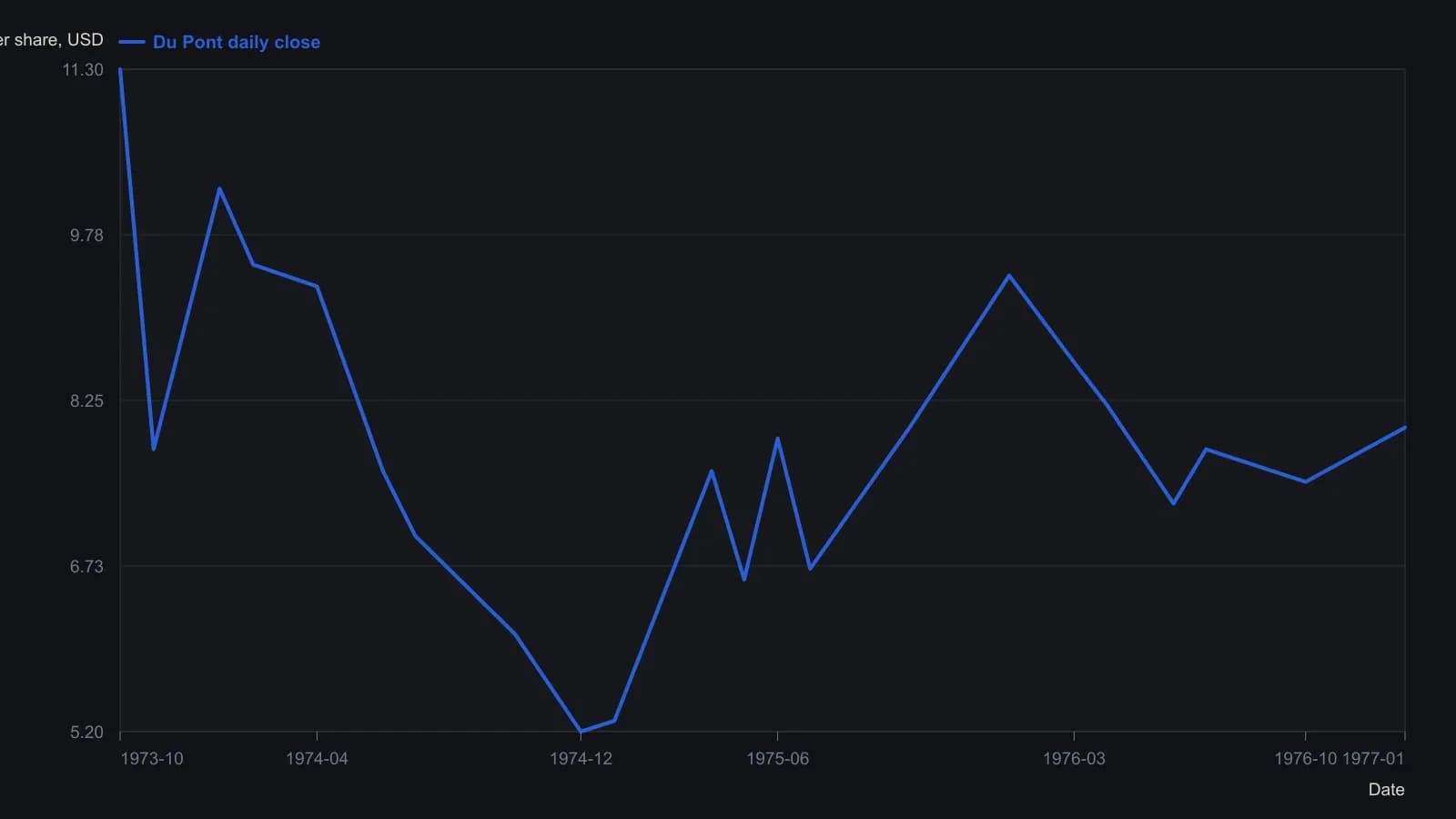
Readings are approximate to about a tenth of a dollar. Integer labels on the figure (141, 125, 155, 159, 123) are share counts at signals, not prices. The January 1976 short of 125 shares is stated in the article and marked −125 on the upper pane.
All readings on this track · 21 readings
- 1987Volatility-layered mechanical system with fixed contracts
- 1994Starting capital from worst-case portfolio walk-forwards
- 1994Bound small-account risk before adding leverage
- 1996Variable position size after entry
- 1996Equity path filters for contract size and drawdown
- 1997Stop distance, equity caps, and trading halts
- 1999Size-matched buy-and-hold evaluation for stock systems
- 2002Size from stop distance to keep dollar risk even
- 2003Share size from daily profit equilibrium
- 2004Half-size energy futures as a pre-trade leverage filter
- 2007Equalizing contract risk in trend following
- 2007Expected-equity sizing and geometric drag
- 2007Predefine the loss before fixed contract sizing
- 2013Weekday, session, and market expectancy for contract size
- 2014Bounded leverage before you size a trade
- 2015Equal-dollar futures size and open-interest liquidity
- 2015Atomize trading decisions: discipline over complexity
- 2017Tiny bets, ruin risk, and mechanical scale
- 2018Near-strike weekly puts and unfunded assignment risk
- 2019Paper trading is unfinished without fill and size rules
- 2019Constructing futures leverage from margin and fixed size