2018issue C0832-35
Near-strike weekly puts and unfunded assignment risk
A nearer weekly put strike collected a larger credit and was treated as a greed error because it raised week-end assignment odds. The same text started at one contract, reserved cash for 200 shares, and still listed margin as a way to stretch buying power. TradersWeek's editorial reading is that this is a pre-entry size filter, not a mood.
- On the 14 May 2018 chain, the 27 strike bid 0.64 against 0.10 at the 25 strike, and choosing the nearer strike was treated as a greed error that raised week-end assignment odds.
- Hesitant option use started with one contract, and the closing note still favored trading small while keeping cash reserved.
- The wheel sequence began only after cash could buy 200 shares, yet selling puts in a margin account was listed as a way to stretch buying power.
- A January 2018 assignment near 35 later sat near 27, and weekly option credits were not applied to that leftover share inventory.
One contract and cash reserved
Hesitant option use was framed as starting with one contract at a time. The closing note still favored trading small while keeping cash reserved.
TradersWeek labels that bound as fixed-contract sizing: hold new option exposure to a small, constant lot size, often a single contract, until the loss path is understood.
Near-strike credit raised assignment odds
On the 14 May 2018 chain, a share quoted at 27 showed a 0.64 bid at the 27 strike versus a 0.10 bid at the 25 strike, so the nearer strike paid a larger credit per contract. Choosing that nearer strike was treated as a greed error because it raised the chance the shares would be assigned at week-end.
The 27-strike credit implied a 26.36 net share cost, but a further drop was still an open loss. A nearby band low near 26.61 was not treated as a guaranteed floor.
Editorial reading: that larger premium is near-strike credit. It raises effective leverage after the credit is booked because assignment is more likely and the net share cost is not a closed loss.
Cash first, then wheel rotation
The wheel sequence was written to start only after cash was already available to buy 200 shares of the chosen name. Selling puts inside a margin account was listed as a way to stretch buying power, which sits in tension with the same text's cash-secured 200-share reserve.
A cash-secured put, as used here, is a short put written only after the account already holds the cash to buy the underlying shares if assigned. TradersWeek calls the cash-first sequence wheel rotation: sell a secured put, then covered calls after assignment, and add a second put only if cash for another hundred shares remains.
Editorial reading: margin management means reserving cash or buying power for assignment before a short put or wheel step is sold, instead of funding the share book after the fact.
Spreads, far strikes, and stops
A credit put spread, short one put and long a lower-strike put, was described as a pair that caps loss while also reducing the collected credit versus a standalone short put.
Far out-of-the-money short puts were placed in a 20% to 50% band, with a price-volatility-expiry check used so the chance of the share reaching the strike stayed under 10%. If a stop was used on a short put, it was placed 25% to 30% below the strike.
Editorial reading: leverage control limits strike distance, contract count, and spread width so a short-premium trade cannot expand into an unplanned full-share loss.
Assignment inventory still needs a size bound
A January 2018 assignment near 35 later sat near 27, and weekly option credits were not applied to reduce that leftover share inventory. Assignment inventory is the share book received when a short put finishes in the money. It converts option risk into a long-stock book that still needs a size bound.
NUGT weekly put quotes by strike, May 14, 2018
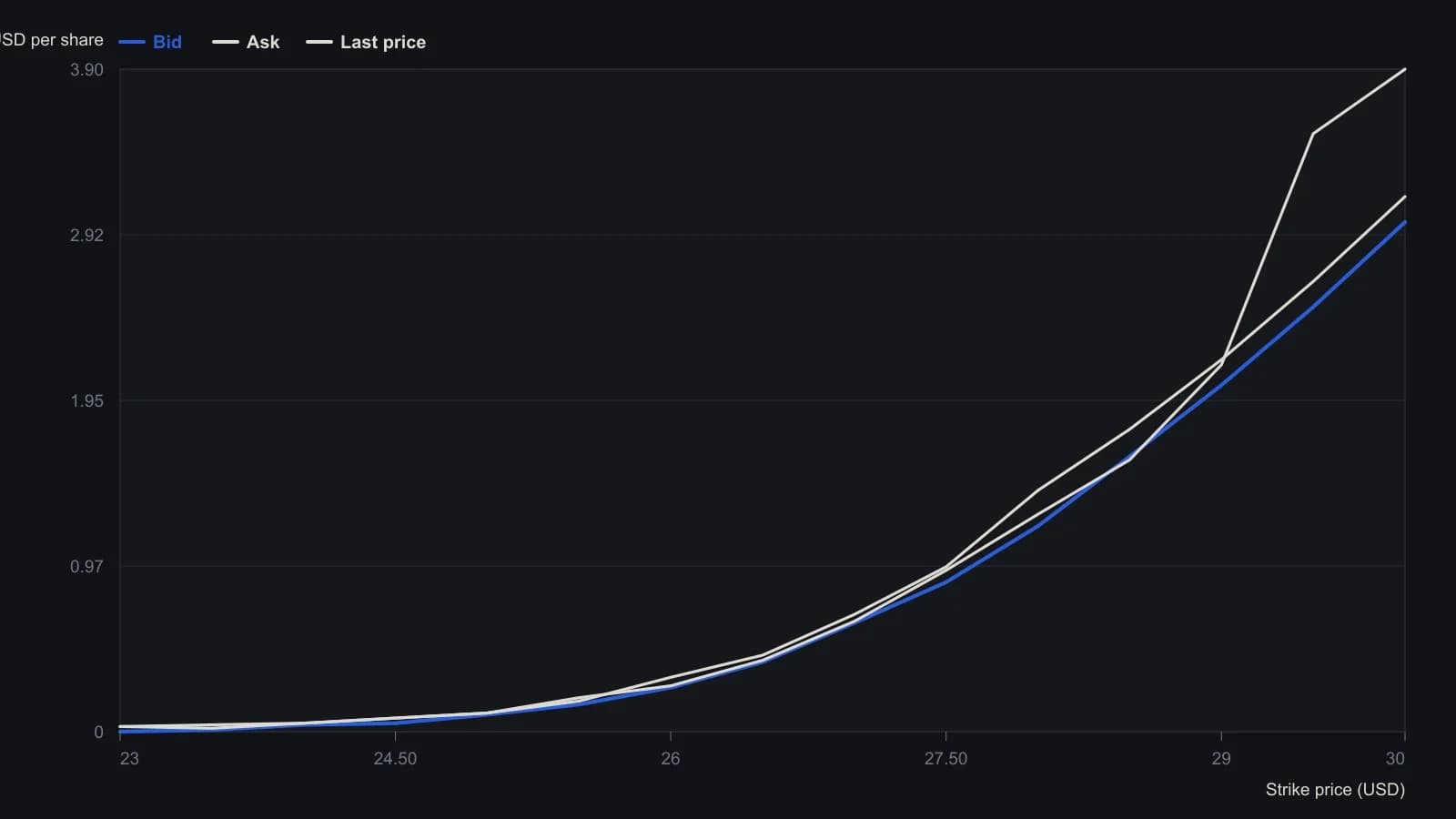
NUGT was quoted at $27.00 on May 14, 2018. Table prices are per-share option quotes; cash credit on a short put is 100 times the bid. Strikes above $27.00 were in the money.
All readings on this track · 21 readings
- 1987Volatility-layered mechanical system with fixed contracts
- 1994Starting capital from worst-case portfolio walk-forwards
- 1994Bound small-account risk before adding leverage
- 1996Variable position size after entry
- 1996Equity path filters for contract size and drawdown
- 1997Stop distance, equity caps, and trading halts
- 1999Size-matched buy-and-hold evaluation for stock systems
- 2002Size from stop distance to keep dollar risk even
- 2003Share size from daily profit equilibrium
- 2004Half-size energy futures as a pre-trade leverage filter
- 2007Equalizing contract risk in trend following
- 2007Expected-equity sizing and geometric drag
- 2007Predefine the loss before fixed contract sizing
- 2013Weekday, session, and market expectancy for contract size
- 2014Bounded leverage before you size a trade
- 2015Equal-dollar futures size and open-interest liquidity
- 2015Atomize trading decisions: discipline over complexity
- 2017Tiny bets, ruin risk, and mechanical scale
- 2018Near-strike weekly puts and unfunded assignment risk
- 2019Paper trading is unfinished without fill and size rules
- 2019Constructing futures leverage from margin and fixed size