1982issue C061-3
Three gates for a futures book: equity risk, expected value, and shrinking pyramids
Futures losses are attributed mainly to weak portfolio control. The archive workflow caps how much equity one position may risk from its stop, opens a trade only when expected profit is much larger than expected loss, and later adds fewer contracts only after a favorable move.
- Futures losses are attributed mainly to weak portfolio control, so risk control and diversification are treated as usable even if prices are regarded as unforecastable.
- Portfolio risk splits into systematic risk, the group-relative volatility of one market versus its commodity complex, and statistical risk from holding too few markets. A single position may not risk more than 3 percent, 5 percent, or 10 percent of equity as the book moves from non-diversified to well diversified, and a non-diversified book may not place more than 50 percent of equity in traded positions.
- Before entry, expected profit is success probability times possible return and expected loss is failure probability times the stop-defined risk. A position is opened only when expected profit is much larger than expected loss.
- After a favorable move, added size uses fewer contracts at each step, only in very large books and only on reactions against the main trend. Adding to a losing position is treated as raising exposure on a failing trade.
Losses as a portfolio-control problem
Futures losses are attributed mainly to weak portfolio control. Risk control and diversification are treated as usable even if prices are regarded as unforecastable.
Portfolio risk is split into systematic risk and statistical risk. Systematic risk is the group-relative volatility of one market versus its commodity complex. Statistical risk is the extra uncertainty created by representing too few distinct markets in one book.
Lock the equity fraction from the stop
A pre-entry and in-trade filter bounds loss or exposure from account equity, volatility, stop distance and current size. A single position is not allowed to risk more than 3 percent of equity in a non-diversified book, 5 percent in a moderately diversified book, or 10 percent in a well diversified book.
In a non-diversified book, no more than 50 percent of account equity is placed in traded positions. The stop sets the loss that this equity fraction is allowed to meet, so size is chosen before entry and kept inside the same bound while the position is held.
Open only when expected profit dominates
Expected value is a pre-entry filter that compares probability-weighted possible return with probability-weighted stop loss before size is committed. Before entry, expected profit is success probability times possible return, and expected loss is failure probability times the stop-defined risk.
A position is opened only when expected profit is much larger than expected loss. Expected position growth is that difference: expected profit minus expected loss on a single trade. Expected portfolio growth is the sum of those position figures.
Add later size only on a working trade
Pyramiding is a holding-period add-on rule that increases a winning position in shrinking increments under stated market and size constraints. After a favorable move, added size uses fewer contracts at each step, only in very large books, and only on reactions against the main trend.
Adding to a losing position is treated as raising exposure on a failing trade. Editorial: later size is read here as an add on a working trade, not as a repair for a loser.
Judge results by return relative to variability
Performance is judged by return relative to the standard deviation of returns over time. That return-to-risk ratio is identified as the Sharpe ratio.
Stop-loss equity caps by how diversified the book is
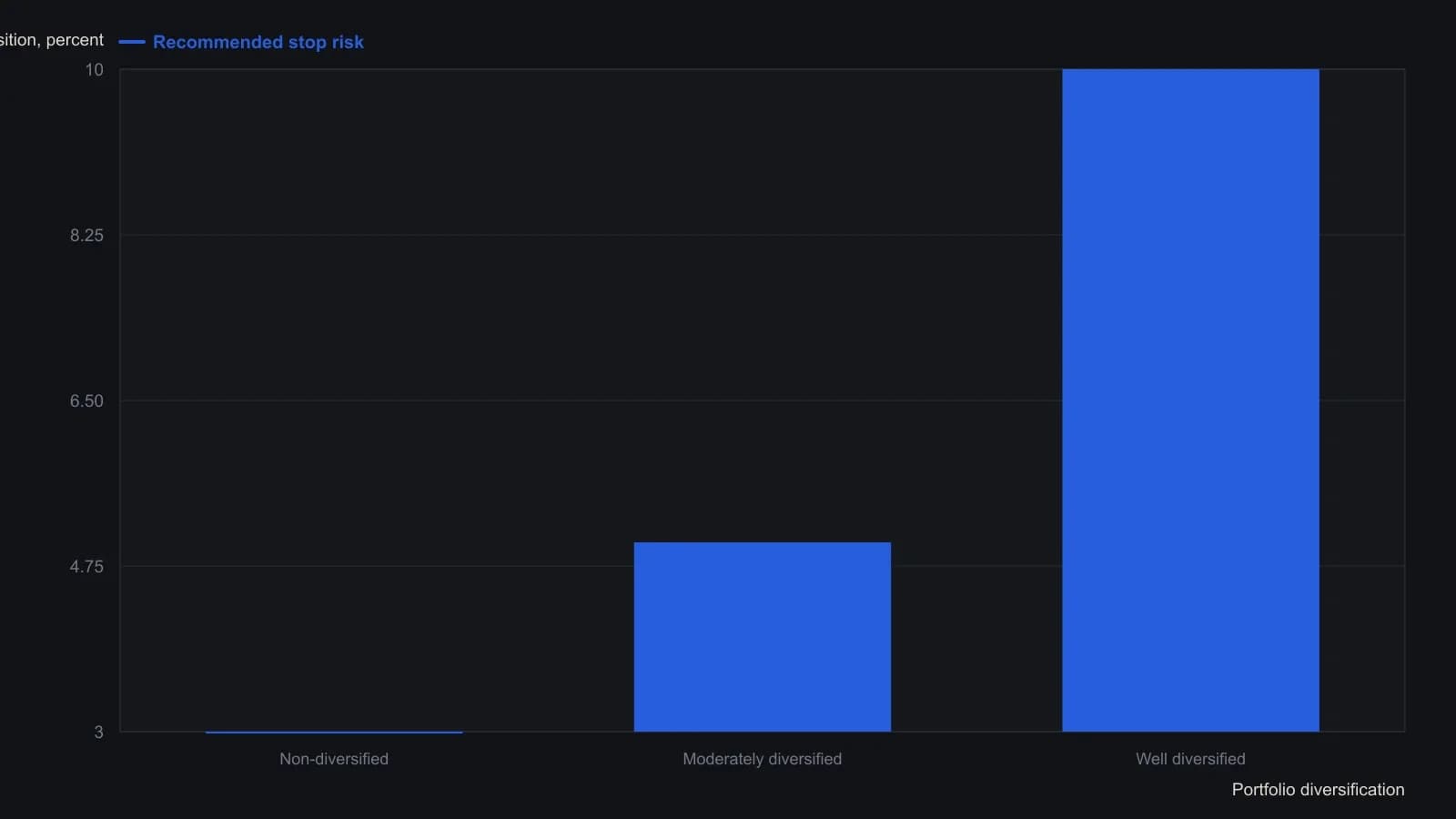
These are the author's recommended ceilings, not measured historical loss rates.
All readings on this track · 9 readings
- 1982Three gates for a futures book: equity risk, expected value, and shrinking pyramids
- 1995A Kelly-style leverage grid and reshuffled paths
- 2004Bound the loss before leverage changes size
- 2010Treat risk of ruin, drawdown limits, and Kelly sizing as consistent pre-trade filters
- 2010Fixed-fractional forex position sizing
- 2013Kelly fraction versus risk of ruin
- 2016Expected value versus leverage, drawdown, and Kelly sizing
- 2017Fixed-fraction sizing versus a theoretical pattern edge
- 2018Evaluating double-bottom breakouts as a testable system