2019issue C0745
Paper trading is unfinished without fill and size rules
Retail paper-trading platforms often omit live-market details, so a clean simulator run can still diverge from live execution. Editorial view: the run is not a live-ready-procedure until limit-order fill assumptions and fixed-contract-sizing sit in the same ruleset as the signal.
- Retail paper-trading platforms often omit live-market details, so a simulator result can diverge from live execution.
- A limit-order touch-fill, granted as soon as price is touched, is treated as an unrealistic fill model and can change outcomes versus live fills.
- Automated paper-trading can fail after go-live when placement, cancel and replace, or session setup is incompatible, including a session-open-reject.
- A first live step uses fixed-contract-sizing with micro forex lots, a few shares, or mini or micro futures rather than full-size contracts.
A clean simulator run is an unfinished test
Paper-trading is a simulated run of entry, exit, and abstention rules used to make a procedure checkable before capital is at risk. Retail paper-trading platforms often omit live-market details, so a simulator result can diverge from live execution.
Editorial view: treat that clean run as an unfinished system test. A live-ready-procedure is the combined signal, order-lifecycle, and size rules that must hold in both simulated and real-money modes.
Touch-fill is an incomplete limit-order test
A limit-order waits for a specified price and may go unfilled even if that price is touched, so fill quality belongs in the system test.
A limit order that fills in simulation as soon as price is touched is treated as a sign of an unrealistic fill model, because such touch fills are uncommon in live trading. That pattern is a touch-fill: a simulator fill granted as soon as price reaches the limit, which live books often do not grant.
The same strategy can produce different outcomes under simulated limit-order touch fills than under live fills.
Same ES 60-minute strategy: simulated vs live equity
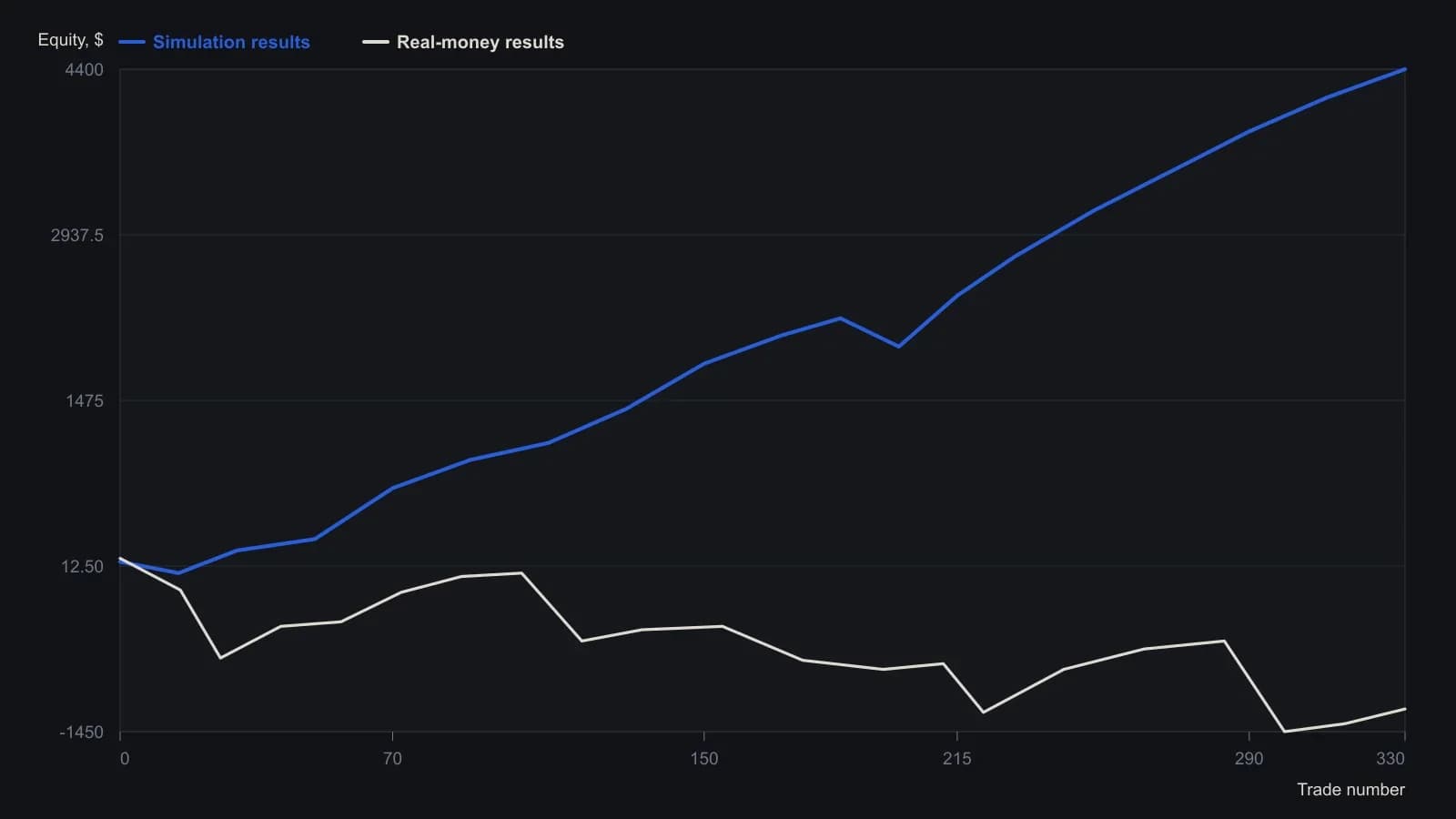
Digitized from Figure 1. The source labels both panels @ES 60 min from 21 March 2019 19:00 to 3 May 2019 17:00 and attributes the gap to simulated limit-order touch fills versus live fills. Readings are to the nearest roughly 50–100 dollars and about 10 trades; the raster does not support finer precision.
Automation still fails on the order lifecycle
Automated paper-trading results can fail after go-live when order placement, cancel and replace handling, or session setup is not compatible with live trading.
A market order sent a split second before a new exchange session may fill in simulation and be rejected by the exchange in live trading. That live rejection is a session-open-reject: a live exchange rejection of an order timed just before a new session that a loose simulator may still fill.
Real-money stakes change the same rules
Real-money stakes change decisions relative to simulation, and automating the signal path does not remove that effect.
Cap the first ticket before leaving simulation
Fixed-contract-sizing is a pre-entry cap on contracts, shares, or lots that keeps loss and exposure bounded when leaving simulation. A first live step keeps size bounded with micro forex lots, a few shares, or mini or micro futures rather than full-size contracts.
One micro equity-index futures contract is described as one-tenth the related mini contract and as 1.25 dollars per tick. When even a small account is not feasible, some firms offer funded capital after a fee-based simulator test that meets a stated hurdle.
Editorial view: the size cap is not a later operations detail. It belongs in the same live-ready-procedure as the paper-trading rules and the limit-order fill model.
All readings on this track · 21 readings
- 1987Volatility-layered mechanical system with fixed contracts
- 1994Starting capital from worst-case portfolio walk-forwards
- 1994Bound small-account risk before adding leverage
- 1996Variable position size after entry
- 1996Equity path filters for contract size and drawdown
- 1997Stop distance, equity caps, and trading halts
- 1999Size-matched buy-and-hold evaluation for stock systems
- 2002Size from stop distance to keep dollar risk even
- 2003Share size from daily profit equilibrium
- 2004Half-size energy futures as a pre-trade leverage filter
- 2007Equalizing contract risk in trend following
- 2007Expected-equity sizing and geometric drag
- 2007Predefine the loss before fixed contract sizing
- 2013Weekday, session, and market expectancy for contract size
- 2014Bounded leverage before you size a trade
- 2015Equal-dollar futures size and open-interest liquidity
- 2015Atomize trading decisions: discipline over complexity
- 2017Tiny bets, ruin risk, and mechanical scale
- 2018Near-strike weekly puts and unfunded assignment risk
- 2019Paper trading is unfinished without fill and size rules
- 2019Constructing futures leverage from margin and fixed size