2007issue C021-4
Equalizing contract risk in trend following
A trend-following signal still leaves how much to trade unspecified. One contract per market concentrates dollar risk in the largest unit-risk line. Scaling contract counts so every market sits near the same equity-relative loss finishes the book before entry.
- Trend-following reacts to observed price rather than forecasts, treats fundamental news as irrelevant, and is a style choice made before systematic rules are written.
- Five questions are required: which market to trade, how much to trade, when to enter, when to exit a loser, and when to exit a winner. Timing alone leaves size and market selection unspecified.
- Fixed-contract-sizing puts the same lot count on every signal, so a one-contract book concentrates dollar risk in the market with the largest unit-risk.
- Risk-equalization scales contract counts so each line sits near the same dollar risk, and that unit-risk is kept as a small share of equity so a drawdown-period still leaves capital to re-enter.
Style comes before the rules
Trend-following is a price-only style that reacts to what the market is doing rather than forecasting. Fundamental news is treated as irrelevant to the decision. The style is chosen first. Systematic rules come after that choice, and the label systems trading is incomplete until the system type is specified.
Five design questions are required: which market to trade, how much to trade, when to enter, when to exit a loser, and when to exit a winner. Answering only the timing question leaves size and market selection unspecified. Starting capital alone is not the decisive success factor, and no starting amount is said to guarantee profits.
One lot is not the same risk in every market
Fixed-contract-sizing takes one contract, or any unchanging lot count, on every signal regardless of account equity, stop distance, or which market is signaling. One-contract-per-signal testing applies that same size to a small account and a large account. For the larger account this is a different, heavily under-levered procedure.
A fixed dollar stop, and even a stop that varies with a market-condition parameter, still does not by itself set how many contracts to hold against a chosen risk budget.
In a $50,000 hypothetical book, one contract each assigned $1,500 of risk to Treasury bond futures versus $500 corn, $325 Exxon single-stock futures, $425 Yahoo single-stock futures, and $250 eurodollar futures. Risk concentrates in the bond line.
Equalizing the book
Unit-risk is the dollar amount at stake on one contract from entry to stop. Volatility-position-sizing scales the contract count from account equity, stop distance, and a chosen exposure so each market's loss unit is bounded before entry and kept aligned while the position is open.
Risk-equalization raises or lowers contract counts so each market's total dollar risk matches the largest unit-risk in the book. Contract counts can be scaled by dividing each market's dollar risk into the largest unit risk and rounding down, producing 3 corn, 1 bond, 4 Exxon, 3 Yahoo, and 6 eurodollar contracts so each line sits near the same dollar risk.
Why the unit stays small
The historical workflow keeps that unit dollar risk a small share of equity, illustrated as perhaps 2 to 5 percent, so a worst-case sequence still leaves capital to re-enter. A drawdown-period is an account stretch driven by trendless or violently two-way markets that taxes discipline even when the entry rules are unchanged.
In the illustrated arithmetic, equalizing contract risk changed a three-of-five win pattern from a $312.50 one-lot loss to a $3,675 gain, and a two-of-five win pattern from a $1,562.50 one-lot loss to a $75 loss, when winners were held at 1.50 times initial risk. Those figures compare the same win and loss counts under two sizing rules.
One-lot dollar risk versus the equalized book
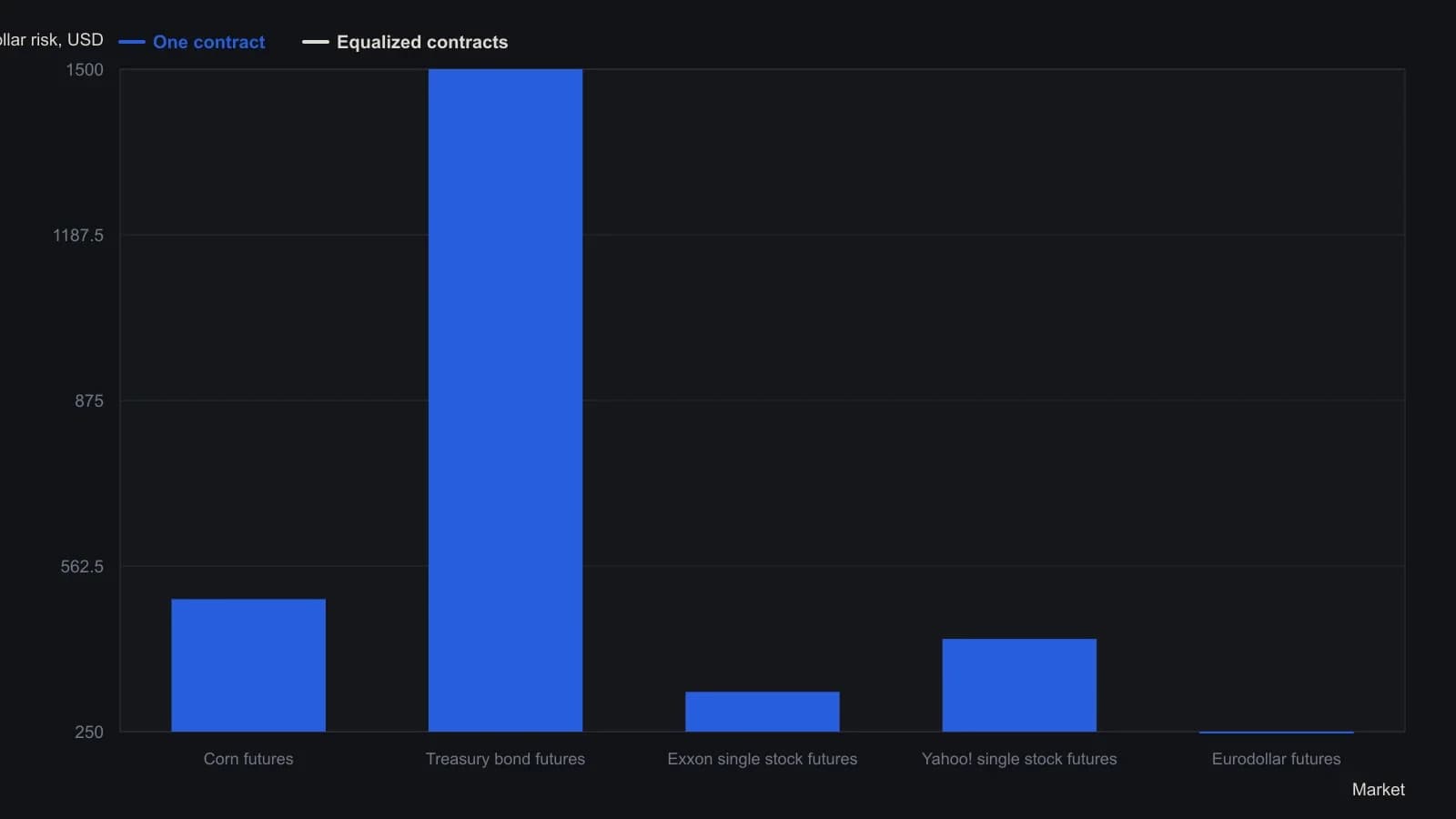
Contract counts are rounded down so no line exceeds the $1,500 Treasury-bond unit; Exxon and Yahoo therefore land a little under that cap.
All readings on this track · 21 readings
- 1987Volatility-layered mechanical system with fixed contracts
- 1994Starting capital from worst-case portfolio walk-forwards
- 1994Bound small-account risk before adding leverage
- 1996Variable position size after entry
- 1996Equity path filters for contract size and drawdown
- 1997Stop distance, equity caps, and trading halts
- 1999Size-matched buy-and-hold evaluation for stock systems
- 2002Size from stop distance to keep dollar risk even
- 2003Share size from daily profit equilibrium
- 2004Half-size energy futures as a pre-trade leverage filter
- 2007Equalizing contract risk in trend following
- 2007Expected-equity sizing and geometric drag
- 2007Predefine the loss before fixed contract sizing
- 2013Weekday, session, and market expectancy for contract size
- 2014Bounded leverage before you size a trade
- 2015Equal-dollar futures size and open-interest liquidity
- 2015Atomize trading decisions: discipline over complexity
- 2017Tiny bets, ruin risk, and mechanical scale
- 2018Near-strike weekly puts and unfunded assignment risk
- 2019Paper trading is unfinished without fill and size rules
- 2019Constructing futures leverage from margin and fixed size