2013issue C1236-38
Weekday, session, and market expectancy for contract size
The archive workflow wrote a countable daily and weekly net-profit target first. Average trade profit by weekday, session, and market then raised or cut a fixed-lot baseline before real-money size was aligned.
- Write a countable daily and weekly net-profit target before any room or contract-count decision.
- Compute average trade profit separately by weekday, session, and market, then weight a fixed-lot baseline toward stronger buckets and cut it on weaker ones.
- Authenticate complete entries, targets, and stops, then use simulated live replications and a rolling window before aligning real-money size.
- Scale lot count from rolling average trade profit so uneven results sit in size, with stop distance and exposure inside the decision.
Set the target before the room or the size
A personal success definition was written first as a countable daily and weekly net-profit target. Room choice and contract count came only after that target existed.
Keep only rooms that can be authenticated
Of 422 rooms inspected, 262 had no track record at all. Later cuts left 16 rooms whose real-time trades showed complete entries, targets, and stops that could be authenticated and replicated.
Measure average trade profit by weekday, session, and market
Average trade profit is the mean result per contract inside a defined bucket such as one weekday, one session, or one futures market.
Average trade profit computed separately for each weekday showed large day-to-day gaps. Contract size was then weighted toward stronger days and reduced on weaker ones.
In the same market, morning and afternoon average trade profit could differ enough to justify shrinking or skipping one session while leaving the other sized.
When one room traded more than one market, average trade profit differed by product, so a larger fixed contract count was reserved for the stronger series.
Use expected value to scale a fixed-lot baseline
Expected-value sizing treats rolling average trade profit as the input that scales a fixed-contract baseline, rather than giving every signal the same lot count. Expected value uses average profit per trade, bucketed by day, session, and market, as the expectancy input that decides whether size stays small or expands.
Fixed contract sizing keeps a one-lot or other fixed-lot baseline and changes the contract count only after expectancy, stop distance, and account capacity are known.
Volatility position sizing scales lot count after measuring how uneven results are across weekdays, sessions, and markets, so exposure is bounded before the order is placed.
Align real-money size only after a rolling window
One hundred to two hundred simulated live replications, plus a rolling average-trade-profit window, were used before real-money size was aligned to contemporary expectancy.
A rolling window drops the oldest observations as new trades arrive so the expectancy used for size stays current.
Put stop distance and exposure inside the size decision
Listed common failures include having no plan before entry, inadequate capital or money management, and unused protective stops, which place stop distance and exposure inside the size decision.
Average trade profit by room and contract
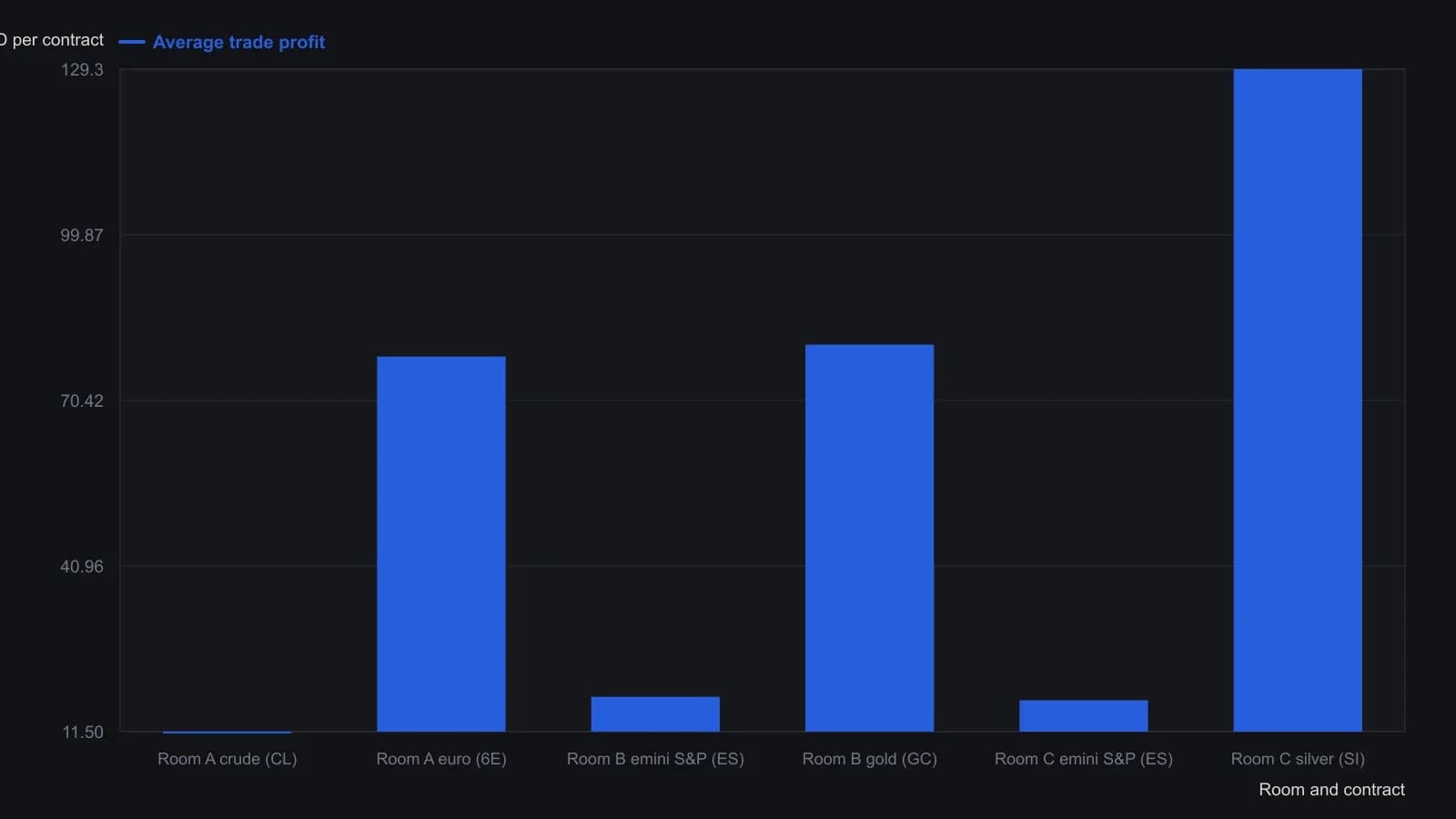
Each pair is a different shortlisted room; the article does not give sample size or dates for these ATP figures.
All readings on this track · 21 readings
- 1987Volatility-layered mechanical system with fixed contracts
- 1994Starting capital from worst-case portfolio walk-forwards
- 1994Bound small-account risk before adding leverage
- 1996Variable position size after entry
- 1996Equity path filters for contract size and drawdown
- 1997Stop distance, equity caps, and trading halts
- 1999Size-matched buy-and-hold evaluation for stock systems
- 2002Size from stop distance to keep dollar risk even
- 2003Share size from daily profit equilibrium
- 2004Half-size energy futures as a pre-trade leverage filter
- 2007Equalizing contract risk in trend following
- 2007Expected-equity sizing and geometric drag
- 2007Predefine the loss before fixed contract sizing
- 2013Weekday, session, and market expectancy for contract size
- 2014Bounded leverage before you size a trade
- 2015Equal-dollar futures size and open-interest liquidity
- 2015Atomize trading decisions: discipline over complexity
- 2017Tiny bets, ruin risk, and mechanical scale
- 2018Near-strike weekly puts and unfunded assignment risk
- 2019Paper trading is unfinished without fill and size rules
- 2019Constructing futures leverage from margin and fixed size