2003issue C011-4
Share size from daily profit equilibrium
A daily profit-equilibrium identity solves for the required average winning trade from a daily point-move budget, a positive win-loss differential, and expected winner and loser counts. Share size is locked first so the implied average-loss limit can be checked before entry.
- A daily profit-equilibrium identity solves for the required average winning trade from a daily point-move budget, a win-loss differential, and the expected counts of winning and losing trades.
- The daily point-move budget adds estimated commissions to an annual income target, then divides by the assumed trading-day count and by shares per trade.
- The win-loss differential must stay positive; a negative gap is treated as making the plan unlikely to remain viable after costs.
- Reducing share size raises the per-trade point move needed for a stated annual target and can convert a previously workable plan into an unworkable one.
A daily profit-equilibrium identity
A daily profit-equilibrium identity solves for the required average winning trade from a point-move budget, a win-loss differential, and the expected counts of winning and losing trades.
A fixed share count is held constant while that required average winner is solved. The average-loss limit is the losing-trade size implied once the required winner and the win-loss gap are fixed.
How the daily point-move budget is formed
The daily point-move budget is the per-share move implied by an annual income target, trading-day count, commissions, and shares per trade.
It is formed by adding estimated commissions to an annual income target, dividing by the assumed trading-day count, then dividing by shares per trade.
The worked model uses 200 trading days as the default year length and a 0.03 per-share commission-and-fee assumption when converting an annual target into that daily budget.
A positive win-loss differential
The win-loss differential is average winning-trade result minus average losing-trade result and must stay positive after costs.
A negative gap is treated as making the plan unlikely to remain viable after costs.
Expected daily winners equal the win ratio times daily trade count. Expected daily losers equal one minus the win ratio times that same count.
Worked table assumptions
The worked tables hold a 60 percent win ratio and vary share size between 500 and 1,000 and daily trade count between 10 and 20 against annual targets of 50,000, 100,000, and 200,000.
Under those table assumptions, a 50,000 annual target at 1,000 shares and 20 trades per day corresponds to a 0.15 required average win and a 0.12 average loss limit.
Share size, frequency, and stable rules
Reducing share size raises the per-trade point move needed to reach a stated annual target, which can force longer holding and convert a previously workable plan into an unworkable one.
Frequency and share size are treated as helpful only while the selection method and money-management rules stay stable. If those rules are unstable, raising size or frequency is presented as a way to push the plan past its limits.
Required winner and implied loss limit at $50,000 a year
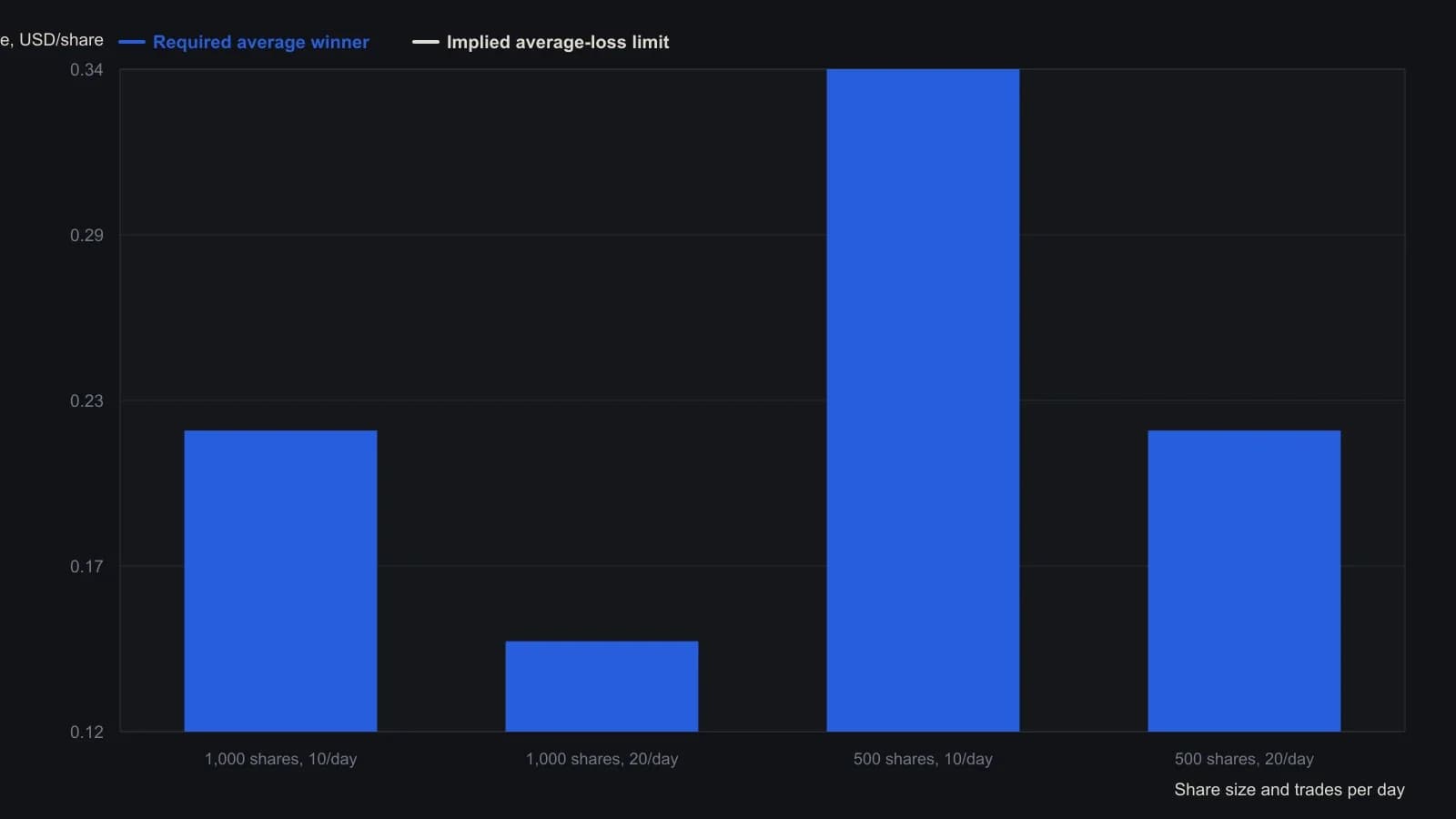
The source holds commissions at $0.03 a share, the average win–loss differential at $0.03, and the win ratio at 60 percent.
All readings on this track · 21 readings
- 1987Volatility-layered mechanical system with fixed contracts
- 1994Starting capital from worst-case portfolio walk-forwards
- 1994Bound small-account risk before adding leverage
- 1996Variable position size after entry
- 1996Equity path filters for contract size and drawdown
- 1997Stop distance, equity caps, and trading halts
- 1999Size-matched buy-and-hold evaluation for stock systems
- 2002Size from stop distance to keep dollar risk even
- 2003Share size from daily profit equilibrium
- 2004Half-size energy futures as a pre-trade leverage filter
- 2007Equalizing contract risk in trend following
- 2007Expected-equity sizing and geometric drag
- 2007Predefine the loss before fixed contract sizing
- 2013Weekday, session, and market expectancy for contract size
- 2014Bounded leverage before you size a trade
- 2015Equal-dollar futures size and open-interest liquidity
- 2015Atomize trading decisions: discipline over complexity
- 2017Tiny bets, ruin risk, and mechanical scale
- 2018Near-strike weekly puts and unfunded assignment risk
- 2019Paper trading is unfinished without fill and size rules
- 2019Constructing futures leverage from margin and fixed size