1996issue C051-8
Equity path filters for contract size and drawdown
A high share of winning days can still leave the account flat if one later loss cancels the streak. Size stays at one contract unless the running win rate allows two, and a break of the equity average, trendline, or accelerating loss line is used to pause or lighten the next trade.
- Exposure is bounded before the next trade because one later loss can cancel a streak of winning days and leave the account flat.
- Fixed contract sizing stays at one unit unless the running win rate holds at or above 57 percent, and it returns to one unit when that line fails.
- Volatility position sizing lightens or pauses exposure when the equity path, recent winner size, or loss pace shows rising result volatility.
- An equity-average filter, a broken equity uptrend line, or an accelerating loss total is a stand-aside or cut-size rule, not a cue to add contracts.
Bound exposure before the next trade
A high share of winning days can still leave the account flat if one later loss is large enough to cancel the prior streak, so exposure has to be bounded before the next trade.
The equity path is a running total of each trade result added to starting capital. It is read for slope, range, and breaks. A downward slope is treated as a cue to reduce position size and inspect whether the method, the market regime, or signal adherence has changed.
One contract and the win-rate band
Fixed contract sizing is a default one-unit book that stays fixed unless a pre-set win-rate condition allows a step to two units and requires a return to one unit when that condition fails.
A running win rate is expected to stay inside a win-rate band such as 50 to 70 percent, or 40 to 60 percent for a trend-following book. A drop below 50 percent is treated as a halt or a cut to half size. A fixed one-contract book can be stepped to two contracts only while the running win rate stays at or above 57 percent, then returned to one contract when it drops below that line.
Cut size when result volatility rises
Volatility position sizing is a filter that lightens or pauses exposure when the equity path, recent winner size, or loss pace shows rising result volatility, so the next trade's loss stays bounded.
When the latest winner falls below the running average winner, size is reduced as an early warning that conditions or a losing streak may be changing.
Stand aside on averages, trendlines, and loss totals
A drawdown limit is a stand-aside or cut-size rule triggered when equity breaks below its moving average or trendline, or when losses accelerate, to keep a losing streak from running the account down.
The equity-average filter is a moving average of the equity path, commonly 10 to 25 periods, that keeps size smaller or idle while equity is below the average. When equity sits below that average, trading is paused or size is lightened until the path recrosses, so a cluster of large losses cannot run the account to zero.
A downside break of an equity uptrend line is used as a filter to stop or lighten positions because it can mark the start of a losing streak. Separate running totals of profits and losses are kept so an accelerating loss line can trigger an adjustment. The same charts are used to change size, switch methods, or halt trading.
One-unit versus two-or-one-unit equity paths
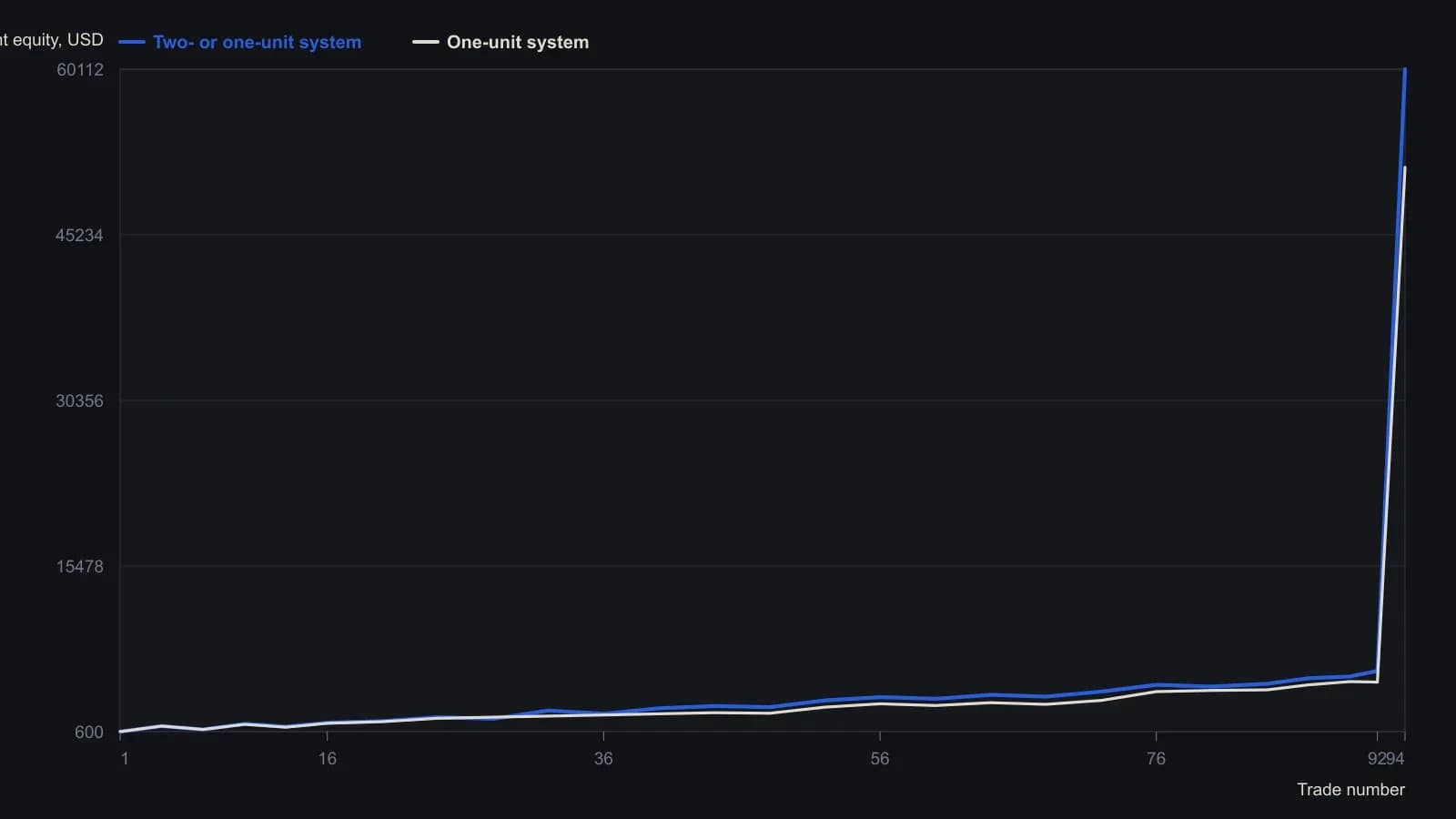
Position size was two units whenever the running percentage of profitable trades was 57 or greater and one unit below that cutoff. The source reports ending equity of $51,292 versus $60,112 and peak-to-equity drawdowns of -$2,433 versus -$3,138.
All readings on this track · 21 readings
- 1987Volatility-layered mechanical system with fixed contracts
- 1994Starting capital from worst-case portfolio walk-forwards
- 1994Bound small-account risk before adding leverage
- 1996Variable position size after entry
- 1996Equity path filters for contract size and drawdown
- 1997Stop distance, equity caps, and trading halts
- 1999Size-matched buy-and-hold evaluation for stock systems
- 2002Size from stop distance to keep dollar risk even
- 2003Share size from daily profit equilibrium
- 2004Half-size energy futures as a pre-trade leverage filter
- 2007Equalizing contract risk in trend following
- 2007Expected-equity sizing and geometric drag
- 2007Predefine the loss before fixed contract sizing
- 2013Weekday, session, and market expectancy for contract size
- 2014Bounded leverage before you size a trade
- 2015Equal-dollar futures size and open-interest liquidity
- 2015Atomize trading decisions: discipline over complexity
- 2017Tiny bets, ruin risk, and mechanical scale
- 2018Near-strike weekly puts and unfunded assignment risk
- 2019Paper trading is unfinished without fill and size rules
- 2019Constructing futures leverage from margin and fixed size