1990issue C031-7
Reverse-martingale pyramiding after clustered wins
A reverse-martingale book adds contracts only after wins and banks unused size as capital-shelter. A fixed-contract-sizing book holds the same count on every round. Editorial reading: the pairing is a two-book drill that asks whether wins cluster enough to justify the extra contracts, and whether unused contracts are large enough to end the series when the run breaks.
- A reverse-martingale series is defined by a run-target of consecutive wins, commonly three or four, not by recovering the original losing stake.
- Simple-reverse-martingale doubles the full stake after each win and treats a break before the run-target as a series loss. Complex-reverse-martingale withholds part of each winning increment as capital-shelter.
- In the described futures application, the series opened after a loss at an average-loss risk-unit, and pyramiding added contracts only when a win equaled or nearly equaled that unit, while staying below a full geometric increase.
- A fixed-contract-sizing book is the constant-exposure baseline. Because size rises only after wins, a broken run can be scaled down sooner and at lower remaining exposure than a straight-martingale.
Two books, one series
A reverse-martingale book adds contracts only after wins and withholds unused contracts as capital-shelter. A fixed-contract-sizing book holds the same contract count on every round and serves as the constant-size baseline against both reverse and straight progressive sizing.
Pyramiding, in this setting, means adding contracts into a sequential winning run instead of holding a constant size through the series. The two books let the progressive series be tested as one procedure against a constant-exposure book.
A run-target, not a recovery rule
A martingale is a progressive sizing rule that changes stake size after each outcome so a series can be tested as one procedure rather than as isolated trades.
A simple reverse-martingale rule doubles the stake after a win. A straight-martingale doubles the stake after a loss. A reverse-martingale series is defined by a run-target of consecutive wins, commonly three or four. It is not defined by recovering the original losing stake.
Simple form, complex form, and capital-shelter
A simple-reverse-martingale doubles the full stake after each win and treats any break before the run-target as a loss of the built-up series. When that form is aimed at six consecutive wins, unfinished shorter winning streaks of four or five are counted as losses if the six-win run-target is not reached.
A complex-reverse-martingale withholds part of accumulated winnings after each step so a later loss can still leave a profit or keep the original stake intact. That withheld increment is capital-shelter: enough prior winnings that a broken run can still return a profit or leave original capital intact.
Adding contracts after a qualifying win
In the described futures application, a reverse-martingale series was opened after a loss. The opening stake was set to an average-loss risk-unit. Contracts were increased only when a win equaled or nearly equaled that risk-unit.
Contract count can be stepped up after qualifying wins while still holding below a full geometric increase. That constraint reduces risk relative to an unconstrained pyramid. A more conservative progression assumes a larger loss unit, which slows the rise in contracts and constrains risk. A more aggressive progression increases size after smaller wins. The risk-unit is the predetermined loss size used to set the opening stake and to decide whether a win is large enough to justify adding contracts.
The constant book and a broken run
A fixed-contract-sizing book that risks the same contract count on every round was used as the constant-size baseline against both reverse and straight progressive sizing.
After a four-win run-target is reached, the progression can continue into further wins if enough capital is held in reserve to preserve a profit if the run breaks. Because size increases only after wins, a broken run or a failed signal sequence can be scaled down sooner and at lower remaining exposure than a progression that enlarges size after losses.
Reverse-martingale book versus fixed-contract book
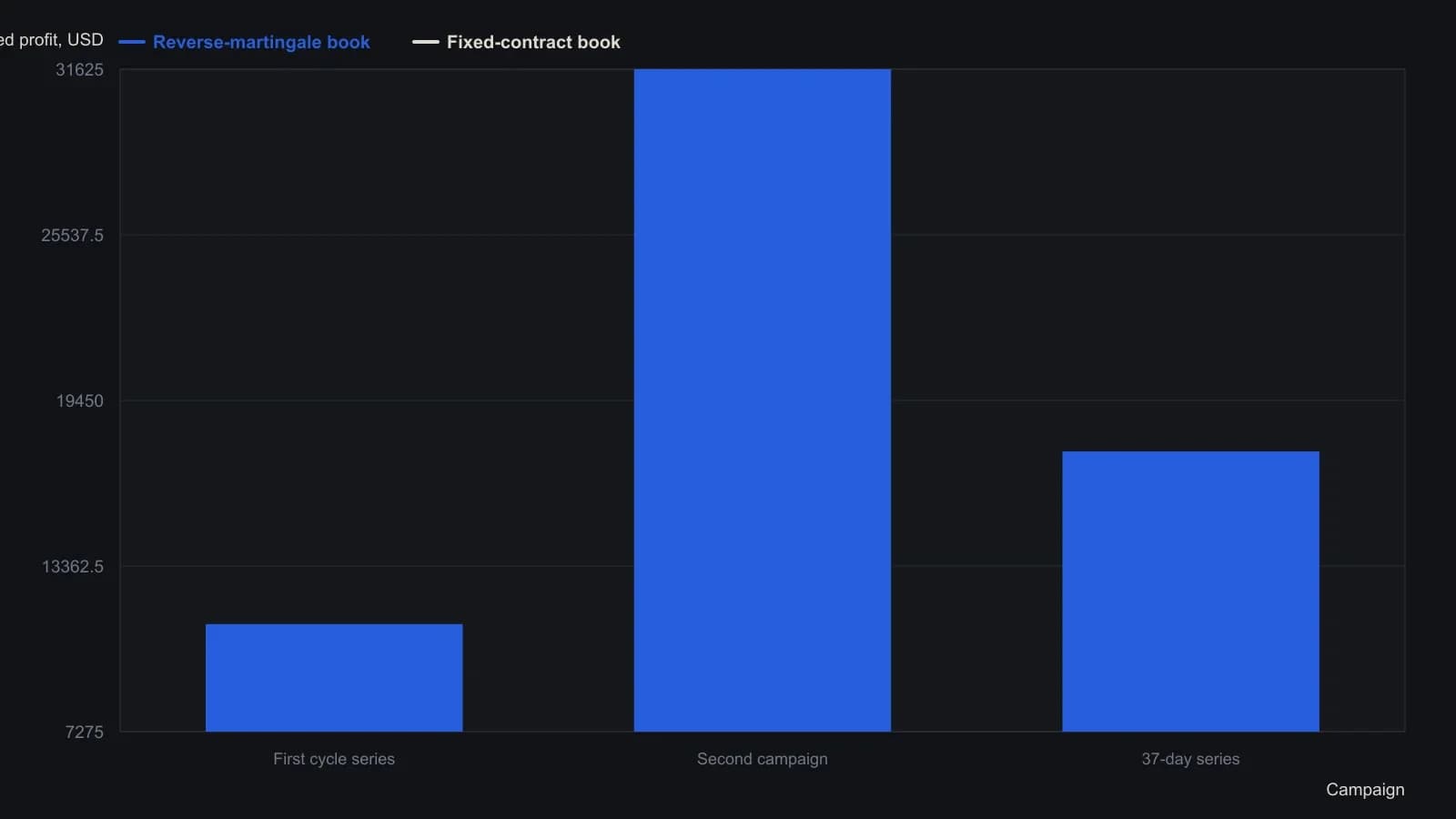
The first two campaigns use Ferguson’s S&P 500 cycle system (about 58 percent winners, average win $1,550 versus average loss $1,150) and hunt a run of four. The 37-day comparison averages 1.4 contracts on the reverse-martingale side, so the two books are not equal-size.
All readings on this track · 9 readings
- 1988Modified-martingale progression lists and ruin bounds
- 1989Scale-in-on-loss on a tempered-martingale-series with a fixed unit-factor
- 1989Shorter series need fewer recovery hits and raise scale-in cash
- 1990Recovery sizing as a series procedure
- 1990Reverse-martingale pyramiding after clustered wins
- 1993Test Martingale against fixed size before you pyramid
- 1998The runs-test as a contract-sizing gate
- 2004Scale-in on a two-close reversal instead of using a price stop
- 2012Four-level risk sizing when stock margin caps fixed fractions