1989issue C031-7
Scale-in-on-loss on a tempered-martingale-series with a fixed unit-factor
The procedure pairs a tempered-martingale-series that sets unit size with a point-spread pair of limits that sets when to buy or sell. Required holdings equal a fixed unit-factor times the first and last remaining series numbers, and a cycle-close arrives only after every series number is gone.
- The procedure pairs a tempered-martingale-series that sets unit size with a point-spread pair of limits that sets when to buy or sell.
- Required holdings equal a fixed unit-factor times the sum of the first and last remaining series numbers, and scale-in-on-loss appends a new series value after a downside fill.
- A cycle-close arrives only after the two-off-on-gain and one-on-on-loss updates have eliminated every series number.
- Peak capital can exceed twice the opening outlay because a losing run can lengthen the series without a stated theoretical bound, which is why an exposure-brake is documented.
How the series and the limits work
The procedure pairs a tempered-martingale-series that sets unit size with a point-spread pair of limits that sets when to buy or sell. Required holdings equal a fixed unit-factor times the sum of the first and last remaining series numbers.
What a fill does to inventory
An upside-limit fill removes the two end numbers of the series. A downside-limit fill appends the prior held-unit count divided by the unit-factor, which is the scale-in-on-loss update.
After each event the working buy and sell limits are rebuilt one point-spread above and below a new base-price taken from the last transaction. If the newly required holding already matches inventory, the event produces no size change and only the base-price and limits update.
When a cycle can close
A cycle-close arrives only after the two-off-on-gain and one-on-on-loss updates have eliminated every series number. For a starting series of 1 through 6, the designed cycle increment equals 21 times the unit-factor times the point-spread.
The same rules accept any starting series, including a single 1, any fixed contracts-per-number unit-factor, and a paired long-and-short cycle on one instrument.
How peak capital can exceed the opening outlay
Peak capital can exceed twice the opening outlay because a losing run can lengthen the series without a stated theoretical bound. Documented exposure-brake choices include widening the point-spread, adding a stop, suspending automatic series updates, and diversifying across names.
Capital path of a scale-in-on-loss cycle in a 20% decline
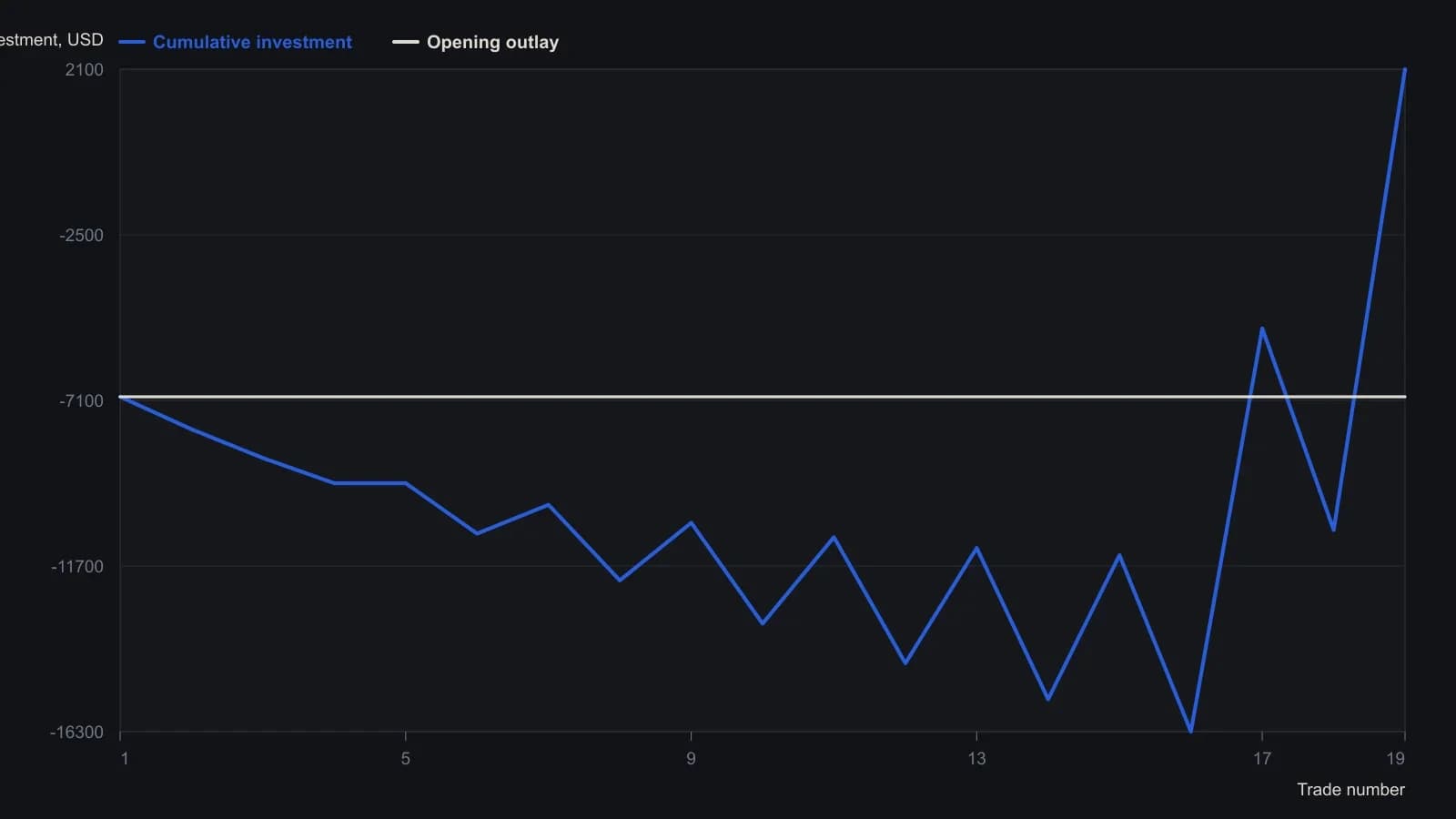
The source fixes a 100-share factor and a $1 point spread on an eight-week drift of about 20%. Ten losing fills and eight winning fills still complete the cycle; a longer losing run has no theoretical cap on cash required.
All readings on this track · 9 readings
- 1988Modified-martingale progression lists and ruin bounds
- 1989Scale-in-on-loss on a tempered-martingale-series with a fixed unit-factor
- 1989Shorter series need fewer recovery hits and raise scale-in cash
- 1990Recovery sizing as a series procedure
- 1990Reverse-martingale pyramiding after clustered wins
- 1993Test Martingale against fixed size before you pyramid
- 1998The runs-test as a contract-sizing gate
- 2004Scale-in on a two-close reversal instead of using a price stop
- 2012Four-level risk sizing when stock margin caps fixed fractions