1998issue C091-3
Finish a trend with a volatility trail, wave permission, and a slower-frame veto
A trend is finished only when a scaled true-range trail can name direction, a wave test can grant or refuse the next entry, and a slower frame can force abstention. This archive note reconstructs that historical workflow as one procedure.
- The volatility trail is a 21-period weighted average of true range, overweighting the latest bar and then multiplied by 3, plotted as a stop-and-reverse envelope.
- In a rise the measure is subtracted from the highest close of that rise and is not reset by later lower closes. A close through that bound reverses the construction onto the lowest close.
- Wave permission allows only upwaves after an up definition and only downwaves after a down definition. A counterwave alert does not cancel the next same-direction entry.
- A higher time frame is used only to name direction, so entries on a substantially lower time frame are taken solely that way.
Trend as a built object
Editorial view: trend is not a slogan. The system is finished only when a scaled true-range trail can name direction, a wave test can grant or refuse the next entry, and a slower frame can force abstention.
The paragraphs that follow record the historical workflow. They do not state a present-day forecast or a trading recommendation.
The volatility trail
True range is the largest of the current high-low difference, the current high versus the prior close, and the current low versus the prior close.
The volatility measure is built as a 21-period weighted average of true range, with heavier weight on the latest bar, then multiplied by 3. That scaled distance is the volatility trail, plotted as a stop-and-reverse envelope.
The same scaled true-range distance is the stop-and-reverse bound. It is computed before entry and while the position is open so the loss threshold tracks current volatility.
How direction is named
In a rise the measure is subtracted from the highest close of that rise and is not reset by later lower closes. A close through that bound reverses the construction, so the same measure is added to the lowest close until a close back through the trail.
Direction is labeled up while the volatility trail sits below the market and down while the trail sits above the market.
Trend-following, in this construction, means stay on the side named by the volatility trail and take only same-direction waves for the system holding period.
Wave permission and the counterwave alert
Entries are restricted to buying upwaves only after an up definition is in force and selling downwaves only after a down definition is in force. That is wave permission: only upwaves after an up definition, only downwaves after a down definition.
A break of the prior opposing wave is only a counterwave alert that direction may change. The next same-direction wave is still taken. The alert is cancelled if that wave recaptures the prior same-direction extreme.
The slower-frame veto
A higher time frame is used only to establish direction. Entries are sought on a substantially lower time frame solely in that same direction.
Paired frames offered as examples include 15-minute versus 60-minute, daily versus weekly, and weekly versus monthly, provided the two frames differ substantially.
One procedure for enter, reverse, and stand aside
The construction is one procedure. It states when to enter, when to reverse, and when to stand aside from a counter-wave or a conflicting slower-frame direction.
The volatility trail names the side. Wave permission grants or refuses the next wave. The slower-frame veto can force abstention when the higher frame disagrees.
Chase Manhattan daily with 3× ATR volatility trail
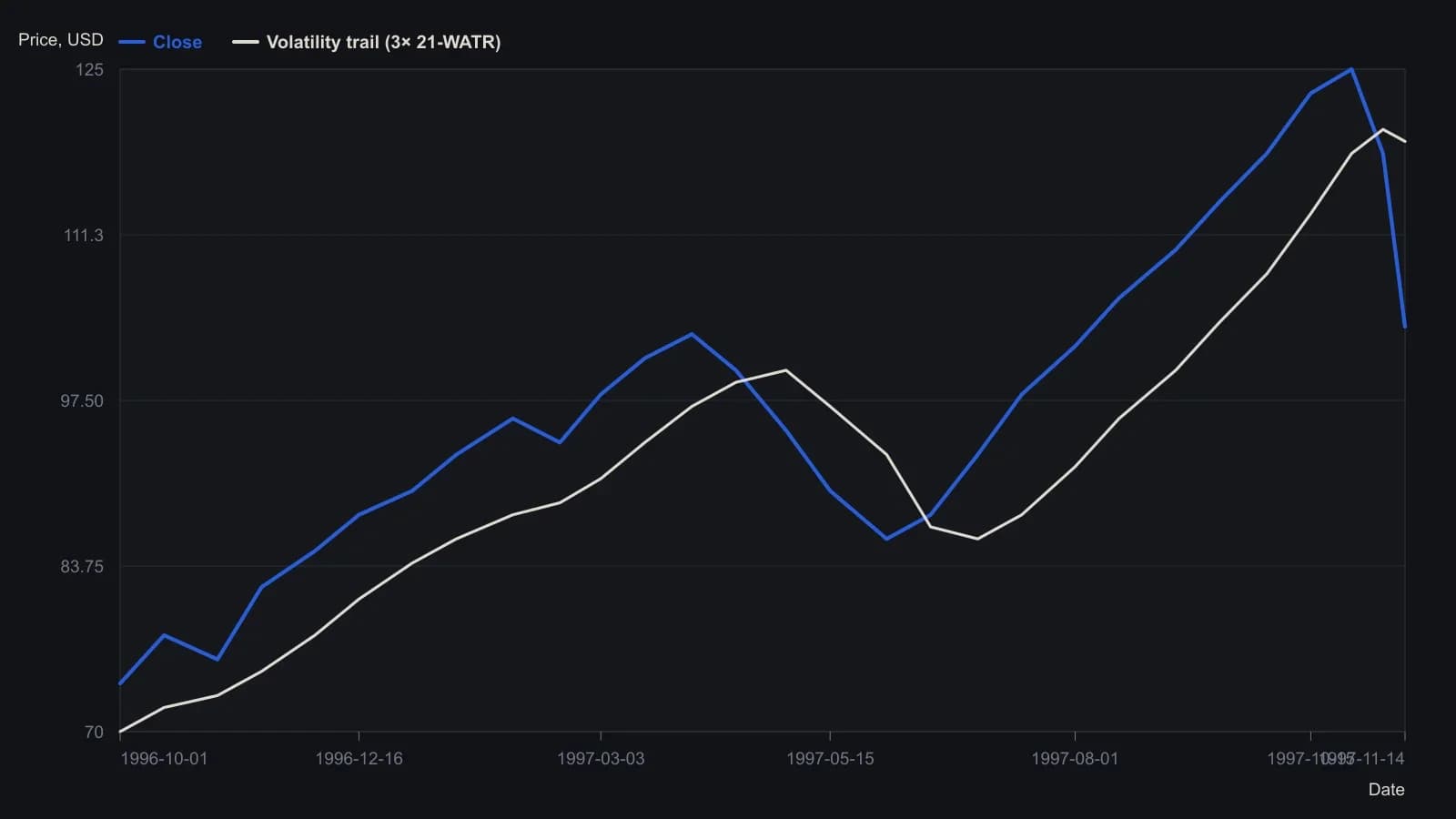
Abraham’s volatility stop is a 21-bar weighted average of true range multiplied by 3, subtracted from the highest close in an advance and added to the lowest close in a decline. Digitized from a low-resolution screenshot; values are approximate to about one dollar.
All readings on this track · 36 readings
- 1988Constructing unsigned true range for directional models
- 1989Evaluate an always-in ATR breakout as one procedure
- 1992Variable lookback and average true range as a trend-filter construction
- 1993A random-walk index that uses true range as its scale
- 1993A shared harness for trend-filter construction
- 1998Finish a trend with a volatility trail, wave permission, and a slower-frame veto
- 1999A trend filter that switches tactics and scales ATR targets
- 2001Filter higher lows with linear regression, then judge the exit
- 2003A Mechanical trading system is a maintained procedure, not only an entry trigger
- 2005Construction of a volatility-bounded long entry
- 2005Six-zone encoding of open, high, low, and close
- 2006Normalized average true range as a pre-entry volatility bound
- 2006Chandelier exits, ATR position sizing, and trailing stops
- 2007Constructing a rule-based entry with Relative Strength Index and ATR position sizing
- 2008Constructing a zero-lag TMA and heikin-ashi crossover as a complete rule set
- 2010Use the session-range percent stop as a pre-trade filter
- 2011OCA exit groups, trailing limits, and ATR stops
- 2011ATR bands around support and resistance for stops and targets
- 2013Algorithmic head-and-shoulders construction with bounded exits
- 2013Constructing ATR-scaled swing pivots and linear-regression divergence
- 2013Constructing volatility bands from typical price
- 2014Constructing true-range contraction filters before expansion
- 2015Constructing touch plans from modified true range
- 2015One checklist for breakout entry and ATR risk
- 2015Percentage true-range construction for cross-market volatility filters
- 2015Construct a percentage true range for cross-market volatility
- 2015Percentage true range as a pre-entry exposure filter
- 2016Constructing ATR-filtered breakout entries
- 2017A dividend date as a pairs-trading classroom
- 2018Range-based volatility as a true-range construction
- 2018Moving average support and volatility-band construction
- 2018Construct a lifecycle breakout from compression
- 2018Pair the book first and let volatility or range set the size
- 2019Trend systems need a no-trade rule
- 2020Average true range as a shared unit for size, pairs, and stops
- 2020Volatility sizing and target-risk leverage as a pre-trade gate