2011issue C048-11
Horizon checks on Covered call writing, the risk-reward ratio, and the Relative Strength Index
Published corrections inverted a covered-call assignment test, moved a sample risk-reward ratio from 0.9 to 0.8, and left a whole-market path usable on weekly bars. Editorial: the delivery rule, the arithmetic, and the sampling interval decide whether those tools are market context.
- A published covered-call expiration rule placed assignment when the underlying finished below the strike; the correction placed assignment when it finished above the strike.
- A sample scalp system's risk-reward ratio was corrected from 0.9 to 0.8, moving win-rate-adjusted expectancy after the risk-reward ratio is applied from 33 to 26 under the published 70-and-100 arithmetic.
- A whole-market projection treated the mapping as unchanged across time frames, added noise on shorter bars, and was judged unusable for intraday speculation, while a weekly sample reduced clutter on a multi-year path that could include the Relative Strength Index.
- Editorial: check whether a short call is exercised at expiration, the risk-reward arithmetic, and the bar length used to build a projected path before reading any of the three as portfolio context.
Three corrections, one horizon habit
Covered call writing, a risk-reward ratio, and a Relative Strength Index path can each be read as portfolio context. The archive record is narrower: a published expiration rule, a sample scalp ratio, and a whole-market projection were each corrected or bounded after the fact.
Editorial: the three cases look like market context only after the assignment test, the expectancy arithmetic, and the sampling interval are checked. Those checks are the article. They are not a ranking of the tools.
Covered call writing and the assignment test
A published covered-call expiration rule placed assignment when the underlying finished below the strike. The correction placed assignment when the underlying finished above the strike. That assignment test is whether a short call is exercised at expiration.
A second published note reversed call moneyness. It treated a finish below the strike as in-the-money and a finish above the strike as out-of-the-money.
Editorial: both notes invert the strike test that decides whether the short call is exercised at expiration. Until that delivery rule is checked, Covered call writing only looks like a regime-aware overlay.
The risk-reward ratio and a tenth of expectancy
A sample scalp system's risk-reward ratio was corrected from 0.9 to 0.8. Under the published 70-and-100 arithmetic, that change moved win-rate-adjusted expectancy after the risk-reward ratio is applied from 33 to 26.
Editorial: a tenth on the ratio is the whole filter. The published arithmetic has to be checked before the sample system is treated as a bounded risk decision.
Sampling interval on a Relative Strength Index path
A whole-market projection method treated the mapping as unchanged across time frames, with shorter bars adding noise rather than new information. The same method was judged inefficient on small time frames and unusable for intraday speculation. It still offered a weekly multi-year path for a broad equity basket and for oscillators including the Relative Strength Index.
Switching the sample from days to weeks was described as sharply reducing clutter so the computed forward picture became more usable for planning. The projection treated every influence on price as interacting inside one device rather than as separable laws that can be studied apart and then added back together.
A dual Relative Strength Index workbook needed a replacement file after a formula error, and large smoothing values were what made the original charts look wrong.
Editorial: the sampling interval is the bar length used to build a projected path. Weekly bars were the interval on which the forward picture was described as usable. Shorter bars were not a finer reading of the same map.
Weekly DIA and the five-year forward path
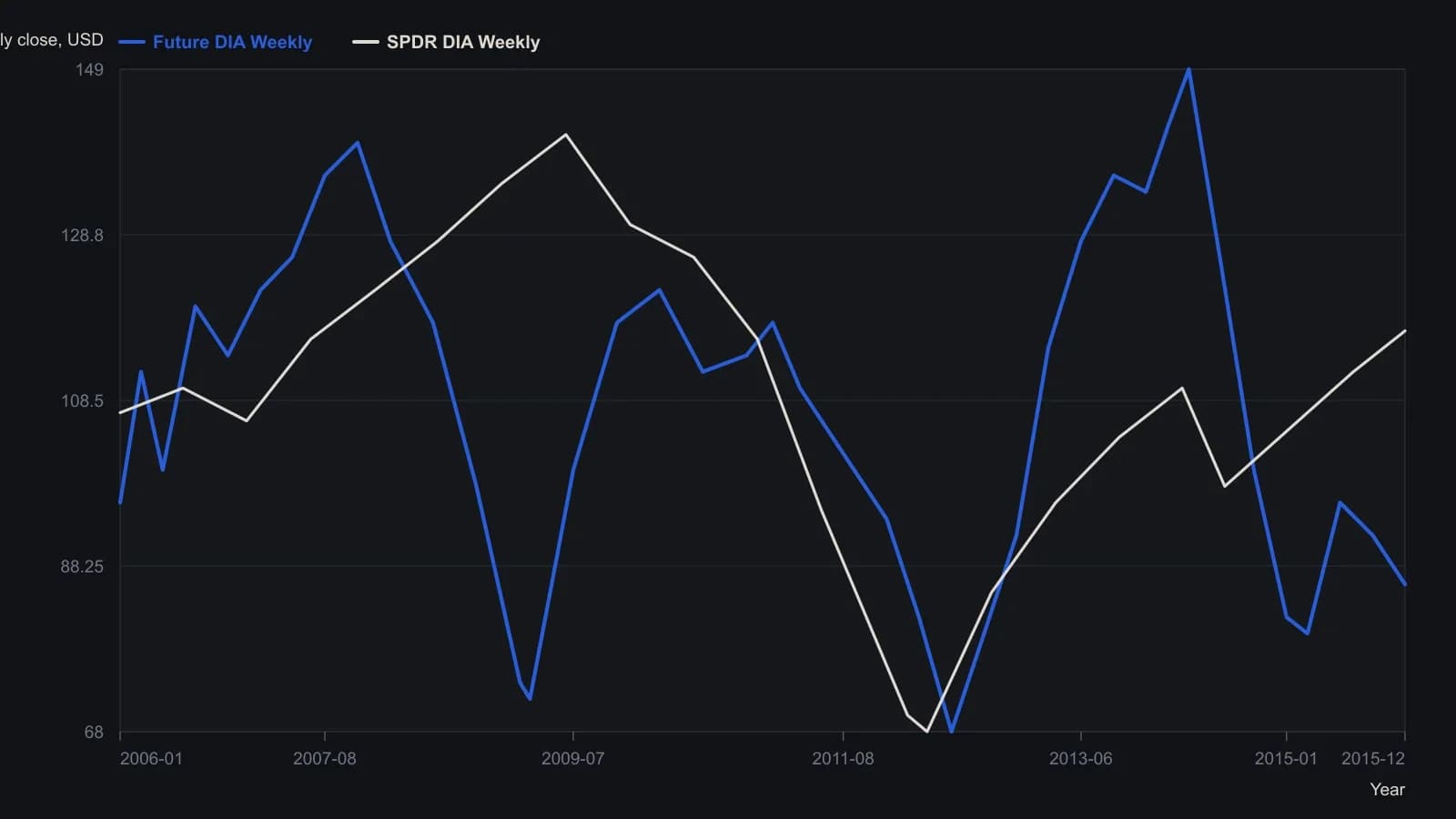
Printed split is 14 January 2011. The authors say daily and intraday versions of the same model are too noisy to use. Points are digitized at roughly quarterly spacing from the raster; turning points are readable to about two index points.
What to check before the three read as context
Editorial: Covered call writing, the risk-reward ratio, and the Relative Strength Index can be filed as market context only after three archive rules are in place. The assignment test must put exercise when the underlying finishes above the strike. The risk-reward ratio must carry the corrected 0.8, and with it the win-rate-adjusted expectancy after the risk-reward ratio is applied. The sampling interval must be the weekly bar that made the projected path usable, not a shorter bar that added noise. Those are delivery, arithmetic, and interval checks, not a claim that the corrected workflows hold now.
All readings on this track · 25 readings
- 1995Sequenced covered-call repair after a growth-stock drawdown
- 1996Covered-call writing as income and assignment discipline
- 1997Relative volatility rank for covered-call overlays
- 1997Covered call time, probability, and implied volatility
- 1999Covered-call income when implied volatility is cheap
- 2000Covered-call income and assignment flexibility
- 2002Covered-call expiration rate versus expected value
- 2003Covered-call versus diagonal housing after a single-name drawdown
- 2003Covered-call overlay on a stock portfolio as a payoff case study
- 2003Ratio backspread and covered-call assignment construction
- 2004Covered-call income is not a safety net
- 2006Evaluating consecutive covered calls across market regimes
- 2007A job-first audit of commodity options in a futures book
- 2011Horizon checks on Covered call writing, the risk-reward ratio, and the Relative Strength Index
- 2012From ex-date verticals to leftover buy-writes, and a call backspread that stays net long
- 2013Year-long covered calls on high-yield industrials
- 2014Year-horizon covered calls on Dow yield ranks
- 2014Covered-call premium as a cost-basis cushion
- 2014Monthly buy-write construction with traffic-light exits
- 2017Low-volatility covered calls need a real premium buffer
- 2017Covered-call futures income as one testable procedure
- 2018Partial covered-call overlays at targets, resistance, and rich volatility
- 2019Weekly covered-call writing as a two-book credit-spread case
- 2019Weekly option income as one holding-period case
- 2019Locking long-call profit with a temporary overlay