2012issue C1044
From ex-date verticals to leftover buy-writes, and a call backspread that stays net long
On an ex-date, a dividend-capture vertical either remains a defined call spread or converts into a buy-write if the long calls are exercised and the short calls survive the assignment lottery. A cheaper put than the cash dividend and a pool of long calls that might not exercise were the stated screens. A call backspread, typically short one lower-strike call and long two higher-strike calls, was the net-long alternative when implied volatility looked cheap and no cash event was required.
- A long equity call does not receive the cash dividend; only stock held through the ex-date does.
- A dividend-capture vertical can remain a defined spread or convert into a buy-write when the long calls are exercised and the short calls remain unassigned after the assignment lottery.
- The put-versus-dividend screen treats a put cheaper than the cash dividend as the more favorable setup for that possible conversion.
- When implied-versus-statistical cheapness favored long-call exposure and no cash event was required, a call backspread was presented as a net-long-contract alternative to buying calls or a debit call vertical.
Cash goes to stock, not to the call
A long equity call does not receive the cash dividend. Only stock held through the ex-date does.
On August 8, about 1.6 million contracts of lopsided call volume, with a put/call ratio of 0.11, was attributed to an overnight dividend-capture spread rather than ordinary directional demand.
How the dividend-capture vertical was built
The construction used swapped verticals so that exercising the long calls into stock could leave a deep buy-write if the short calls escaped the clearinghouse assignment process.
A buy-write is a long-stock and short-call package that can be assembled directly or left behind when a vertical’s long calls are exercised and its short calls remain unassigned. A dividend-capture vertical is the paired call spread used overnight so that exercising the long strike into stock may leave a deep covered call if the short strike survives assignment.
Two screens and the assignment lottery
Two stated prerequisites were a corresponding put cheaper than the 2.65 dividend and an existing open-interest pool of long calls that might not exercise.
The first check is the put-versus-dividend screen: it compares the put at the short-call strike with the cash dividend and treats a cheaper put as the more favorable conversion setup. The second hangs on the assignment lottery, the clearinghouse process that allocates exercise notices to a subset of short option holders, so some short calls in a given strike may remain unassigned.
Volume, open interest and unclaimed cash
The regular August 555 and 560 calls each traded about 22,000 contracts against open interest near 2,300 and 3,300, while the 560 put was about 0.33 versus the 2.65 cash amount.
The next session, remaining open-interest pools of about 750 and 500 contracts implied roughly 198,750 plus 132,500 of unclaimed dividend cash, more than 330,000, at 265 per contract.
What unassigned short calls became
Unassigned short calls in that structure converted into buy-writes with short-put-equivalent risk. The 560 put was 0.33 beforehand and about 0.25 midmarket on the ex-date.
A call backspread when volatility looked cheap
When implied volatility was cheap versus recent implied and statistical ranges, a call backspread was presented as a net-long-contract alternative to buying calls or a debit call vertical.
Implied-versus-statistical cheapness compares current implied volatility with recent implied readings and the underlying’s realized range, and was used to judge whether outright or ratio long-call structures looked inexpensive. A call backspread is a ratio call spread that sells fewer lower-strike contracts than it buys of a higher strike, leaving a net long contract count. The typical construction was short one lower-strike call and long two higher-strike calls.
Editorial note: TradersWeek contrasts that leftover buy-write with the call backspread. The backspread keeps a net-long contract profile when volatility is cheap and no cash event is required, instead of depending on overnight exercise and the assignment lottery.
AMZN 1-by-2 October call backspread versus two long 240 calls
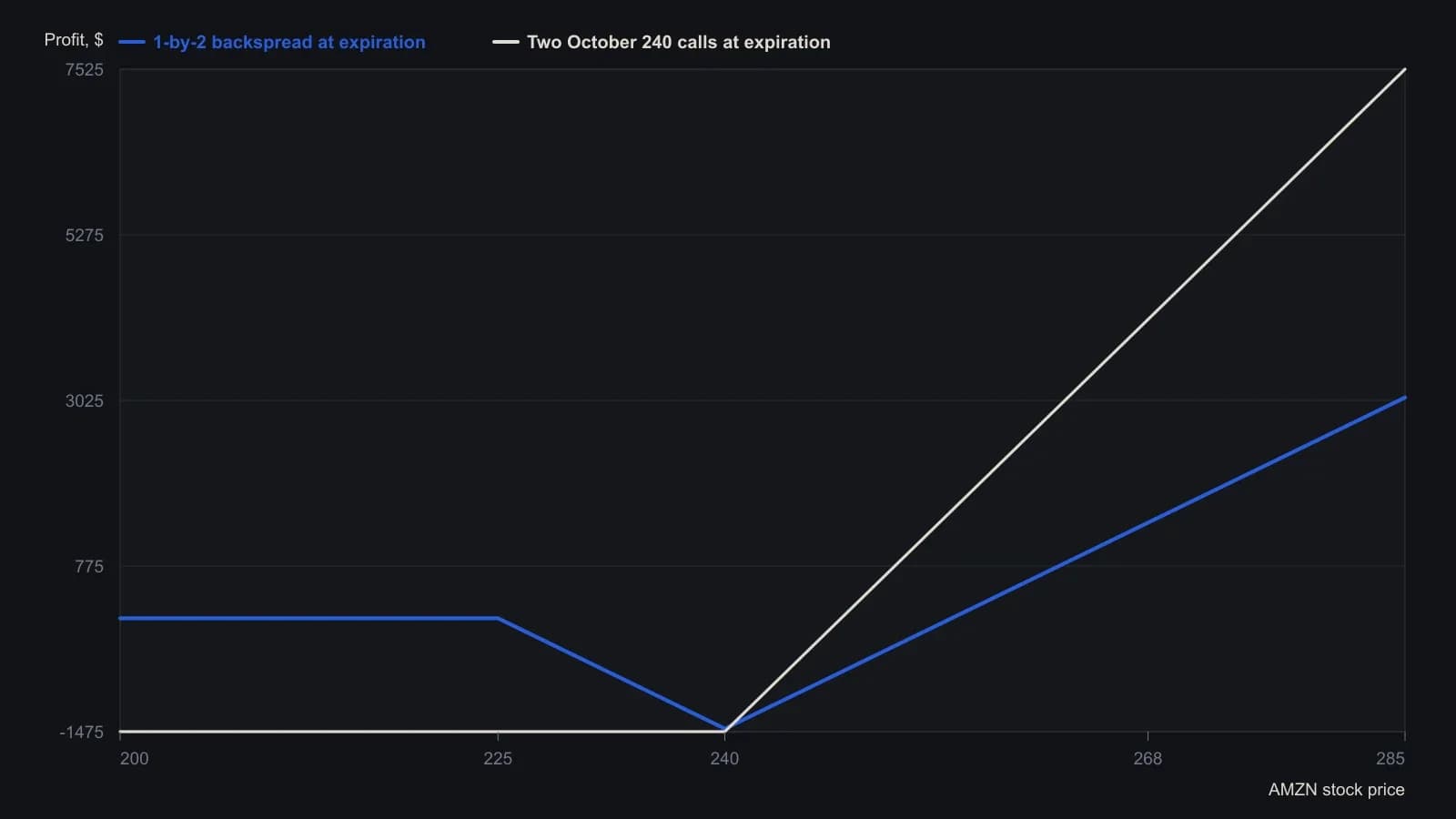
The source also drew 66-day theoretical curves, which are not reconstructed here. It annotated a long-call max loss of $1,466 without labeling that call's strike, so that contract is omitted. The printed 'approximately $1,475' risk at 240 is the two-call debit; the backspread worst case from the $65 credit is $1,435.
All readings on this track · 25 readings
- 1995Sequenced covered-call repair after a growth-stock drawdown
- 1996Covered-call writing as income and assignment discipline
- 1997Relative volatility rank for covered-call overlays
- 1997Covered call time, probability, and implied volatility
- 1999Covered-call income when implied volatility is cheap
- 2000Covered-call income and assignment flexibility
- 2002Covered-call expiration rate versus expected value
- 2003Covered-call versus diagonal housing after a single-name drawdown
- 2003Covered-call overlay on a stock portfolio as a payoff case study
- 2003Ratio backspread and covered-call assignment construction
- 2004Covered-call income is not a safety net
- 2006Evaluating consecutive covered calls across market regimes
- 2007A job-first audit of commodity options in a futures book
- 2011Horizon checks on Covered call writing, the risk-reward ratio, and the Relative Strength Index
- 2012From ex-date verticals to leftover buy-writes, and a call backspread that stays net long
- 2013Year-long covered calls on high-yield industrials
- 2014Year-horizon covered calls on Dow yield ranks
- 2014Covered-call premium as a cost-basis cushion
- 2014Monthly buy-write construction with traffic-light exits
- 2017Low-volatility covered calls need a real premium buffer
- 2017Covered-call futures income as one testable procedure
- 2018Partial covered-call overlays at targets, resistance, and rich volatility
- 2019Weekly covered-call writing as a two-book credit-spread case
- 2019Weekly option income as one holding-period case
- 2019Locking long-call profit with a temporary overlay