2018issue C1042-43
Partial covered-call overlays at targets, resistance, and rich volatility
Covered call writing sells a call against a long share lot, collecting a credit while giving up upside above the strike. Editorial framing: write that call only when a planned share-sale target, overhead resistance, or a rich implied-volatility credit already explains the sale, and keep partial coverage so leftover shares still participate if the name breaks out.
- A one-call-per-hundred-shares overlay caps upside at the short strike and reduces residual downside only by the premium collected.
- If the underlying stays below the short strike through expiration, the writer keeps the premium, and that same credit is the only downside offset.
- Editorial reading: write the call only when a planned share-sale target, overhead resistance, or a rich implied-volatility credit already explains why upside is being sold.
- Writing fewer calls than the full share lot forgoes maximum income but leaves uncovered shares with uncapped upside if the stock trends sharply higher.
What the overlay pays
Covered call writing is selling a call against a long share lot so a credit is collected while upside above the strike is given up. A one-call-per-hundred-shares overlay produces a payoff with upside capped at the short strike and residual downside reduced only by the premium collected.
If the underlying stays below the short strike through expiration, the writer keeps the premium and the only downside offset equals that same credit.
An overlay instead of a standing coupon
Editorial interpretation: run the sale as an option income procedure, a repeatable set of entry, abstention, assignment, and roll rules that turns premium collection into a testable overlay instead of a one-off coupon. Write only when a planned share-sale target, overhead resistance, or a rich implied-volatility credit already explains why upside is being sold.
A planned share-sale target
A predetermined share-sale target supplies a natural strike. Rewrite that strike while price stays below it, and allow assignment if the target is reached.
Overhead resistance
Overhead resistance is a prior high that has already rejected price and can justify placing a short strike at or just above that stall while the range is tested. When prior highs are expected to cap a name, a short call at or above that resistance can collect income while the stock tests a breakout, a breakdown, or a continued range.
A rich implied-volatility credit
Implied-volatility credit is the options market's priced-in move; a spike fattens the premium that is also the overlay's maximum profit at initiation. The credit received at entry is the overlay's maximum profit, so a spike in implied volatility is treated as a condition that increases the premium available to the writer.
Keep leftover shares uncovered
Partial coverage means writing calls against only a fraction of the long shares so uncovered stock keeps uncapped upside if price trends through the strike. Writing fewer calls than the full share lot forgoes maximum income but leaves uncovered shares with uncapped upside if the stock trends sharply higher.
Editorial interpretation: size the short below a full hedge so leftover shares still participate if the name breaks out.
If price trades through the strike
After price trades through the strike, the writer can accept assignment, repurchase the short call, or roll to a higher strike by buying back the original option and selling another. A roll-up is repurchasing the original short call and selling a higher strike after a rally, accepting a possible debit and extra transaction cost to keep the stock.
Partial covered-call risk curves vs Intel stock price
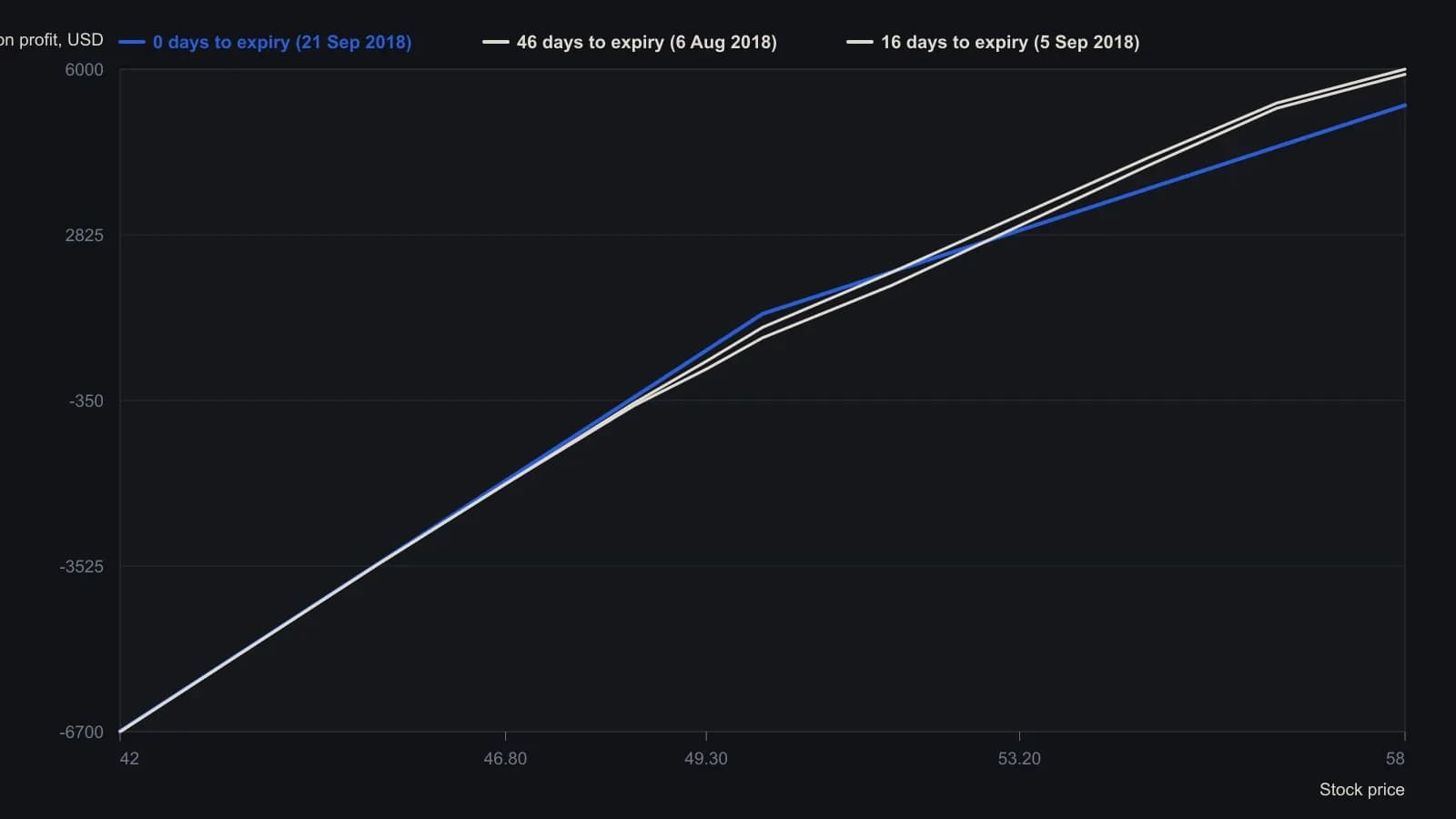
Pre-expiry curves are digitized from the raster (about ±$150 / ±$0.2). The 0-day kink at the 50 strike matches long 1,000 shares plus five short 50-strike calls, not the figure caption’s “short one.” Snapshot date 6 Aug 2018.
All readings on this track · 25 readings
- 1995Sequenced covered-call repair after a growth-stock drawdown
- 1996Covered-call writing as income and assignment discipline
- 1997Relative volatility rank for covered-call overlays
- 1997Covered call time, probability, and implied volatility
- 1999Covered-call income when implied volatility is cheap
- 2000Covered-call income and assignment flexibility
- 2002Covered-call expiration rate versus expected value
- 2003Covered-call versus diagonal housing after a single-name drawdown
- 2003Covered-call overlay on a stock portfolio as a payoff case study
- 2003Ratio backspread and covered-call assignment construction
- 2004Covered-call income is not a safety net
- 2006Evaluating consecutive covered calls across market regimes
- 2007A job-first audit of commodity options in a futures book
- 2011Horizon checks on Covered call writing, the risk-reward ratio, and the Relative Strength Index
- 2012From ex-date verticals to leftover buy-writes, and a call backspread that stays net long
- 2013Year-long covered calls on high-yield industrials
- 2014Year-horizon covered calls on Dow yield ranks
- 2014Covered-call premium as a cost-basis cushion
- 2014Monthly buy-write construction with traffic-light exits
- 2017Low-volatility covered calls need a real premium buffer
- 2017Covered-call futures income as one testable procedure
- 2018Partial covered-call overlays at targets, resistance, and rich volatility
- 2019Weekly covered-call writing as a two-book credit-spread case
- 2019Weekly option income as one holding-period case
- 2019Locking long-call profit with a temporary overlay