2017issue C1133
Low-volatility covered calls need a real premium buffer
A lasting drop in market volatility left option premium unusually cheap and encouraged income sellers to understate a later snapback. A March corn covered-call example shows a distant 3.90 call sold for 0.07 barely moving the loss point, while a 3.60 call sold for 0.20 collects more premium and shifts breakeven closer.
- A lasting drop in market volatility was described as leaving option premium unusually cheap and encouraging income sellers to understate a later volatility snapback.
- Aggressive naked selling of deep out-of-the-money futures options was framed as a poor fit; markets near long-term highs or lows were identified as more suitable for covered call writing and covered put writing.
- A 3.90 call sold for 0.07 against long March corn near 3.60 only lowered the cushion to about 3.53, capped profit near 0.37, and still left a 0.25 adverse move losing about 1250 before costs.
- Selling a 3.60 call for 0.20 was presented as a proximal strike that collected more premium and moved breakeven closer, but low implied volatility could still inflate the short call on a sharp rally.
Cheap volatility and understated snapback
A sharp, lasting drop in market volatility was described as leaving option premium unusually cheap. Implied volatility is the price the options market is charging for expected movement. When it is unusually low, an option income strategy collects little risk buffer: the underlying does not have to move far against the position before collected premium is used up.
That cheap-premium setting was also described as encouraging income sellers to understate a later volatility snapback. Strike choice, entry, and abstention stay one testable rule set. A distant short call is still part of that procedure, not a separate income add-on.
Covered writing near long-term extremes
Aggressive naked selling of deep out-of-the-money futures options was framed as a poor fit for that cheap-volatility setting. Markets near long-term highs or lows were identified as more suitable settings for covered call writing and covered put writing than for that aggressive naked selling.
Covered call writing owns the underlying futures contract and sells a call against it so premium can offset some decline while gains above the short strike are given up. Covered put writing is the short-futures counterpart that sells a put against a short underlying position near a long-term extreme.
The March corn overlay
A long March corn futures entry near 3.60 with a 3.90 call sold for 0.07 only lowers the downside cushion to about 3.53. The risk buffer is that short stretch between the futures entry and the premium-adjusted loss point.
That distant-strike overlay was calculated to cap maximum profit near 0.37, or about 1850 before costs, while a 0.25 adverse futures move would still lose about 1250. The distant, cheap short call was criticized for capping upside without buying enough error room to justify giving up gains beyond the strike.
A proximal strike and a cheap call
Selling a 3.60 call for 0.20 instead of the 3.90 call for 0.07 was presented as collecting more premium and shifting breakeven to a closer, more attainable level. That closer listing is a proximal strike: extra premium is large enough to change breakeven and the odds of reaching the capped maximum.
Because implied volatility was already low, a sharp rally could still inflate the short call enough to frustrate the overlay even when the long futures side worked.
March corn covered-call premium and implied downside buffer
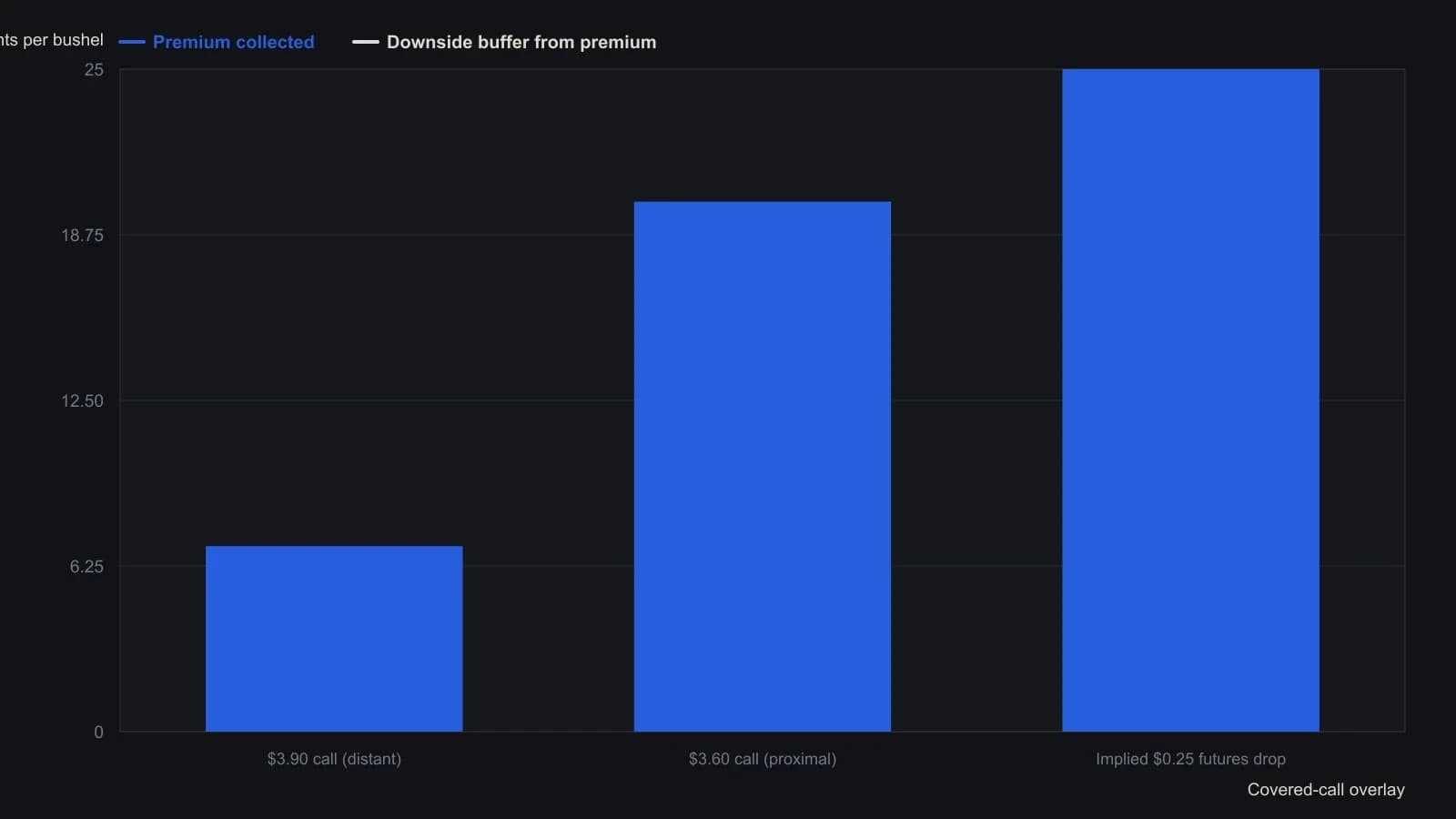
Premiums are as quoted in the article, before commissions and exchange fees. The distant-strike buffer is $3.60 minus $0.07; the proximal strike collects $0.20 at the futures entry itself.
All readings on this track · 25 readings
- 1995Sequenced covered-call repair after a growth-stock drawdown
- 1996Covered-call writing as income and assignment discipline
- 1997Relative volatility rank for covered-call overlays
- 1997Covered call time, probability, and implied volatility
- 1999Covered-call income when implied volatility is cheap
- 2000Covered-call income and assignment flexibility
- 2002Covered-call expiration rate versus expected value
- 2003Covered-call versus diagonal housing after a single-name drawdown
- 2003Covered-call overlay on a stock portfolio as a payoff case study
- 2003Ratio backspread and covered-call assignment construction
- 2004Covered-call income is not a safety net
- 2006Evaluating consecutive covered calls across market regimes
- 2007A job-first audit of commodity options in a futures book
- 2011Horizon checks on Covered call writing, the risk-reward ratio, and the Relative Strength Index
- 2012From ex-date verticals to leftover buy-writes, and a call backspread that stays net long
- 2013Year-long covered calls on high-yield industrials
- 2014Year-horizon covered calls on Dow yield ranks
- 2014Covered-call premium as a cost-basis cushion
- 2014Monthly buy-write construction with traffic-light exits
- 2017Low-volatility covered calls need a real premium buffer
- 2017Covered-call futures income as one testable procedure
- 2018Partial covered-call overlays at targets, resistance, and rich volatility
- 2019Weekly covered-call writing as a two-book credit-spread case
- 2019Weekly option income as one holding-period case
- 2019Locking long-call profit with a temporary overlay