2000issue C011-4
Covered-call income and assignment flexibility
A covered call sells a call against stock already owned so an exercise can be met by delivery. The archive sets extra income, a target sale, and a limited downside cushion as the reasons to write, then shows when to buy the call back, accept assignment, or sell puts to repurchase the same name.
- Covered call writing sells a call against stock already owned so that an exercise can be met by delivering that holding.
- The archive lists three motives: extra income when little near-term upside is expected, a target sale above the current price, and a limited cushion if the stock falls.
- If the stock rises beyond strike plus premium received, buying the call back costs more than the premium collected, so the overlay underperforms an unoptioned long stock position.
- The archive advises against writing calls on a very-low-basis holding when assignment would create an unwanted tax event, and favors writing only when listed options exist, look fairly priced, and are large relative to commission.
A call against stock already owned
Covered call writing is defined as selling a call against stock already owned so that an exercise can be met by delivering that holding.
The archive lists three motives for selling calls on owned stock: extra income when little near-term upside is expected, a target sale above the current price, and a limited cushion if the stock falls.
Keeping the shares or accepting the call
In a worked path, stock bought near 33 with a 35-strike call sold for 2.50 can still be kept at expiration by buying the call back. Economic value is similar to letting the shares be called.
If the stock rises beyond strike plus premium received, buying the call back costs more than the premium collected, so the overlay underperforms an unoptioned long stock position.
An option income strategy after assignment
A follow-on procedure after assignment is to sell slightly out-of-the-money puts until the same name is put back. Repurchase is treated as acceptable because the stock was already wanted.
When the archive would not write
The archive advises against writing calls on a very-low-basis holding when assignment would create an unwanted tax event. It favors writing only when listed options exist, look fairly priced, and are large relative to commission.
Covered-call premiums are described as most attractive when options are overpriced, which the archive associates with unusually high market volatility such as a correction.
Option premium analysis of two October strikes
A strike only 4 percent above the then-current stock price is treated as having a material chance of being reached, because that gap is much smaller than one standard deviation in the example.
In the October 75 versus October 70 comparison, commission of about 0.20 per share plus a 0.18 bid gap left expected October 75 income near 0.87, so the October 70 was preferred.
Live quotes showed the October 70 bid 0.02 below the theoretical value and with substantial volume. The example trade was the October 70 rather than the missing or thinner 75 strike.
October TLAB covered-call premiums by strike
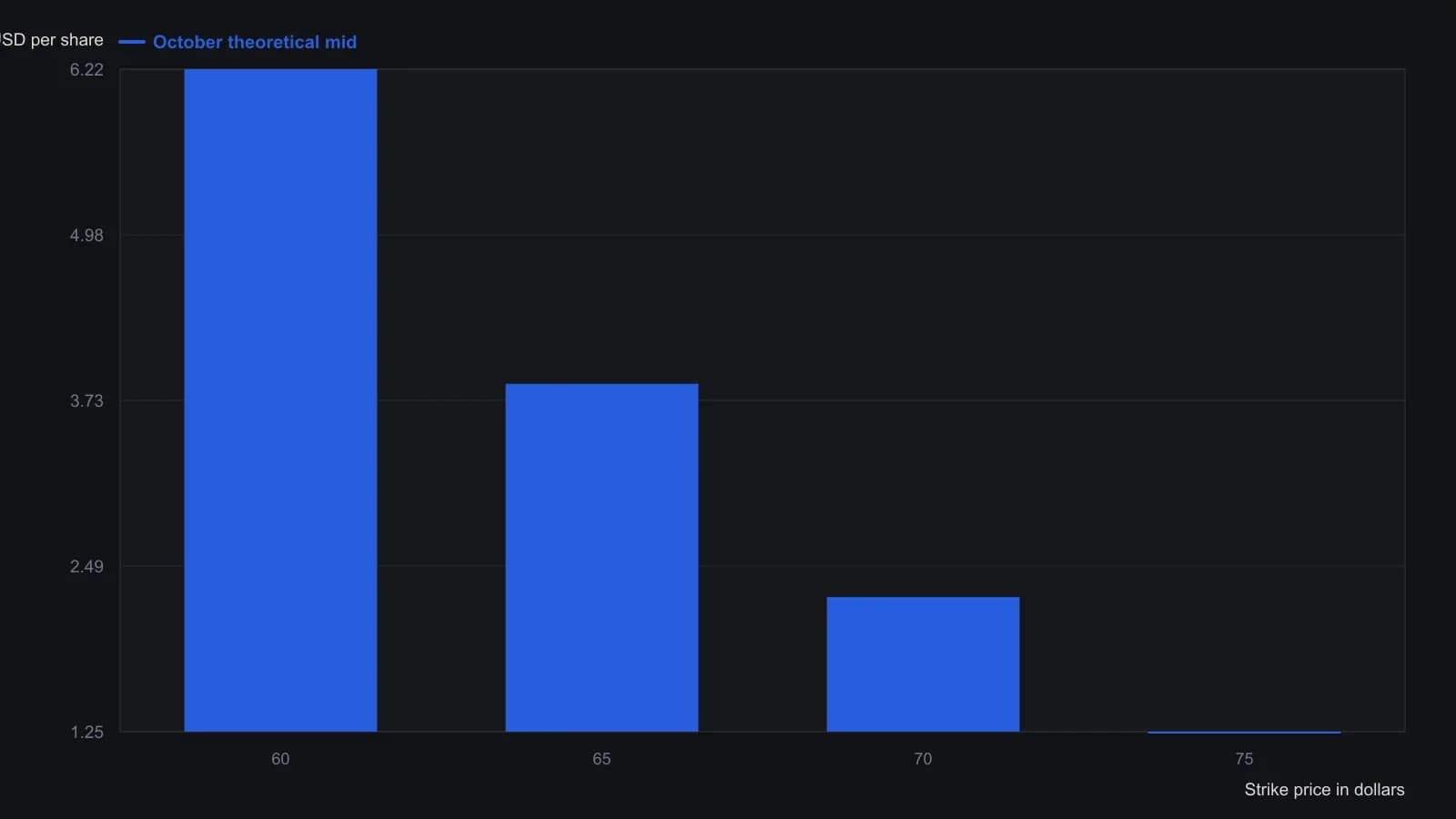
Calculator snapshot dated 4 September 1999; the October series has 40 days to expiration. Each cell also printed a bid-ask increment that is not plotted.
All readings on this track · 25 readings
- 1995Sequenced covered-call repair after a growth-stock drawdown
- 1996Covered-call writing as income and assignment discipline
- 1997Relative volatility rank for covered-call overlays
- 1997Covered call time, probability, and implied volatility
- 1999Covered-call income when implied volatility is cheap
- 2000Covered-call income and assignment flexibility
- 2002Covered-call expiration rate versus expected value
- 2003Covered-call versus diagonal housing after a single-name drawdown
- 2003Covered-call overlay on a stock portfolio as a payoff case study
- 2003Ratio backspread and covered-call assignment construction
- 2004Covered-call income is not a safety net
- 2006Evaluating consecutive covered calls across market regimes
- 2007A job-first audit of commodity options in a futures book
- 2011Horizon checks on Covered call writing, the risk-reward ratio, and the Relative Strength Index
- 2012From ex-date verticals to leftover buy-writes, and a call backspread that stays net long
- 2013Year-long covered calls on high-yield industrials
- 2014Year-horizon covered calls on Dow yield ranks
- 2014Covered-call premium as a cost-basis cushion
- 2014Monthly buy-write construction with traffic-light exits
- 2017Low-volatility covered calls need a real premium buffer
- 2017Covered-call futures income as one testable procedure
- 2018Partial covered-call overlays at targets, resistance, and rich volatility
- 2019Weekly covered-call writing as a two-book credit-spread case
- 2019Weekly option income as one holding-period case
- 2019Locking long-call profit with a temporary overlay