2014issue C0139
Year-horizon covered calls on Dow yield ranks
After the last cash session of the calendar year, the thirty Dow industrials are ranked by dividend yield and the ten highest-yielding names are held with equal dollar weights until the next year-end. The covered write uses longer-dated calls so the overlay shares that one-year stock hold.
- The year-end-yield-rank keeps the ten highest-yielding Dow industrials and funds each name with the same dollar weight until the next year-end rerank.
- A lower-priced-subset of the five cheapest names inside that list follows the same equal-weight-year-hold.
- Cash-dividend entitlement still turns on the ex-dividend-cutoff; declaration, record, and payable dates are the other three calendar markers.
- The covered-write sells one call per one-hundred-share lot, and tenor-match replaces a monthly harvest because short-dated premium on these high-yield names was treated as too thin.
A ranking that already lasts a year
After the last cash session of the calendar year, the thirty Dow industrials are ranked by dividend yield and the ten highest-yielding names are kept. That year-end-yield-rank is the equity book the overlay later writes against.
Each selected name is funded with the same dollar weight and held until the ranking is repeated at the next year-end. The equal-weight-year-hold therefore lasts a full dividend year.
The five lowest-priced names inside that ten-name list form a nested lower-priced-subset. It follows the same equal-weight, one-year hold.
2013 Dogs of the Dow ranked by year-end dividend yield
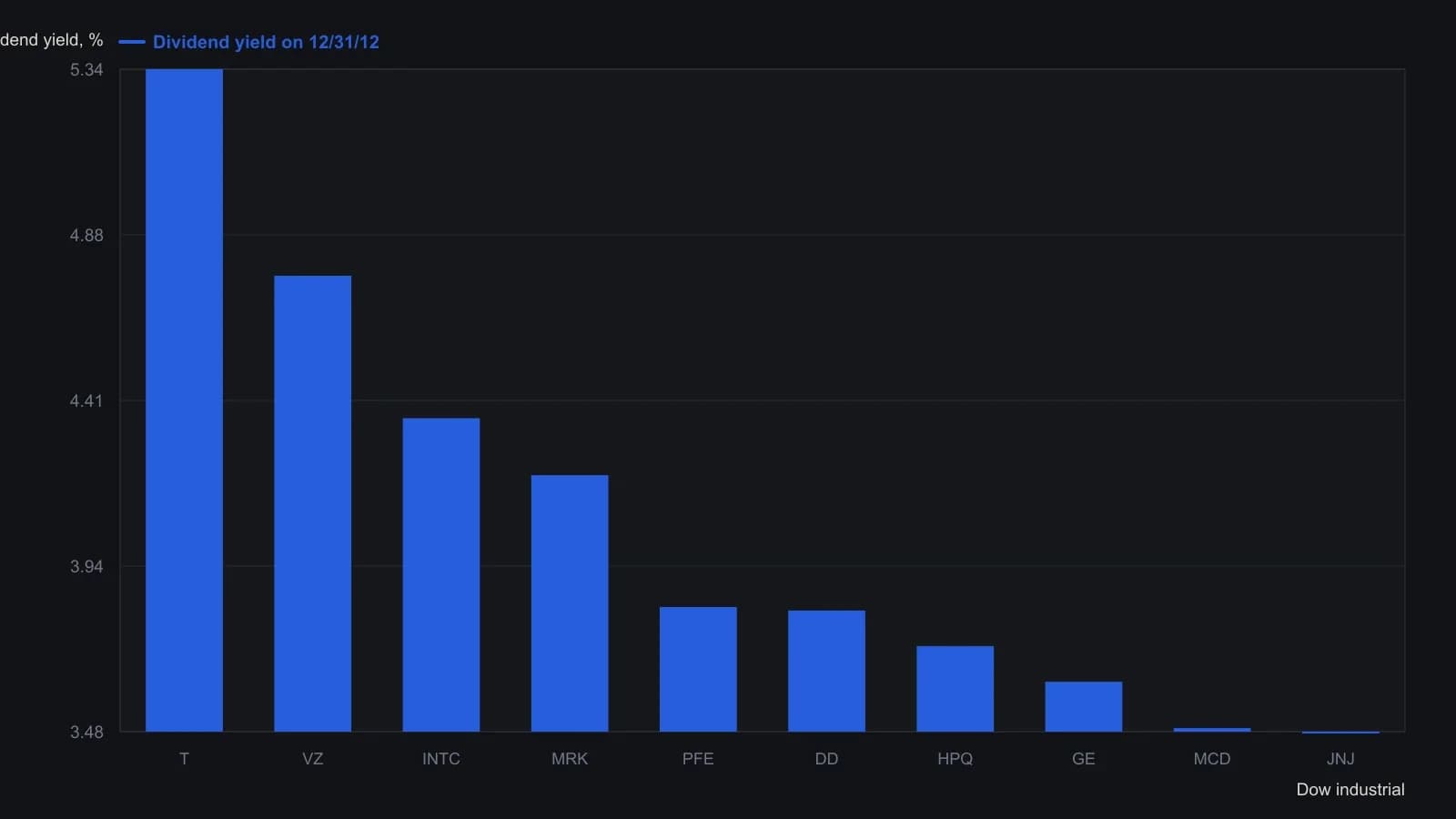
Selection date is the 31 December 2012 close, the start of the 2013 one-year hold. The five cheaper issues are the small dogs in the source table; they are not plotted as a second series.
The cash-dividend calendar
Cash-dividend entitlement requires a long share position on or before the ex-dividend date. That ex-dividend-cutoff is the ownership test for the declared cash payout.
Declaration, record, and payable dates are the other three calendar markers. They do not replace the need to own the shares on or before the cutoff.
A covered write with a matching tenor
The overlay sells one call, struck at or slightly out of the money, against each one-hundred-share stock lot. In a covered-write the long lot covers the short call because the strike sits at or slightly above the market.
Short-dated calls on these high-yield names were treated as too thinly priced for a monthly harvest, so the write uses longer-dated premium to match the year-long stock hold. That tenor-match keeps the option overlay on the same calendar as the rank rotation.
In the 2013 ranking cycle used for the illustration, five names were treated as the qualifying set for the covered-write example.
All readings on this track · 25 readings
- 1995Sequenced covered-call repair after a growth-stock drawdown
- 1996Covered-call writing as income and assignment discipline
- 1997Relative volatility rank for covered-call overlays
- 1997Covered call time, probability, and implied volatility
- 1999Covered-call income when implied volatility is cheap
- 2000Covered-call income and assignment flexibility
- 2002Covered-call expiration rate versus expected value
- 2003Covered-call versus diagonal housing after a single-name drawdown
- 2003Covered-call overlay on a stock portfolio as a payoff case study
- 2003Ratio backspread and covered-call assignment construction
- 2004Covered-call income is not a safety net
- 2006Evaluating consecutive covered calls across market regimes
- 2007A job-first audit of commodity options in a futures book
- 2011Horizon checks on Covered call writing, the risk-reward ratio, and the Relative Strength Index
- 2012From ex-date verticals to leftover buy-writes, and a call backspread that stays net long
- 2013Year-long covered calls on high-yield industrials
- 2014Year-horizon covered calls on Dow yield ranks
- 2014Covered-call premium as a cost-basis cushion
- 2014Monthly buy-write construction with traffic-light exits
- 2017Low-volatility covered calls need a real premium buffer
- 2017Covered-call futures income as one testable procedure
- 2018Partial covered-call overlays at targets, resistance, and rich volatility
- 2019Weekly covered-call writing as a two-book credit-spread case
- 2019Weekly option income as one holding-period case
- 2019Locking long-call profit with a temporary overlay