2003issue C081-3
Covered-call overlay on a stock portfolio as a payoff case study
The archive pairs 100 shares bought at 29 with a six-month 30-strike call sold for 4 points, then reads the kept premium, the strike cap, and the two expiration branches against an unhedged buy-and-hold payoff. Allocation and diversification remain exposure-control steps, not an option-income stream.
- Allocation across asset classes and diversification within a class are presented as first-pass exposure controls that can dampen swings but do not create an option-income stream.
- Covered-call writing owns the shares and sells a call so assignment can be met with stock already held; selling the same call without the shares is an uncovered position.
- In the worked case the 4-point premium is kept in both branches: shares are delivered at 30 if the stock finishes above the strike, or net share cost falls from 29 to 25 if the call expires.
- Option-premium analysis shows a buy-and-hold payoff that moves with the share price, while the covered-call line is capped at 3400 above 30 and sits above the unhedged line on declines.
Allocation and diversification as exposure control
Splitting capital across several asset classes is presented as a first-pass way to dampen net portfolio swings, because some holdings can rise while others fall. Within-class diversification is described as holding several stocks across industries, or mixing government and corporate bonds of different maturities, to limit damage from one security failing.
Allocation and diversification are treated as exposure-control steps that do not themselves create an option-income stream.
Covered-call writing on one holding
Covered-call writing means owning the underlying shares and selling a call against that holding so assignment can be met by delivering stock already in the account. The archive specifies the position as owning 100 shares and selling one call. Assignment is exercise of the call, requiring the writer to sell the shares at the strike. Selling the same call without the shares is labeled an uncovered position.
Two expiration branches in the worked case
In the worked case, 100 shares bought at 29 are paired with a six-month 30-strike call sold for 4 points, and that premium is kept in both expiration outcomes. If the stock finishes above 30 the call is exercised and the shares are delivered at 30. If it finishes below 30 the call expires and the 4-point premium lowers net share cost from 29 to 25.
Net share cost is the original purchase price reduced by premium kept when the call expires unexercised. An option-income strategy, in this setting, is a rule-based overlay that collects call premium against a long stock position and then follows a defined expiration branch: delivery at the strike or worthless expiry with a lower net share cost.
Reading the premium on the account-value line
Option-premium analysis of the expiration diagram shows buy-and-hold as a linear account-value line versus stock price. That buy-and-hold payoff is an unhedged long-stock account-value line that moves one-for-one with the share price. The covered-call line is capped at 3400 once the stock is above 30 and sits above the unhedged line on declines.
Option-premium analysis reads the collected premium as a parallel shift and an upside cap on the account-value line versus stock price, rather than as a standalone return forecast. The option-income overlay is described as slowing the rate of account-value change in both falling markets and strong advances, collecting premium when price is range-bound, and giving up unhedged upside above the strike.
Covered-call versus buy-and-hold account value at expiration
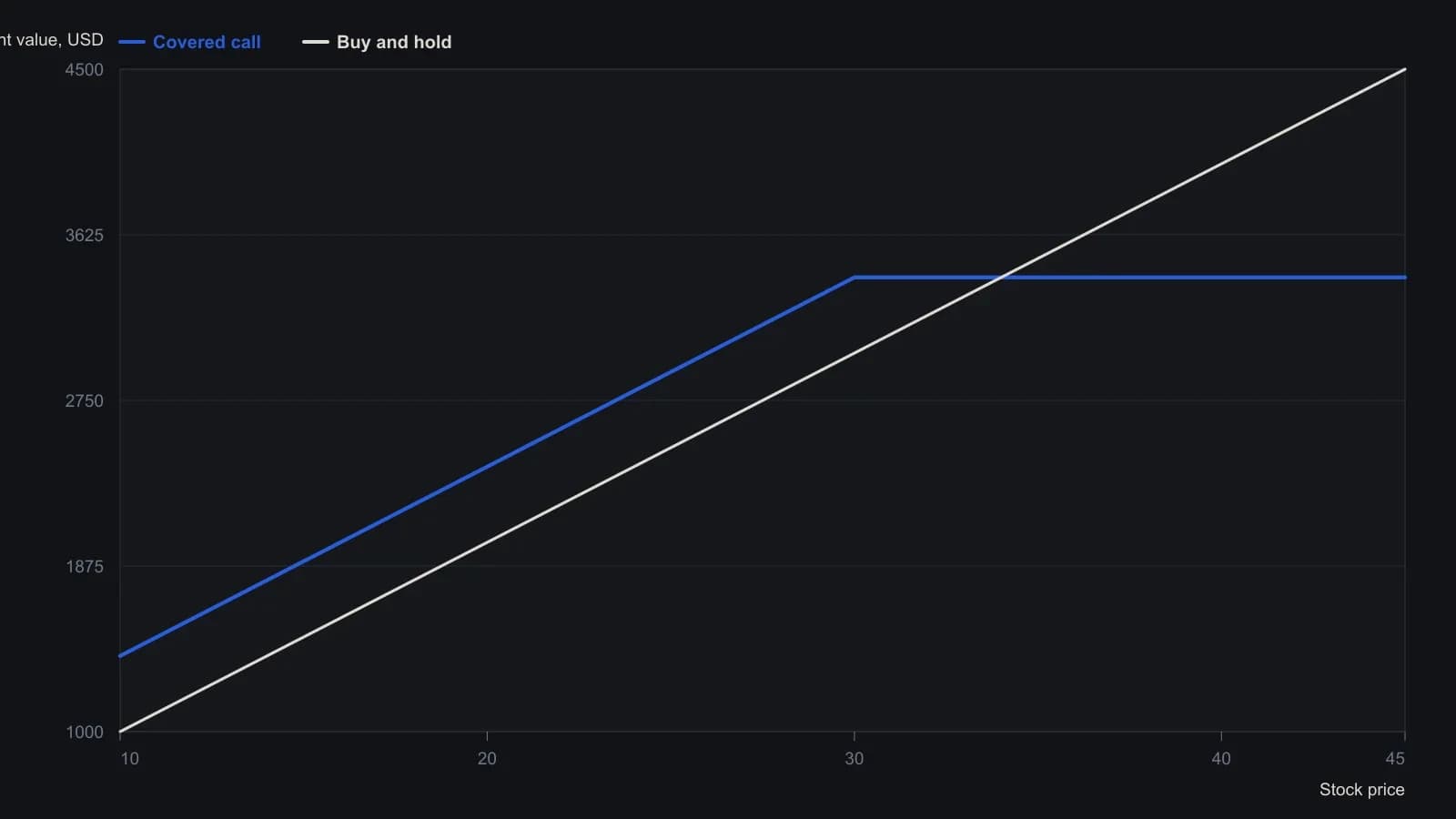
Expiration payoff only. The source fixes 100 XYZ shares at $29 and a January 2004 30-strike call sold for $4; it does not mark the position before expiration.
All readings on this track · 25 readings
- 1995Sequenced covered-call repair after a growth-stock drawdown
- 1996Covered-call writing as income and assignment discipline
- 1997Relative volatility rank for covered-call overlays
- 1997Covered call time, probability, and implied volatility
- 1999Covered-call income when implied volatility is cheap
- 2000Covered-call income and assignment flexibility
- 2002Covered-call expiration rate versus expected value
- 2003Covered-call versus diagonal housing after a single-name drawdown
- 2003Covered-call overlay on a stock portfolio as a payoff case study
- 2003Ratio backspread and covered-call assignment construction
- 2004Covered-call income is not a safety net
- 2006Evaluating consecutive covered calls across market regimes
- 2007A job-first audit of commodity options in a futures book
- 2011Horizon checks on Covered call writing, the risk-reward ratio, and the Relative Strength Index
- 2012From ex-date verticals to leftover buy-writes, and a call backspread that stays net long
- 2013Year-long covered calls on high-yield industrials
- 2014Year-horizon covered calls on Dow yield ranks
- 2014Covered-call premium as a cost-basis cushion
- 2014Monthly buy-write construction with traffic-light exits
- 2017Low-volatility covered calls need a real premium buffer
- 2017Covered-call futures income as one testable procedure
- 2018Partial covered-call overlays at targets, resistance, and rich volatility
- 2019Weekly covered-call writing as a two-book credit-spread case
- 2019Weekly option income as one holding-period case
- 2019Locking long-call profit with a temporary overlay