2006issue C051-3
Evaluating consecutive covered calls across market regimes
A covered-call overlay collects premium while the long holding stays in the book. The archive workflow rolled consecutive at-the-money calls on a broad US equity index and tagged each window as a market regime, so the overlay can be scored against a buy-and-hold benchmark by tenor, strike richness, and context rather than by one all-period average.
- A covered-call overlay is ahead of a buy-and-hold benchmark only while price stays below strike plus received premium. A larger rally leaves it behind because the asset is called away.
- A sharp decline still produces a loss, because the long underlying remains in the book.
- Consecutive one-month and two-month at-the-money calls were rolled as one income process and scored in bull, sideways, and bear windows.
- Editorial view: score the overlay by tenor, strike richness, and market regime rather than treating it as an automatic upgrade to an unoptioned holding.
What a covered-call overlay does
A covered-call overlay holds the underlying and sells a call, aiming to keep the premium when the asset is expected to drift sideways over the option's life. Covered-call writing is a two-legged overlay that keeps the underlying long and sells a call against it, collecting premium while capping upside if the asset is called away.
Relative to a buy-and-hold benchmark, the overlay is ahead only while price stays below strike plus received premium. A larger rally leaves it behind because the asset is called away. A sharp decline still produces a loss, because the long underlying remains in the book.
A repeatable income process
The archive framed successive short calls as one option income strategy: a repeatable entry, rollover, and expiry procedure that turns those calls into one testable income process rather than a one-off trade. Consecutive one-month and two-month at-the-money calls were rolled on a broad US equity index, using the third Friday as the rollover date. An at-the-money call is a sold call whose strike equals the spot price at the rollover date, used here as the primary income strike.
Call prices were reconstructed by feeding historically implied volatility into a Black-Scholes pricer, together with the index dividend yield and matching one- or two-month Treasury rates. The comparison omitted transaction fees.
At expiry, overlay profit equaled the premium compounded over the option's life when the index finished at or above strike. When the index finished below strike, that compounded premium was reduced by the absolute decline.
Read each window as a market regime
A market regime here is a sample window labeled bull, sideways, or bear from the size of the underlying move, so the overlay can be scored by context rather than by one all-period average. The buy-and-hold benchmark is an unoptioned long position in the same underlying, used to judge whether the overlay helped or hurt in a given window.
Whether the harvested premium is large enough
Option premium analysis is a check of whether the harvested call price is large enough, given tenor and moneyness, to offset the upside given up and the declines still borne by the long holding. Calls struck farther out of the money collected a premium that was too small, given that tenor and moneyness, to offset those two costs. The archive applied that check to both one-month and two-month tenors, with the at-the-money call as the primary income strike.
ATM covered-call overlay versus buy-and-hold by market regime, 1970–2004
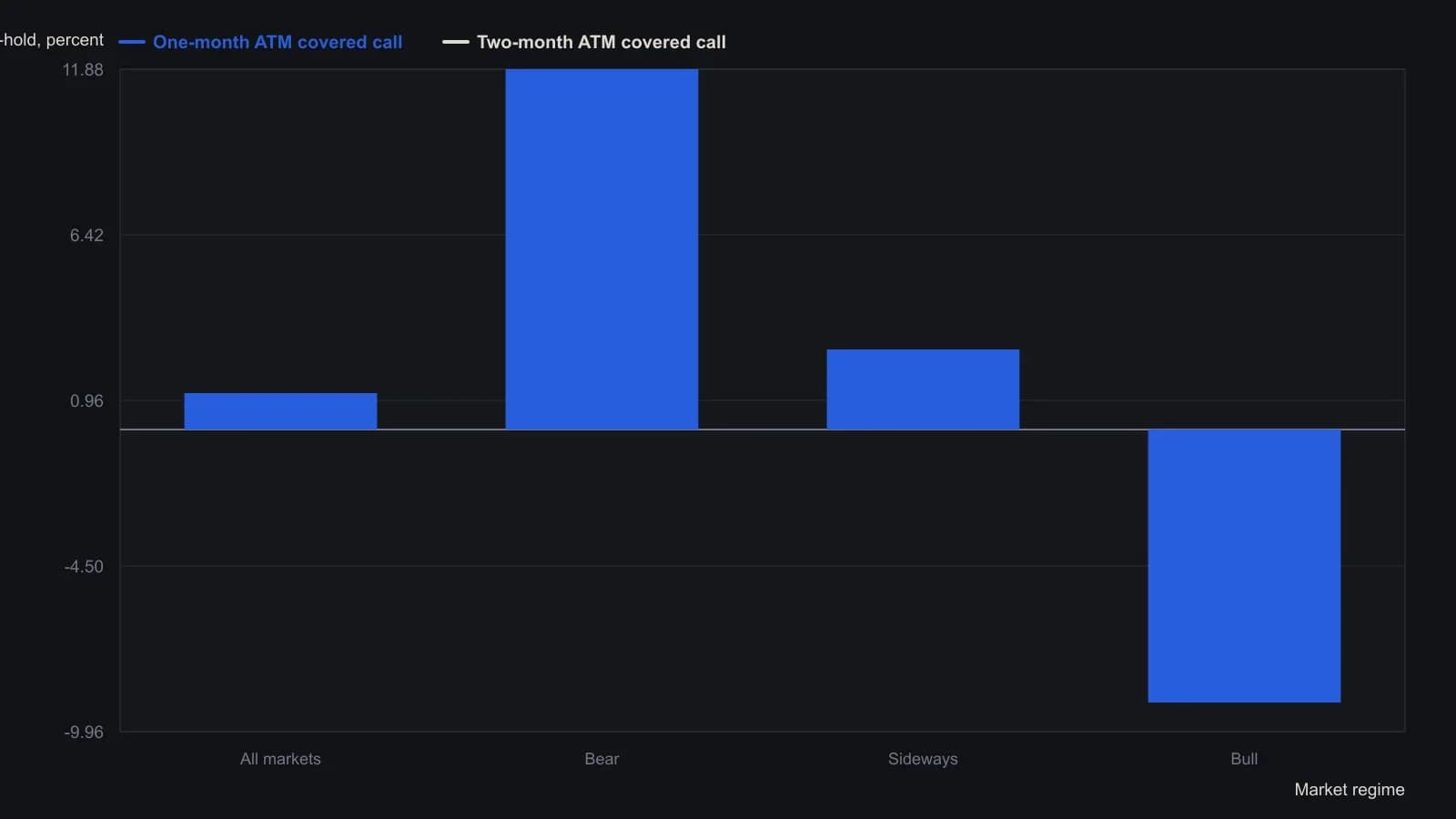
Calls are at-the-money on the S&P 500 and rolled on each third Friday. Bull windows are defined as a rise of 35% or more and bear windows as a decline of at least 15%; all other windows are sideways. Transaction fees are omitted.
All readings on this track · 25 readings
- 1995Sequenced covered-call repair after a growth-stock drawdown
- 1996Covered-call writing as income and assignment discipline
- 1997Relative volatility rank for covered-call overlays
- 1997Covered call time, probability, and implied volatility
- 1999Covered-call income when implied volatility is cheap
- 2000Covered-call income and assignment flexibility
- 2002Covered-call expiration rate versus expected value
- 2003Covered-call versus diagonal housing after a single-name drawdown
- 2003Covered-call overlay on a stock portfolio as a payoff case study
- 2003Ratio backspread and covered-call assignment construction
- 2004Covered-call income is not a safety net
- 2006Evaluating consecutive covered calls across market regimes
- 2007A job-first audit of commodity options in a futures book
- 2011Horizon checks on Covered call writing, the risk-reward ratio, and the Relative Strength Index
- 2012From ex-date verticals to leftover buy-writes, and a call backspread that stays net long
- 2013Year-long covered calls on high-yield industrials
- 2014Year-horizon covered calls on Dow yield ranks
- 2014Covered-call premium as a cost-basis cushion
- 2014Monthly buy-write construction with traffic-light exits
- 2017Low-volatility covered calls need a real premium buffer
- 2017Covered-call futures income as one testable procedure
- 2018Partial covered-call overlays at targets, resistance, and rich volatility
- 2019Weekly covered-call writing as a two-book credit-spread case
- 2019Weekly option income as one holding-period case
- 2019Locking long-call profit with a temporary overlay