2019issue C0328-35
Weekly option income as one holding-period case
A weekly option-income procedure can be examined as one holding-period rule. Covered-call writing and a credit-spread overlay stay attached to the stock path, so entry, exit, and stay-out conditions are judged together.
- The weekly procedure can be applied over a short or longer holding period while the same credit-spread overlay remains in force as the stock path changes.
- Account value is restated as the stock holding plus the collected weekly credit, not as a standalone overlay result.
- An adverse week can leave an unrealized stock loss while the defined credit is retained and the next weekly-serial credit spread is written again.
- A higher stock path can reduce upside capture in the underlying, while the credit on the weekly spread remains defined in advance.
What the case examines
The source presents a weekly option-income procedure that can be applied over either a short or longer holding period, with the same credit-spread overlay remaining in force as the stock path changes.
An option-income strategy is a procedure that repeatedly sells option premium to generate income while the underlying position remains in force. Covered-call writing sells calls against a long stock holding so that collected premium is evaluated with the stock path, not as a standalone trade.
An option spread is a defined-risk combination of long and short options used to collect or limit premium around a price band. A credit spread is a short option paired with a further-out long option so the net credit is bounded by a defined maximum loss.
The weekly serial is an options expiration that settles on a weekly cycle and is rolled or replaced as part of the income procedure. The holding-period rule is the joint entry, exit, and stay-out conditions that define one complete cycle of the income system.
Alphabet class C (GOOG) daily closes through 2018
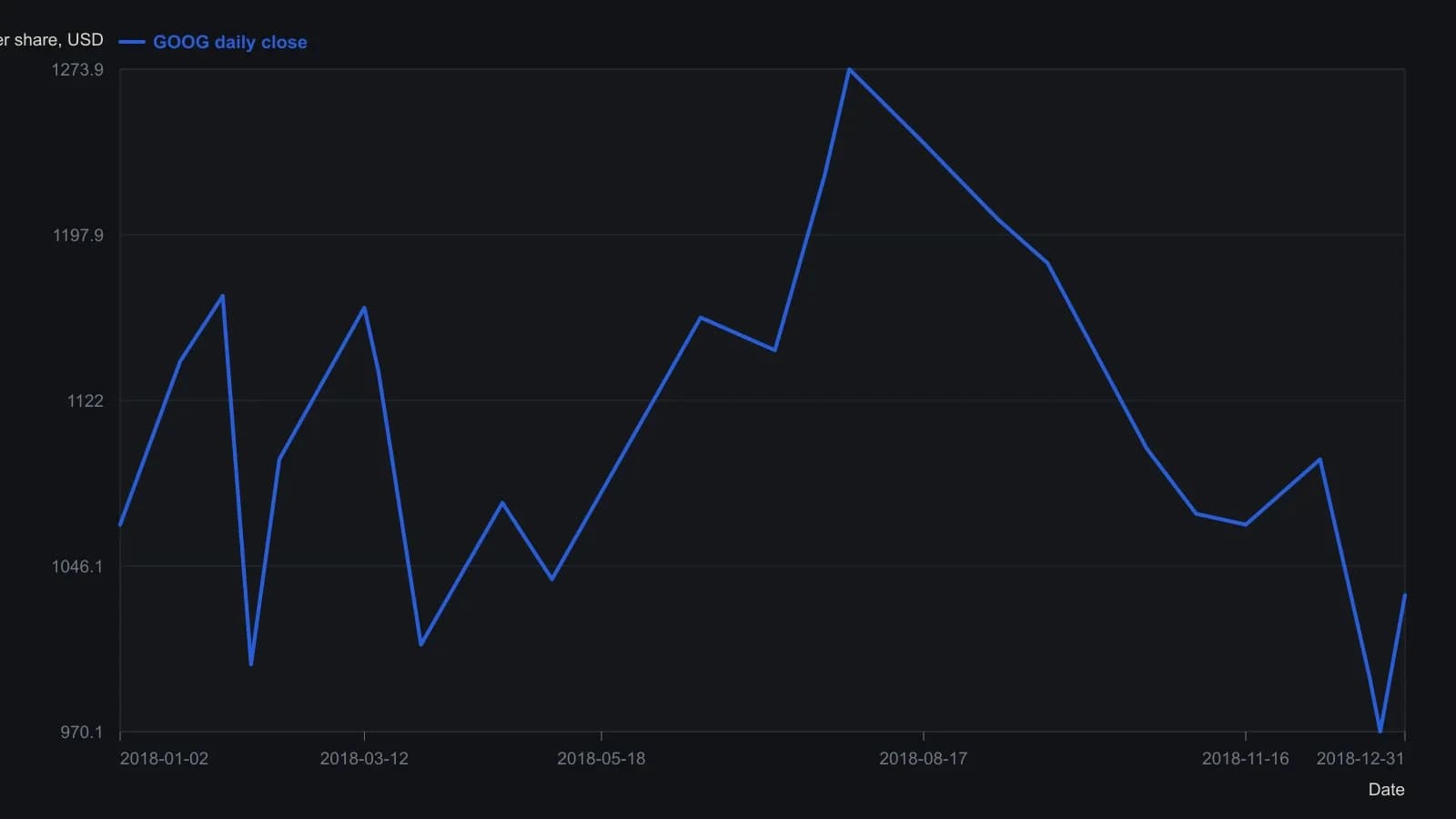
Digitized closes are rounded to the nearest five dollars except where the article or the chart prints an exact figure. Volume and on-balance volume appear in lower panes on the same figure, but their vertical scales are only partly numbered, so those series were not converted.
How the opening credit is restated
One worked path shows a call credit spread initiated for a credit of about 5.90 against a stock holding. Account value is then restated as 31500 plus 590, or 32090.
That restatement keeps the weekly credit attached to the stock holding for the same cycle of the income procedure.
An adverse week on the same overlay
In a subsequent adverse path the stock is described as falling by about 5 percent, or 15 points, to 305. That leaves an unrealized stock loss of 1500 while the 590 credit is retained.
The next week's 305.0 to 320.0 call credit spread is again initiated around 5.90. After that adverse week the source restates total account value as 30500 plus 590, or 31090, and labels the net change a 910 loss.
The same credit-spread overlay remains in force as the stock path changes. The weekly serial is replaced as part of the income procedure rather than closed as a separate trade.
Upside capture and the defined credit
The teaching point of the overlay is that a higher stock path can reduce upside capture in the underlying while the credit collected on the weekly spread remains defined in advance.
The procedure can be applied over a short or longer holding period. In either case the overlay is still read against the stock path at the end of the cycle.
All readings on this track · 25 readings
- 1995Sequenced covered-call repair after a growth-stock drawdown
- 1996Covered-call writing as income and assignment discipline
- 1997Relative volatility rank for covered-call overlays
- 1997Covered call time, probability, and implied volatility
- 1999Covered-call income when implied volatility is cheap
- 2000Covered-call income and assignment flexibility
- 2002Covered-call expiration rate versus expected value
- 2003Covered-call versus diagonal housing after a single-name drawdown
- 2003Covered-call overlay on a stock portfolio as a payoff case study
- 2003Ratio backspread and covered-call assignment construction
- 2004Covered-call income is not a safety net
- 2006Evaluating consecutive covered calls across market regimes
- 2007A job-first audit of commodity options in a futures book
- 2011Horizon checks on Covered call writing, the risk-reward ratio, and the Relative Strength Index
- 2012From ex-date verticals to leftover buy-writes, and a call backspread that stays net long
- 2013Year-long covered calls on high-yield industrials
- 2014Year-horizon covered calls on Dow yield ranks
- 2014Covered-call premium as a cost-basis cushion
- 2014Monthly buy-write construction with traffic-light exits
- 2017Low-volatility covered calls need a real premium buffer
- 2017Covered-call futures income as one testable procedure
- 2018Partial covered-call overlays at targets, resistance, and rich volatility
- 2019Weekly covered-call writing as a two-book credit-spread case
- 2019Weekly option income as one holding-period case
- 2019Locking long-call profit with a temporary overlay