2019issue C0424-25
Locking long-call profit with a temporary overlay
After SLV rose from 13.63 to 14.75, eight April 2019 14-strike calls showed an open gain of 456 and still risked giving back that gain plus the original 464 debit. The archive then writes eight April 15 calls, later buys them back, and trims the long sleeve.
- A profitable long-call book can still give back both its open gain and its original debit if it is left unadjusted.
- Covered-call-writing against that book can turn the worst remaining outcome into a locked-in profit, while capping further upside.
- When the short calls cheapen after a pullback and a drop in implied volatility, buying them back and cutting part of the long sleeve can restore unlimited upside and raise the worst-case minimum profit.
- The option-income-strategy treats the overlay and the later unwind as one procedure, with the risk-reward-ratio used as a filter before each adjustment.
In the worked example, eight April 2019 14-strike SLV calls were opened with the underlying near 13.62. The 464 debit was both the cost and the maximum loss. The book had 136 days left to expiration and still had unlimited upside.
Thirty days later the underlying had risen from 13.63 to 14.75. The same long-call book showed an open gain of 456. It remained exposed to giving back that gain and the original 464 debit.
The first adjustment
Selling eight April 15 calls against the long 14s limited further upside to 816. It converted the worst outcome into a locked-in profit of 18. Position-delta was left near 184, described as roughly equivalent to 184 shares.
That covered-call-writing step placed the single position in a temporary, more defensive payoff. The archive presents writing the out-of-the-money calls as a way to reduce remaining risk and stay through a short-term pullback.
Retiring the overlay
Twenty days after that overlay, SLV had slipped from 14.75 to 14.42. Implied volatility on the short 15-strike calls had fallen from about 21 percent to about 17 percent, and those short calls had cheapened from 0.60 to 0.28.
Buying back the eight short 15-strike calls and selling four of the original long 14-strike calls restored unlimited upside. The worst-case minimum profit rose to 84, and position-delta increased to about 273. The cheaper buyback of the shorts is presented as intended to improve the original book's reward-to-risk profile.
One procedure, not two trades
The sequence is framed as an alternative to flattening a profitable long-call book when a near-term pullback is feared but the longer-term upside thesis is still held. Under the option-income-strategy, selling premium against the existing book, holding the overlay, and later unwinding it belong to one procedure rather than to separate discretionary decisions.
Before each adjustment, the risk-reward-ratio is the remaining upside versus remaining downside on the live book. That filter is used so a feared pullback cannot return the trade to a full original loss.
SLV April 14/15 overlay payoff at expiration
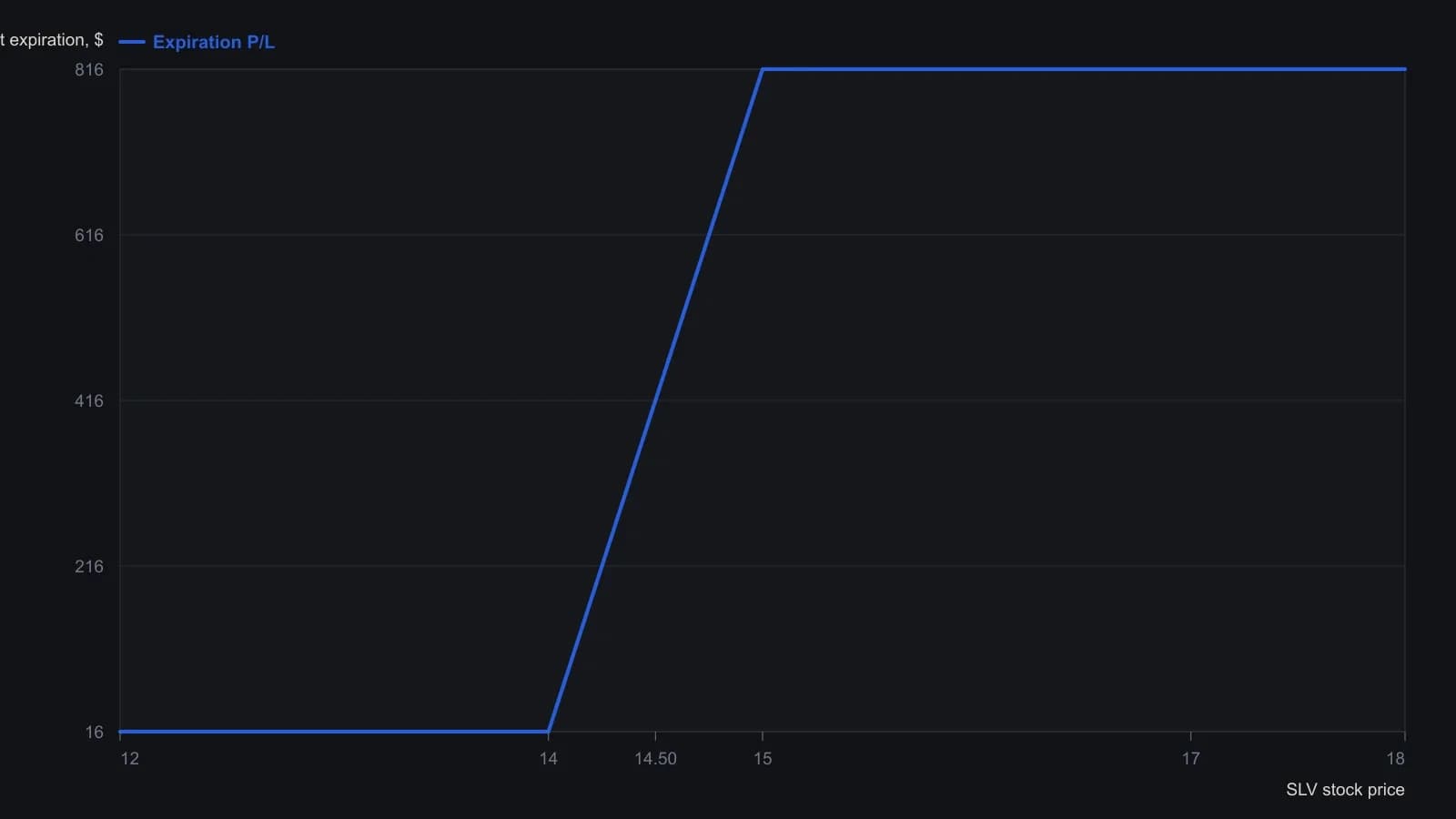
Expiration payoff only. The companion risk graph also plots 105-, 70- and 35-day marks; those live curves are not in the table and are omitted.
All readings on this track · 25 readings
- 1995Sequenced covered-call repair after a growth-stock drawdown
- 1996Covered-call writing as income and assignment discipline
- 1997Relative volatility rank for covered-call overlays
- 1997Covered call time, probability, and implied volatility
- 1999Covered-call income when implied volatility is cheap
- 2000Covered-call income and assignment flexibility
- 2002Covered-call expiration rate versus expected value
- 2003Covered-call versus diagonal housing after a single-name drawdown
- 2003Covered-call overlay on a stock portfolio as a payoff case study
- 2003Ratio backspread and covered-call assignment construction
- 2004Covered-call income is not a safety net
- 2006Evaluating consecutive covered calls across market regimes
- 2007A job-first audit of commodity options in a futures book
- 2011Horizon checks on Covered call writing, the risk-reward ratio, and the Relative Strength Index
- 2012From ex-date verticals to leftover buy-writes, and a call backspread that stays net long
- 2013Year-long covered calls on high-yield industrials
- 2014Year-horizon covered calls on Dow yield ranks
- 2014Covered-call premium as a cost-basis cushion
- 2014Monthly buy-write construction with traffic-light exits
- 2017Low-volatility covered calls need a real premium buffer
- 2017Covered-call futures income as one testable procedure
- 2018Partial covered-call overlays at targets, resistance, and rich volatility
- 2019Weekly covered-call writing as a two-book credit-spread case
- 2019Weekly option income as one holding-period case
- 2019Locking long-call profit with a temporary overlay