1996issue C031-7
Covered-call writing as income and assignment discipline
A covered-call-write pairs a long equity or futures position with a short call on the same underlying. The archive treated collected option-premium as income that produces basis-reduction, and it treated assignment as the duty to deliver the held issue. Editorial reading: premium, buffer, assignment, and the duty to stay long are one holding-period procedure, not free add-on yield.
- A call write is covered only when ownership of the underlying offsets it. A sale without that long is a naked-write and is compared to a short sale.
- Option-premium collected at sale is treated as income that produces basis-reduction and a defined downside buffer. Assignment still requires delivery of the held shares or futures.
- The write is called conservative only for holders who can accept assignment and remain with a losing long if price falls below the collected premium.
- Editorial reading: treat premium, basis-reduction, assignment, and the duty to stay long as one holding-period procedure, not as free add-on yield.
Listed options and a covered write
Exchange-listed calls and puts trade in a public market and can be transferred. Over-the-counter options are privately negotiated and typically are not passed on.
A covered-call-write is a long equity or futures position paired with a short call struck above the current price of that same underlying. The write is covered only when it is offset by ownership of the underlying. A write without that long is a naked-write and is compared to a short sale.
Option-premium is the market price of an option. It is set by conventional bid and offer and is described as reflecting underlying price, volatility, interest rates, and remaining life.
A purchased option is framed as a wasting right that can expire worthless if the strike is not reached. The writer is obligated to perform if the holder exercises.
Income, basis-reduction, and assignment
If a covered call expires unexercised, the writer keeps the premium and the long position. If the call is exercised, assignment requires the writer to deliver the held shares or futures.
Premium collected at sale is treated as income that lowers the effective basis of the long position. That basis-reduction supplies a defined downside buffer.
A worked equity example estimated expected yield as the average of the worthless-expiration path and the assignment path, because one of those terminal outcomes must occur.
Premium comparisons across issues and months
Cross-issue comparisons treated richer premiums as a volatility effect. Nearer months were treated as higher annualized yields with lower assignment odds.
Near-month-annualization converts a short-horizon premium outcome into a yearly rate. That conversion makes nearer expirations look larger than later ones with similar cash premium.
Dividends were given as a reason some equity calls look cheap relative to owning the stock.
Futures covered writes were presented as lower-yield versions of the same income-and-buffer idea. That reading applied only if the writer keeps the futures long through expiration and accepts a hard cap if the contract rallies through the strike.
Annualized yield on seven covered-call writes
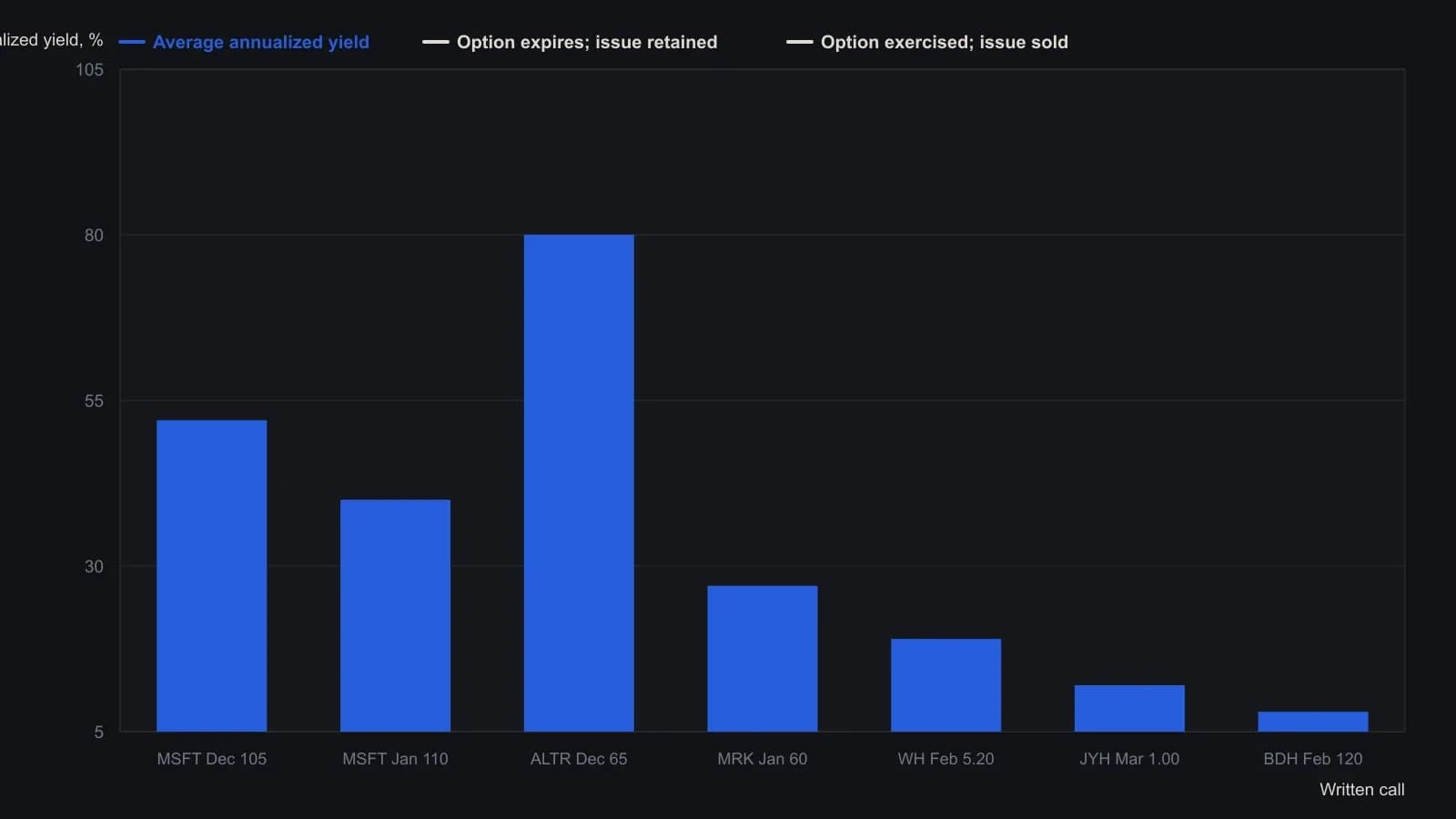
Each yield is annualized from 8 November 1995 to that option's expiration. Average annualized yield is the unweighted mean of the expire-worthless and assigned outcomes; the source does not assign probabilities to those two states.
When the write is called conservative
The write is characterized as conservative only for holders who can accept assignment and sit with a losing long if price falls below the collected premium.
American-style-exercise lets the holder exercise on any day before expiration rather than only at expiry. Early exercise can still interrupt a planned rewrite. That flexibility is given as a reason American-style premium exceeds European-style premium.
Editorial: the archive workflow is a duty to remain long through the holding period, including after a losing move that stays inside the collected premium, and including the hard cap if the underlying is called away.
All readings on this track · 25 readings
- 1995Sequenced covered-call repair after a growth-stock drawdown
- 1996Covered-call writing as income and assignment discipline
- 1997Relative volatility rank for covered-call overlays
- 1997Covered call time, probability, and implied volatility
- 1999Covered-call income when implied volatility is cheap
- 2000Covered-call income and assignment flexibility
- 2002Covered-call expiration rate versus expected value
- 2003Covered-call versus diagonal housing after a single-name drawdown
- 2003Covered-call overlay on a stock portfolio as a payoff case study
- 2003Ratio backspread and covered-call assignment construction
- 2004Covered-call income is not a safety net
- 2006Evaluating consecutive covered calls across market regimes
- 2007A job-first audit of commodity options in a futures book
- 2011Horizon checks on Covered call writing, the risk-reward ratio, and the Relative Strength Index
- 2012From ex-date verticals to leftover buy-writes, and a call backspread that stays net long
- 2013Year-long covered calls on high-yield industrials
- 2014Year-horizon covered calls on Dow yield ranks
- 2014Covered-call premium as a cost-basis cushion
- 2014Monthly buy-write construction with traffic-light exits
- 2017Low-volatility covered calls need a real premium buffer
- 2017Covered-call futures income as one testable procedure
- 2018Partial covered-call overlays at targets, resistance, and rich volatility
- 2019Weekly covered-call writing as a two-book credit-spread case
- 2019Weekly option income as one holding-period case
- 2019Locking long-call profit with a temporary overlay