2014issue C1232-37
Monthly buy-write construction with traffic-light exits
A historical covered-call book commits capital only at a monthly decision-time, ranks each buy-write by annualized-return-at-assignment and protection-level, and uses green, yellow, and red exit-conditions to rewrite, recover, or replace names.
- New capital is committed only at the monthly weekend decision-time after the third Friday, weekly priority-screen results feed that gate, and every commitment is a stock-plus-short-call buy-write.
- Strikes must clear more than 10 percent annualized-return-at-assignment, the kept strike is the one with the largest protection-level, and available cash is allocated to the highest cushions first.
- Tenor follows a three-then-four-then-two-month expiration-ladder and is then shifted so expiration is not too close to an ex-dividend date.
- Green, yellow, and red exit-conditions decide whether to rewrite the last-green-strike, place a recovery-overlay, or sell a name that fails the priority-screen and fund a new buy-write.
A monthly operating book
The archive describes covered-call construction as a repeating monthly book, not a single standalone trade. Each holding is a buy-write: a long stock position paired with a short call and treated as one holding. Weekly results from a priority-screen feed one monthly decision-time, when new or replacement buy-writes are chosen.
The calendar gate
New capital is committed only at monthly weekend decision-times after the third Friday. Weekly screens feed those decisions, and every commitment is a stock-plus-short-call buy-write. The decision-time is the weekend after the third Friday of each month.
Book size after the priority-screen
Initial sizing uses a floor of 25000 currency units per buy-write and at least four names. Those names come after a selective screen that typically leaves fewer than ten priority candidates. The priority-screen is a selective weekly filter meant to keep names judged unlikely to fall substantially.
Strike, tenor and cash order
Call tenor is chosen on the expiration-ladder. The preference is three-month first, then four-month, then two-month. The chosen expiration is then shifted so it is not too close to an ex-dividend date.
Among strikes that produce more than 10 percent annualized-return-at-assignment, construction keeps the strike that maximizes the percent cushion from purchase price down to that strike. Available cash is allocated to the highest cushions first.
Annualized-return-at-assignment is the percent profit if the short call is assigned, scaled by 365 over days held, then increased by the annual dividend when one is assumed. Protection-level is the percent the stock can fall from purchase price to the chosen strike while the assignment-return target is still met.
Worked construction examples
In a worked example, a 35.12 purchase assigned at 36 after 91 days is 2.51 percent unannualized and 10.05 percent annualized. A 1.28 percent dividend lifts that annualized figure to 11.33 percent.
In a second worked example, a 37.50 purchase against a 36 strike implies a 4.0 percent protection cushion.
Green, yellow and red labels
At each decision-time a holding is labeled green if price is above the short-call strike, yellow if price has fallen modestly below that strike, and red if the decline is treated as substantial. That label is the exit-condition. It is assigned from price versus strike and from remaining assignment return.
The last-green-strike is the strike last set when the holding started or exited in the green state. Later yellow rewrites reuse this strike. If price is below the last-green-strike, the name stays yellow and that same strike is rewritten only when the best annualized assignment return across the next four expirations exceeds 5 percent. Otherwise the name is labeled red.
When a recovery-overlay is used
A broad-market drop of more than 15 percent over three months is treated as a major-market event, distinct from a 10 percent move treated as ordinary. Recovery construction then uses a recovery-overlay: a one-month short call struck 3.145 percent above the current stock price.
If that 15 percent three-month market drop has not occurred, a red name that still passes the priority-screen is kept on recovery rules. A name that fails the screen is sold and the cash funds a new screened buy-write.
S&P 500 annualized recovery after 15% three-month declines
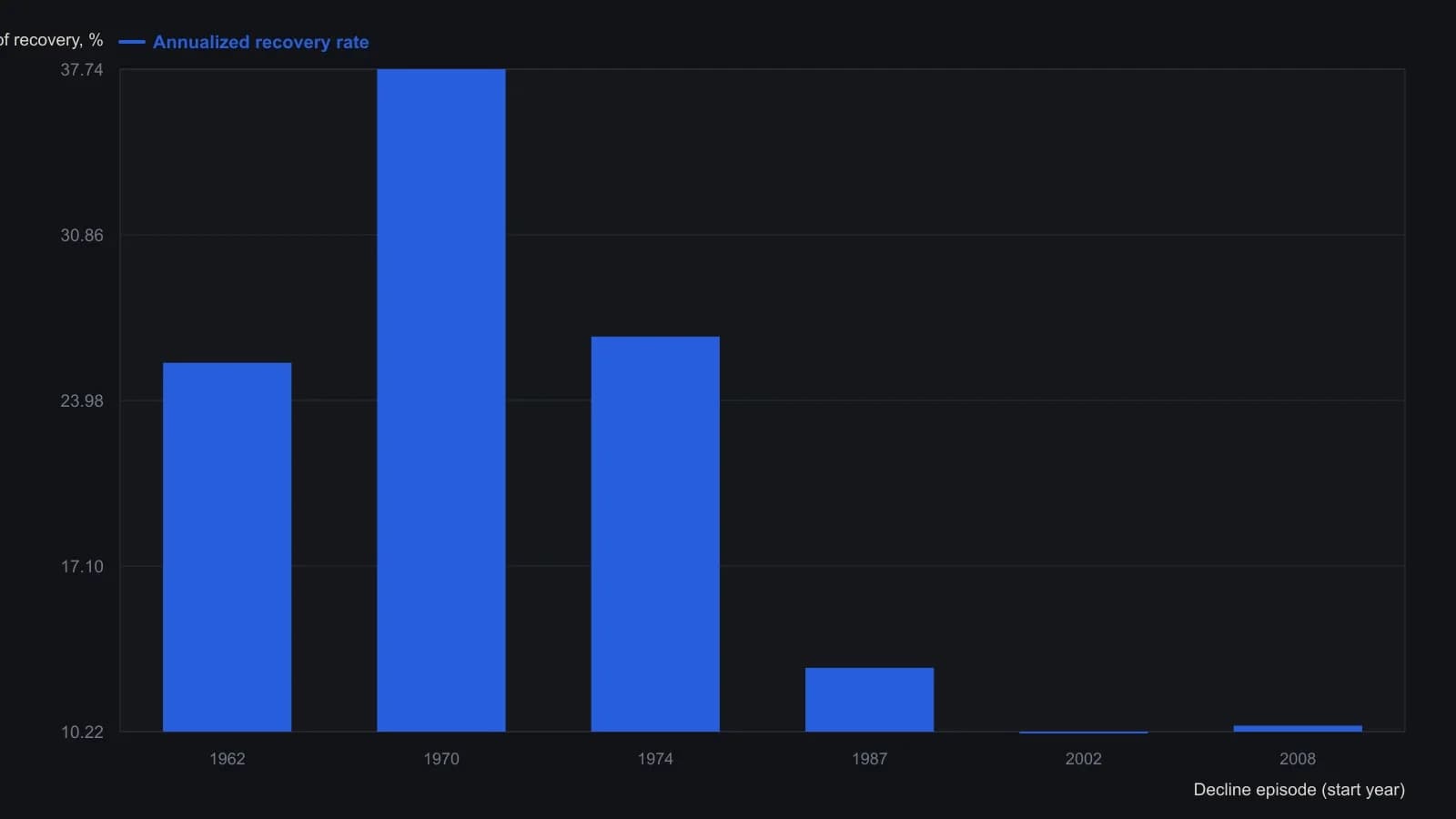
A major decline is defined as more than 15 percent in three months; a 10 percent correction is treated as normal. Recovery months run from the bottom date to the breakeven date. Printed annualized rates equal twelve times the monthly rate, not a compound annual growth rate.
All readings on this track · 25 readings
- 1995Sequenced covered-call repair after a growth-stock drawdown
- 1996Covered-call writing as income and assignment discipline
- 1997Relative volatility rank for covered-call overlays
- 1997Covered call time, probability, and implied volatility
- 1999Covered-call income when implied volatility is cheap
- 2000Covered-call income and assignment flexibility
- 2002Covered-call expiration rate versus expected value
- 2003Covered-call versus diagonal housing after a single-name drawdown
- 2003Covered-call overlay on a stock portfolio as a payoff case study
- 2003Ratio backspread and covered-call assignment construction
- 2004Covered-call income is not a safety net
- 2006Evaluating consecutive covered calls across market regimes
- 2007A job-first audit of commodity options in a futures book
- 2011Horizon checks on Covered call writing, the risk-reward ratio, and the Relative Strength Index
- 2012From ex-date verticals to leftover buy-writes, and a call backspread that stays net long
- 2013Year-long covered calls on high-yield industrials
- 2014Year-horizon covered calls on Dow yield ranks
- 2014Covered-call premium as a cost-basis cushion
- 2014Monthly buy-write construction with traffic-light exits
- 2017Low-volatility covered calls need a real premium buffer
- 2017Covered-call futures income as one testable procedure
- 2018Partial covered-call overlays at targets, resistance, and rich volatility
- 2019Weekly covered-call writing as a two-book credit-spread case
- 2019Weekly option income as one holding-period case
- 2019Locking long-call profit with a temporary overlay