1997issue C121-4
Covered call time, probability, and implied volatility
A 1998 archive case treats covered call writing as a short-horizon check. Implied volatility analysis and remaining calendar time produce a finish probability, and option premium analysis asks whether that overlay still belongs against owned shares.
- A short-horizon formula using remaining time, strike, spot, interest rate, and implied volatility can estimate the chance a call finishes in the money before the next expiration window.
- Selling out-of-the-money call premium against owned shares was presented as typically favoring the seller about two-thirds of the time, with about a one-third chance the stock would be called away.
- Lengthening the Dell horizon to January 1998 raised the estimated 75-strike call probability, so calendar time is part of the same check as implied volatility.
- Maximum hedge effect was described as covering half the position about two weeks before expiration and the remainder on a price surge, with further out-of-the-money calls, buy stops, or closing the option as follow-ups.
Time and probability around a covered call
A short-horizon probability formula using remaining time to expiration, strike, spot, interest rate, and implied volatility can estimate the chance a call finishes in the money before the next expiration window.
Covered call writing in the archive placed that estimate on out-of-the-money call premium sold against owned shares. Implied volatility analysis supplied the volatility input. Option premium analysis used the resulting finish chance as context for keeping the overlay.
Archive context for selling premium
Selling out-of-the-money call premium against owned shares was presented as typically favoring the seller about two-thirds of the time, with about a one-third chance the stock would be called away.
Clearing-house economists were cited as reporting that, on average, 67 percent of options expire at zero or at a loss, used as supporting context for selling out-of-the-money premium.
The February 1997 Dell worksheets
In a February 1997 Dell example, February 75 calls were sold for one-half to three-quarters while the stock was in the mid-60s, using 55 percent implied volatility and a 0.07 interest rate with about 0.0493 of a year remaining.
The same Dell February 75 setup produced an estimated 14 percent probability in the first worksheet and a 31.30 percent call probability at a 66 spot, implying a 68.7 percent chance of collecting premium while keeping the shares.
The path into expiration
Despite a surge to 76 on February 19, 1997 that lifted the option to 1 3/4, Dell closed at 71 1/8 on February 21 and the 75 call expired worthless.
What a longer window did to the odds
Lengthening the horizon to January 16, 1998 with Dell at 66 and a 75 strike raised the estimated call probability to 40.34 percent, while a two-week window at 71 still showed 38.26 percent.
A tabulated short-horizon case with Dell at 71, 15 days to a 75 strike, 40 percent implied volatility, and a 0.07 rate estimated a 38.26 percent call probability and a 61.74 percent put probability.
Dell 75-call finish probability at 18 versus 280 days
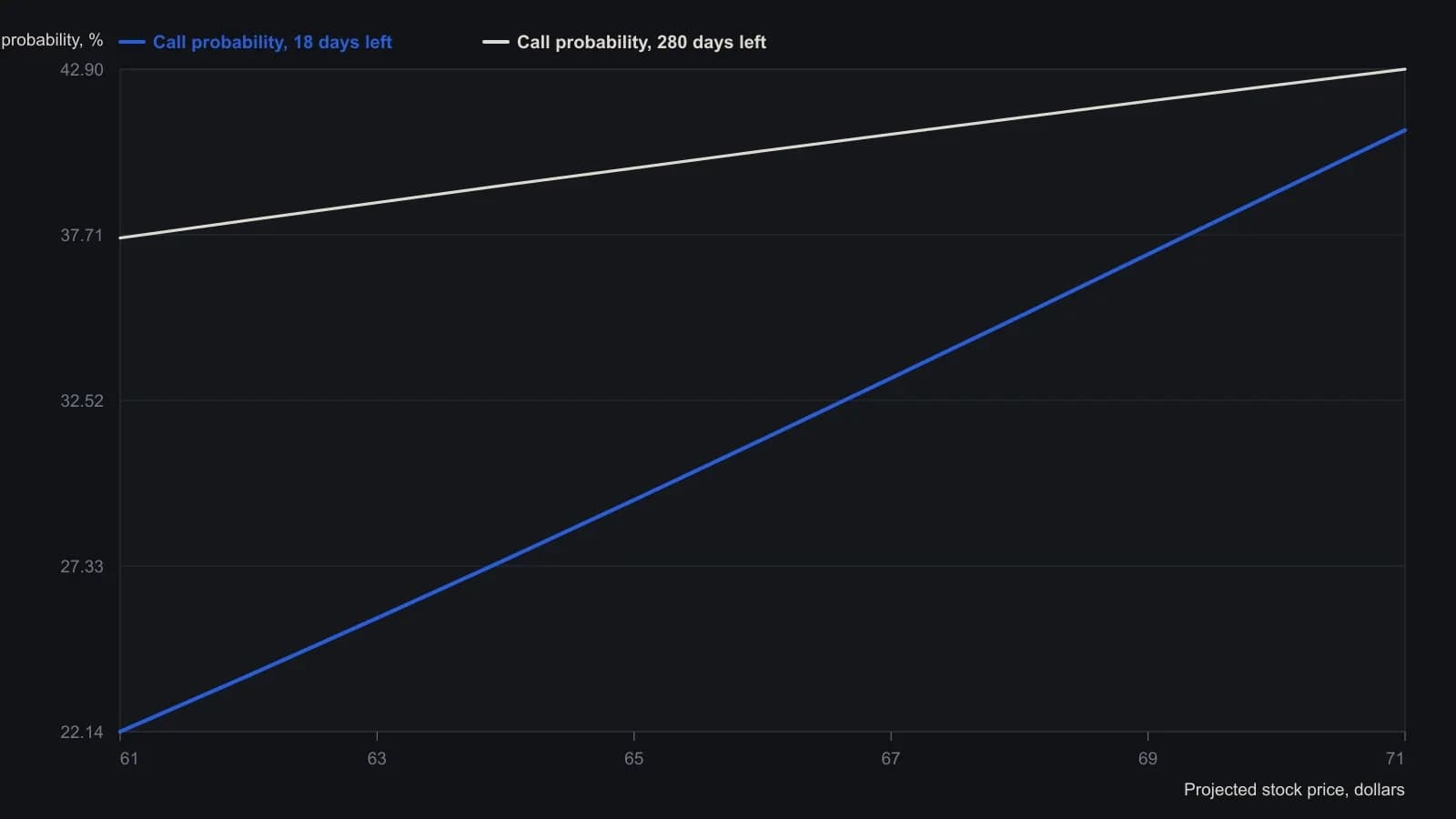
Both worksheets fix the 75 strike, 55 percent implied volatility, a 7 percent risk-free rate, a 66 dollar Dell spot, and zero dividends. Only time to expiration changes.
Follow-up controls on the overlay
Maximum hedge effect was described as covering half the position about two weeks before expiration and the remainder on a price surge, with further out-of-the-money calls, buy stops, or closing the option used as follow-up controls.
All readings on this track · 25 readings
- 1995Sequenced covered-call repair after a growth-stock drawdown
- 1996Covered-call writing as income and assignment discipline
- 1997Relative volatility rank for covered-call overlays
- 1997Covered call time, probability, and implied volatility
- 1999Covered-call income when implied volatility is cheap
- 2000Covered-call income and assignment flexibility
- 2002Covered-call expiration rate versus expected value
- 2003Covered-call versus diagonal housing after a single-name drawdown
- 2003Covered-call overlay on a stock portfolio as a payoff case study
- 2003Ratio backspread and covered-call assignment construction
- 2004Covered-call income is not a safety net
- 2006Evaluating consecutive covered calls across market regimes
- 2007A job-first audit of commodity options in a futures book
- 2011Horizon checks on Covered call writing, the risk-reward ratio, and the Relative Strength Index
- 2012From ex-date verticals to leftover buy-writes, and a call backspread that stays net long
- 2013Year-long covered calls on high-yield industrials
- 2014Year-horizon covered calls on Dow yield ranks
- 2014Covered-call premium as a cost-basis cushion
- 2014Monthly buy-write construction with traffic-light exits
- 2017Low-volatility covered calls need a real premium buffer
- 2017Covered-call futures income as one testable procedure
- 2018Partial covered-call overlays at targets, resistance, and rich volatility
- 2019Weekly covered-call writing as a two-book credit-spread case
- 2019Weekly option income as one holding-period case
- 2019Locking long-call profit with a temporary overlay