2004issue C021-4
Covered-call income is not a safety net
A covered call is long stock plus a short call, and the leftover payoff matches a naked short put. Editorial reading: collected premium is a volatility and price-level overlay, and a stop-loss, not the word covered, is what bounds residual share risk.
- Covered-call writing means owning the shares and selling a call so assignment can be met with stock already held. Covered does not mean downside is hedged.
- The covered-call payoff matches a naked short put, so leftover risk is still a large stock decline minus the premium received.
- Option income is treated as a rising-market overlay that needs a viable market regime, richer implied volatility, and a share-price location filter.
- The close-out rule is to stand aside when the regime breaks and to keep a precommitted stop-loss so leftover share risk cannot erase the account.
What covered means
Covered-call writing is owning the underlying shares and selling a call against them so assignment can be met with stock already held. The call buyer may take the shares at the strike. The writer is covered only because those shares are already held.
An option-income strategy is a rules-based overlay that treats collected call premium as an intended return stream over a defined holding period. Market regime is the trend and volatility backdrop that decides whether that overlay is even viable.
The leftover payoff matches a short put
The covered-call payoff is drawn as the same risk curve as a naked short put. Naked-put equivalence is the observation that a covered call's payoff matches a short put, so downside is not structurally hedged. Leftover downside is still a large stock decline minus the premium received.
A rising-market overlay can fail in a break
The overlay is treated as mainly a rising-market tactic. Late-1990s writers booked both share gains and call premium, then saw the same overlay fail to offset the sharp post-spring-2000 declines.
A rolling plan that buys back cheaper short calls and rewrites lower assumed every dip would be bought. After spring 2000, many technology declines were too large and too fast for that roll to keep pace.
Volatility and price level as filters
A market-volatility screen uses a VIX band near 20 on the low side and 30 on the high side. Implied volatility is the options-implied estimate of future movement that, with calendar time, sets most of an option's time value. Richer implied volatility is what fattens option time value for the writer.
At the time of writing, VIX sat at 17.39 after a two-week-earlier spike to 26. That reading was treated as a short-term peak versus the prior six months rather than a requirement that VIX equal 30.
Share-price selection is used as a risk filter. Issues bought near 10 to 20 are said to leave less capital at risk than names above 100, because dollar drawdowns accrue more slowly and are easier to bound.
The August 7, 2003 illustration longs stock at 20.55 and sells a September 22.50 call at 1.10, stating residual risk as 20.55 minus 1.10, or 19.45 (1,945 per unit). That illustration locates the write after a successful retest of a long-built base near 10 and support near 20, treating location, not premium size, as the entry filter.
A stop, not coverage, bounds residual risk
A stop-loss is a precommitted bound or full exit that caps residual share risk after the premium credit is booked. The close-out rule is to exit and stand aside when the regime breaks, and to keep defined risk plus a precommitted money-management stop so leftover share risk cannot erase the account.
Editorial reading: the word covered does not bound residual share risk. The stop-loss does.
Broadcom weekly price and the $20.24 support
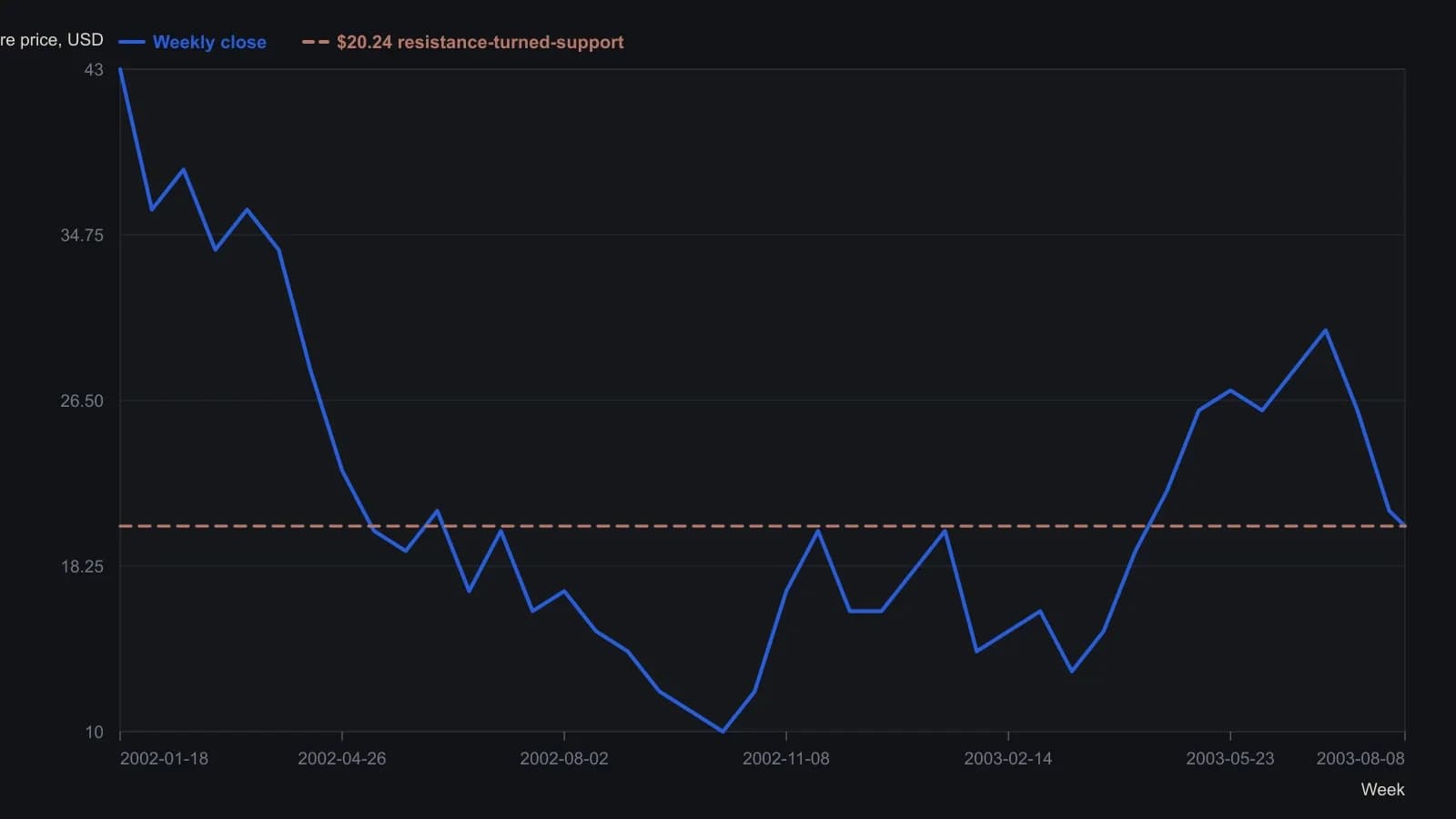
Closes were read off weekly candlesticks and are approximate to about one dollar, except the 20.24 last print labeled on the source chart.
All readings on this track · 25 readings
- 1995Sequenced covered-call repair after a growth-stock drawdown
- 1996Covered-call writing as income and assignment discipline
- 1997Relative volatility rank for covered-call overlays
- 1997Covered call time, probability, and implied volatility
- 1999Covered-call income when implied volatility is cheap
- 2000Covered-call income and assignment flexibility
- 2002Covered-call expiration rate versus expected value
- 2003Covered-call versus diagonal housing after a single-name drawdown
- 2003Covered-call overlay on a stock portfolio as a payoff case study
- 2003Ratio backspread and covered-call assignment construction
- 2004Covered-call income is not a safety net
- 2006Evaluating consecutive covered calls across market regimes
- 2007A job-first audit of commodity options in a futures book
- 2011Horizon checks on Covered call writing, the risk-reward ratio, and the Relative Strength Index
- 2012From ex-date verticals to leftover buy-writes, and a call backspread that stays net long
- 2013Year-long covered calls on high-yield industrials
- 2014Year-horizon covered calls on Dow yield ranks
- 2014Covered-call premium as a cost-basis cushion
- 2014Monthly buy-write construction with traffic-light exits
- 2017Low-volatility covered calls need a real premium buffer
- 2017Covered-call futures income as one testable procedure
- 2018Partial covered-call overlays at targets, resistance, and rich volatility
- 2019Weekly covered-call writing as a two-book credit-spread case
- 2019Weekly option income as one holding-period case
- 2019Locking long-call profit with a temporary overlay