1995issue C051-7
Sequenced covered-call repair after a growth-stock drawdown
A long stock book is overlaid, then repaired, after a policy-rate selloff takes the shares well through the first short strike. Editorial reading: each write, split, ratio, or roll is an option-income step scored by option-premium analysis as a change in net basis, remaining shares, and residual exposure.
- Covered-call writing sells calls against a long stock holding so collected premium lowers net basis and supplies a limited cushion if the shares fall.
- An option-income strategy writes, splits, ratios, or rolls short calls while the long remains open, instead of treating the first overlay as a finished hedge.
- Option-premium analysis splits a call price into intrinsic value and time value, then chooses expiry and moneyness to size that time value against assignment and residual delta.
- A split-strike overlay can shrink inventory through the lower strike, while ratio-writing leaves uncovered shorts that need an explicit cover rule.
A repair sequence, not a one-time hedge
This archive case follows one long stock book through a sequence of short-call overlays after a broad selloff. Editorial reading: covered-call writing is taught here as a multi-step option-income strategy, a repeatable overlay that writes, splits, ratios, or rolls short calls to harvest premium while the long remains open.
Covered-call writing means selling calls against a long stock holding so collected premium lowers net basis and supplies a limited cushion if the shares fall. Net basis is the purchase price of the shares minus cumulative net premiums, used as the overlaid book’s breakeven.
The opening covered write
The case opened by pairing 1,000 shares bought at 70.50 with 10 short April 70 calls sold the same day at 3.50, producing a net basis of 67 and about 5 percent of premium cushion versus the purchase price.
The initial covered-write payoff was described as sitting above an unhedged long at any expiration price below 74, in exchange for giving up further upside once the short 70 strike was reached.
After the selloff
After a second 1994 policy-rate increase triggered a broad selloff, the shares later broke well below the 70 strike toward 60. The open loss on the overlaid book was 7 per share versus 10.50 on the stock alone.
Editorial reading: the holding had left the market regime that supported the first write. The first premium is not treated as a completed hedge. Later overlays are scored as further changes to net basis, remaining shares, and residual exposure.
Opening Intel covered-write profit versus buying the shares outright
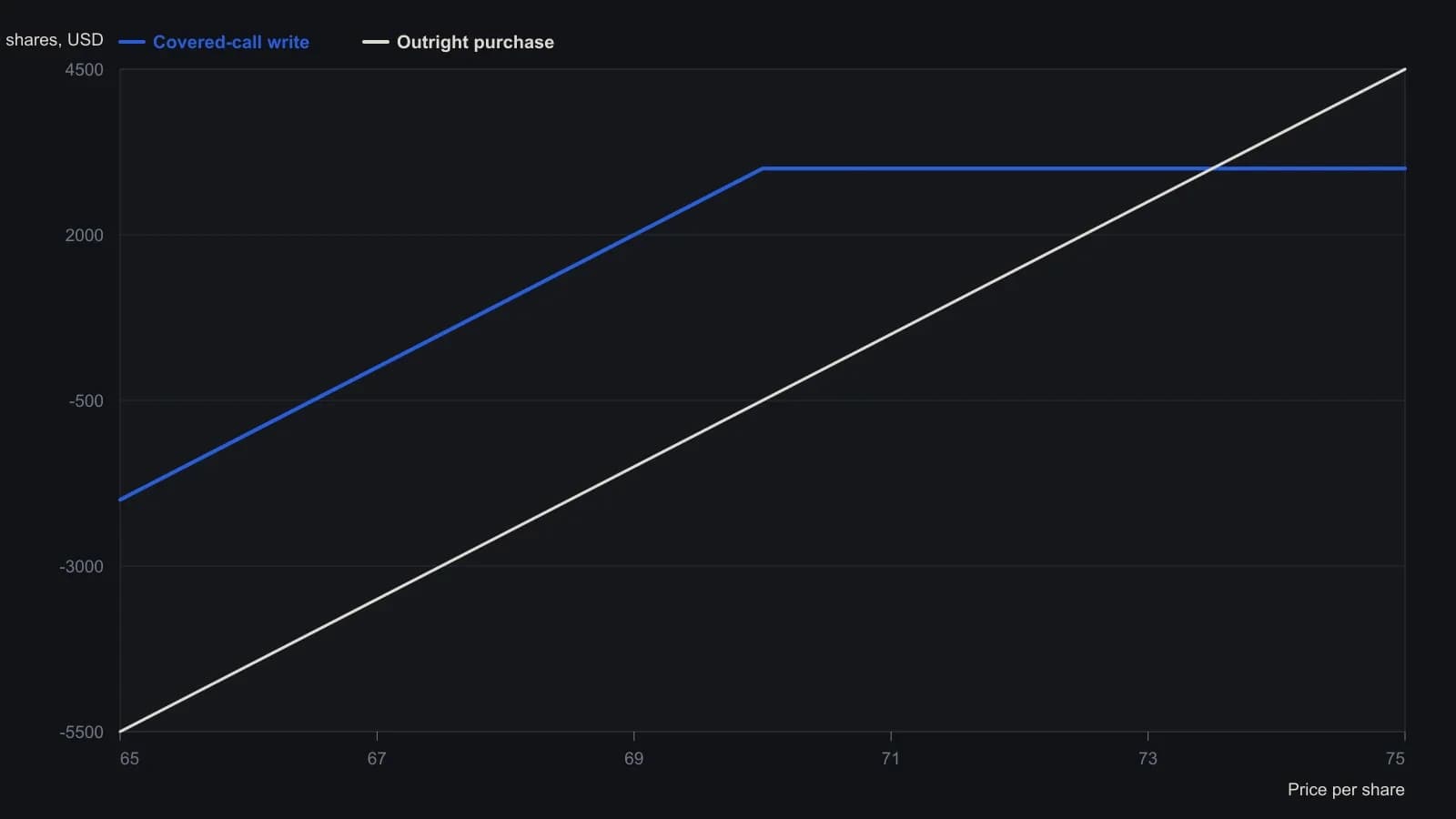
This is the March 1994 opening book only; later split-strike, 3-to-1 ratio, and January roll repairs are not on these lines. The write is treated as assigned at any expiry price of $70 or higher.
A split-strike overlay
The first repair sold five October 60 calls at 6 5/8 and five October 70 calls at 2 3/4, splitting the book so the lower-strike lot’s basis fell to 60.37 and the higher-strike lot’s basis fell to 64.25.
That structure is a split-strike overlay: writing mixed in-the-money and near-the-money calls on one holding so assignment of the lower strike can shrink inventory while the higher strike keeps some upside.
Longer-dated contracts were chosen because a longer remaining term was treated as raising both time premium and the chance the strike is reached, so the writer demanded more compensation. Editorial reading: that choice is option-premium analysis, splitting a call price into intrinsic value and time value, then choosing expiry and moneyness to size that time value against assignment and residual delta.
Assignment at the October expiry
At the October expiry the shares were near 61, the 60-strike calls were assigned, and that half of the holding was removed without a realized stock loss on the reduced-basis lot.
A short-of-neutral ratio write
A later overlay used a 3-to-1 write of January 70 calls, short of the roughly 5-to-1 count implied by a 0.20 delta for neutrality, because a possible rebound was still allowed for and the leftover uncovered shorts required a cover plan if price rose through the strike.
Ratio-writing means selling more calls than shares so short-option delta more nearly offsets the long stock. Delta is the fraction of a one-unit stock move expected in the option price, used here to scale how many calls would approach a market-neutral write. Leftover uncovered calls need an explicit cover rule.
A same-day roll and the write-up comparison
Near the January expiry the remaining cheap shorts were bought back and replaced the same day with April 70 calls, moving net basis from 62.75 to 64.07 and then down to 60.19.
At the write-up the shares traded near 71, close to the original 70.50 purchase, while the overlaid basis of 60.19 sat about 15 percent below that market price, so an unhedged long was near flat and the overlaid book still had unused premium cushion.
All readings on this track · 25 readings
- 1995Sequenced covered-call repair after a growth-stock drawdown
- 1996Covered-call writing as income and assignment discipline
- 1997Relative volatility rank for covered-call overlays
- 1997Covered call time, probability, and implied volatility
- 1999Covered-call income when implied volatility is cheap
- 2000Covered-call income and assignment flexibility
- 2002Covered-call expiration rate versus expected value
- 2003Covered-call versus diagonal housing after a single-name drawdown
- 2003Covered-call overlay on a stock portfolio as a payoff case study
- 2003Ratio backspread and covered-call assignment construction
- 2004Covered-call income is not a safety net
- 2006Evaluating consecutive covered calls across market regimes
- 2007A job-first audit of commodity options in a futures book
- 2011Horizon checks on Covered call writing, the risk-reward ratio, and the Relative Strength Index
- 2012From ex-date verticals to leftover buy-writes, and a call backspread that stays net long
- 2013Year-long covered calls on high-yield industrials
- 2014Year-horizon covered calls on Dow yield ranks
- 2014Covered-call premium as a cost-basis cushion
- 2014Monthly buy-write construction with traffic-light exits
- 2017Low-volatility covered calls need a real premium buffer
- 2017Covered-call futures income as one testable procedure
- 2018Partial covered-call overlays at targets, resistance, and rich volatility
- 2019Weekly covered-call writing as a two-book credit-spread case
- 2019Weekly option income as one holding-period case
- 2019Locking long-call profit with a temporary overlay