1992issue C121-9
Constructing volatility-adaptive trailing stops
This editorial article treats stop construction as two stacked decisions. First choose how much room a holding horizon is allowed. Then replace a static line with a volatility-scaled exponential average so the same posted bound tightens when conditions expand and loosens when they pause.
- After a position is open, a stop becomes a market order when the market trades at a preset price. A trailing stop is moved with price, while a fixed stop remains at its original level.
- Stop distance is a horizon choice first: shorter trades may trail a few ticks beyond a two-to-five-day extreme, while intermediate trades may sit just beyond a fourteen-to-thirty-day extreme, a range boundary, or a fixed-dollar offset from the best price reached.
- The adaptive moving average scales its exponential weight by the ratio of a recent closing-price standard deviation to a chosen historical reference, so the average takes larger steps when volatility rises and smaller steps when prices are quiet.
- By design the adaptive level tightens when the market is moving and loosens when it pauses, combining a trailing-stop update with a volatility-sensitive bound.
An editorial reading of the construction
Editorial: TradersWeek treats stop construction as two stacked decisions. The first decision is how much room a chosen holding horizon is allowed. The second is whether that bound stays a static line or is replaced by a volatility-scaled exponential average.
The archive workflow below is the historical construction. The two-decision framing is editorial and is not attributed to the archive.
Stops after the position is open
After a position is open, a stop becomes a market order when the market trades at a preset price. A trailing stop is a posted exit that is moved as price advances or declines and becomes a market order if the stop price trades. A fixed stop is an exit left at its original price after placement rather than walked with the market.
A posted stop is an order given to the broker in advance so the exit does not depend on enforcing an unposted mental level.
Horizon sets the room
Stop distance is framed as a horizon choice. Shorter trades may trail a few ticks beyond a two-to-five-day extreme. Intermediate trades may sit just beyond a fourteen-to-thirty-day extreme, a range boundary, or a fixed-dollar offset from the best price reached.
That lookback extreme or range boundary is the horizon envelope. It sets how far a stop sits from current price for a chosen holding period.
Replace the static line
An adaptive moving average is an exponential average whose smoothing weight rises and falls with recent volatility relative to a chosen reference scale. The adaptive average scales its exponential weight by the ratio of a recent closing-price standard deviation to a chosen historical reference, so the average takes larger steps when volatility rises and smaller steps when prices are quiet.
The volatility-adjusted weight is the variable-index alpha. It replaces a constant exponential smoother so the average steps faster in active markets and slower in quiet ones. The reference standard deviation is the historical volatility scale used to normalize the recent standard deviation when the adaptive weight is computed.
On a 630-day daily-close sample, the 30-day standard deviation ranged from 0.39 to 2.03 with an average of 1.02. A reference of 0.5 was chosen so the index could approach about 4, mapping roughly a 30-day exponential average toward a seven-day average.
The recursive construction
The recursive construction uses 0.065 as the 30-day exponential weight. Today's adaptive value equals (recent 30-day standard deviation divided by 0.5) times 0.065 times today's price, plus one minus that weight times yesterday's adaptive value. Highs or lows may replace the close.
Raising the reference factor from 0.5 toward 1.0 slows the adaptive average, which the construction uses to set a looser or less obvious intraday stop.
Worksheet close and VIDYA for the bond contract
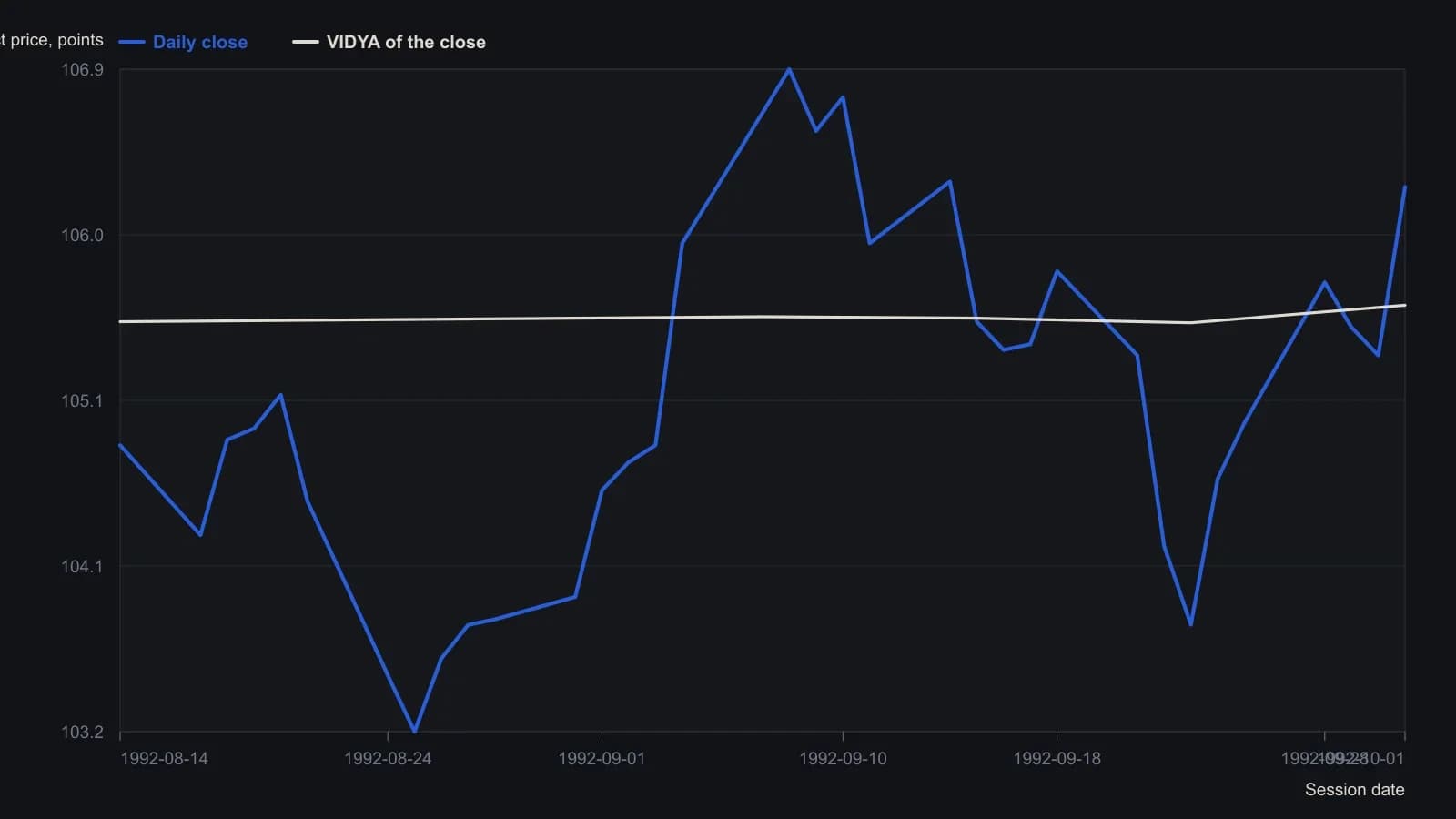
VIDYA on this sheet uses the population standard deviation of the prior 30 closes, a 0.5 reference deviation, and the 0.065 weight of a 30-day exponential average. The computed deviation and VIDYA columns are printed only on the last five rows.
Three ways to post the bound
Three stop constructions are specified. A close-based adaptive level can be used as an intraday trigger or as a next-open exit after a close through the average. A next-open exit waits for the following session open after a close through the adaptive level, rather than acting on an intraday touch.
A high-based adaptive level uses next-open action. Longs are trailed from the adaptive average of lows, while shorts are trailed from the adaptive average of highs.
A volatility stop is a loss or exposure bound whose location is driven by a volatility-sensitive level instead of a fixed tick, bar-count, or dollar offset.
How the bound tightens and loosens
By design the adaptive level tightens when the market is moving and loosens when it pauses, combining a trailing-stop update with a volatility-sensitive bound.
All readings on this track · 12 readings
- 1989A close-only volatility reverse bound to average true range
- 1992Equity-curve average as a live-capital gate
- 1992Constructing volatility-adaptive trailing stops
- 1993Constructing skew-adjusted volatility stops and pyramid size
- 1999Evaluating a long-only breakout system with a volatility stop
- 1999When markets burst, not trend
- 2005Building entry rules with ratchet volatility stops
- 2005Pricing entries, stops and exits in range units
- 2013Constructing asymmetric volatility bands for reversal, trend, and stops
- 2015Mark the stop, the target, and the invalidation line before entry
- 2019Bounding capital risk with phase-aware stops
- 2019Measure the Bollinger Bands touch before adding engulfing and a volatility stop