2017issue C1140-45
Calendar regimes, RSI events, and sector rotation rules
Before a sector or calendar idea is allowed to become a trade, name the active calendar-regime or sector-regime, score the name with an rsi-event-study instead of a single reading, and write enter, exit, and abstention as one rotation-procedure.
- Sector rotation is framed as buying a market segment as it leaves a downtrend and selling when that trend reverses, with timing from economic-cycle stage, technical indicators, or relative-strength rank.
- Calendar-regime keys such as turn of the month, day of week, or a named session group which names historically outpaced or lagged a broad benchmark, while year-by-year ranks show no fixed best or worst sector.
- An rsi-event-study records later paths after a high RSI close, including how price arrived there, and splits into an overbought-fork of continue-with-strength versus mean reversion.
- A rotation-procedure is one written package that may enter, exit, or stand in cash, and a vehicle-constraint of weighting, cost, and volume decides whether a sector product can carry it.
A checklist before the trade
Sector and calendar ideas are easy to narrate and hard to keep honest. Editorial: TradersWeek treats three questions as a gate before any of those ideas is allowed to become a trade. Name the active calendar-regime or sector-regime. Score the name with an rsi-event-study rather than a single oscillator print. Encode enter, exit, and abstention as one rotation-procedure.
The archive facts describe a historical workflow for rotation, calendar grouping, and RSI events. They do not authorize a live allocation.
Name the calendar-regime or sector-regime
A calendar-regime is a recurring window defined by day of week, day of month, turn of month, or a named session, used to group historical outcomes. The archive proposes those keys, including day of year and a named session, for which names historically outpaced or lagged a broad benchmark exchange-traded fund.
A sector-regime is a market-segment state inferred from economic-cycle stage, trend direction, or relative-strength rank, rather than from a single security pick. Sector rotation is framed as buying a market segment as it leaves a downtrend and selling when that trend reverses, with timing drawn from those cycle stages, technical indicators, or relative-strength rankings.
A year-by-year sector-rank display is presented as having no fixed best or worst sector each year. Healthcare ranks are shown staying high across most of that window except one year. The gap between the top and bottom sector in a given year is described as wide. Carrying the prior year’s top sector into the next year is treated as a non-persistent selection rule.
Over the displayed window about half the listed sectors finished above a broad large-cap benchmark and about half finished below it. Rotation is framed as choosing among those ranks rather than holding the whole index.
Read the vehicle-constraint
Sector vehicles used for that rotation are described as market-cap, fundamentally, equally, single-factor, or multifactor weighted. They place cash in a segment that can be more or less volatile than a broad benchmark.
A comparison of sector-fund families records wide gaps in combined assets, inception dates, net expense ratios, and aggregate daily volume. Those gaps are a vehicle-constraint. They decide whether a product can carry a rotation-procedure at all.
Score an rsi-event-study, not a single reading
A high RSI close is offered as an event definition. The fuller dataset is every later path after that threshold in the lookback, plus whether price arrived there quickly, slowly, in a streak, or with noise, rather than the single reading itself. That lookback is an rsi-event-study.
The same RSI-event sample is said to split into names that historically kept rising when overbought flags appeared and names that reversed. That overbought-fork maps onto two testable styles: continue-with-strength versus mean reversion.
Editorial: a lone RSI print is not a sector-regime and not a calendar-regime. It is only a sampling event until the later paths are scored.
Write one rotation-procedure
A sector or seasonal procedure is described as one package that may enter, exit, or stand in cash, using tools such as trailing stop-limit orders and technical exit signals. That package is expected to trail a benchmark in some windows.
Editorial: enter, exit, and abstention belong in the same written rotation-procedure. If the calendar-regime, the sector-regime, or the rsi-event-study does not clear, the procedure stands in cash.
Healthcare ETF cumulative returns by sponsor, 2007–2017
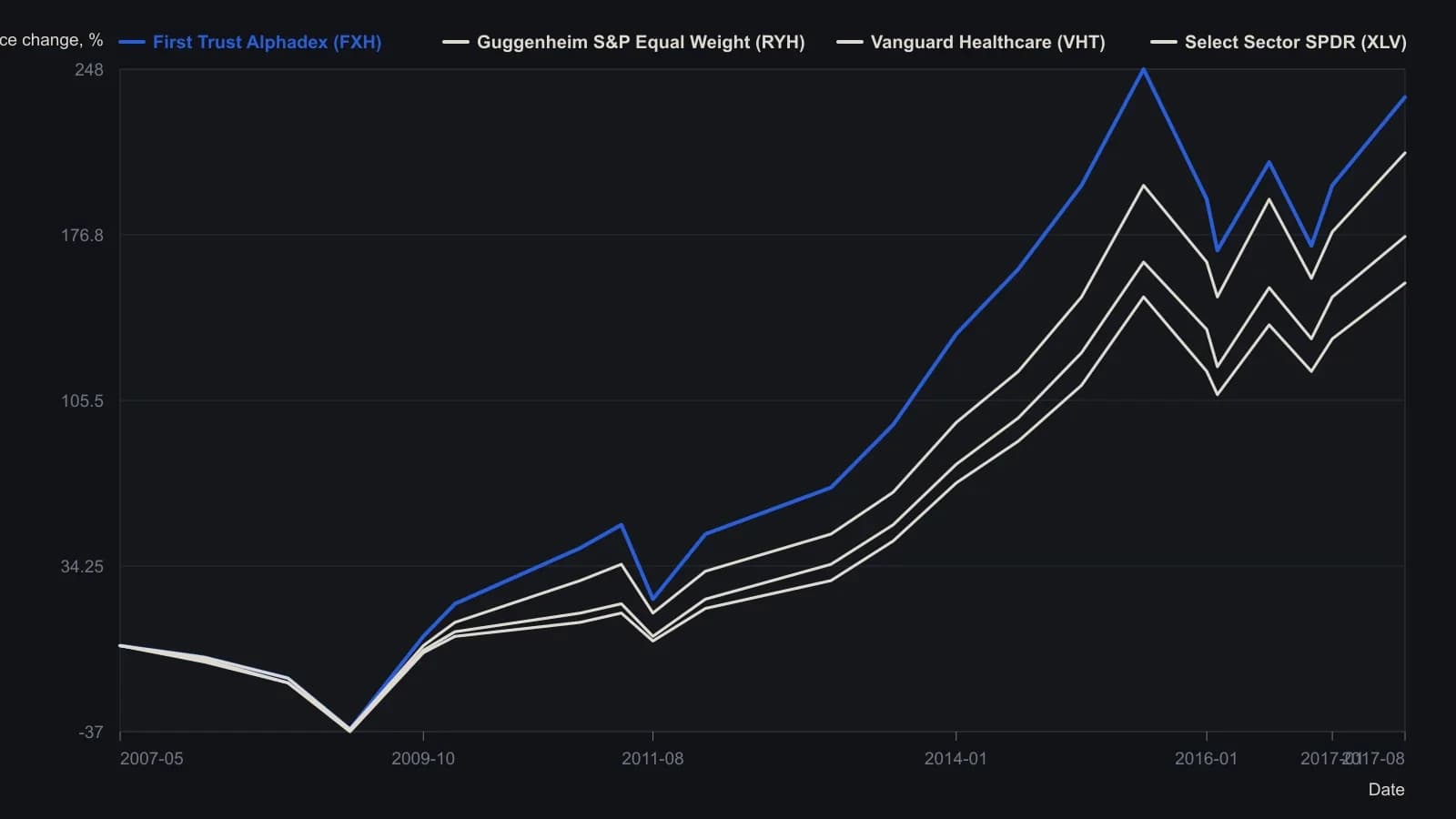
Fidelity, John Hancock and Invesco healthcare ETFs were left off the source plot because their track records were too short for the common window. Readings are from the raster, not official NAV totals, so treat them as about ±5 percentage points.
All readings on this track · 21 readings
- 1986Two gates for setup and operator readiness
- 1990Time-only cycle dates in a Treasury bond case study
- 1990Constant-dollar regimes, the value line, and nested cycles
- 1992The four-year election cycle as an equity regime map
- 1992A semiconductor seasonal-index before the relative-strength overlay
- 1992Lock the holiday window as a regime, then veto resistance
- 1995Regime-aware stock screening with intermarket context
- 1996Standard-error bands, width gates, and weekday counts
- 1999Constructing seasonal factors from centered moving averages
- 2000Seasonal window, then weekly breadth
- 2004Copper as a regime map for cycles and recessions
- 2008Election-cycle windows as a mechanical seasonal system
- 2012A 2012 case study in Kondratieff-wave and presidential-cycle overlays
- 2012The October to May window as a mechanical portfolio procedure
- 2013Half-year seasonality as an equity regime overlay
- 2014Seasonal cycles as a regime overlay
- 2015Seasonal oil window as a defined-risk spread case
- 2017Calendar regimes, RSI events, and sector rotation rules
- 2018Seasonal windows as testable entry and abstention rules
- 2019Calendar rotation of seasonal and regime questions
- 2020Constructing calendar interval votes for cycle workbooks