1985issue C071-3
Minimum tickets can price a small book out of its own exit
The first ten equity orders booked 350 in commissions and left the account behind before any price move. Closing that book would have added another 350 ticket-floor, so the names were held; a later unfinished event sale then paid a second bill the thesis had not earned.
- A ticket-floor is part of the executable price: the first ten equity orders produced a 350 commission outlay and left the account behind before any price move.
- Another ten tickets at a 35 minimum each would have added a 350 exit-surcharge and turned a booked 1200 of price loss plus entry fees into a contemplated 1550 all-in hole.
- The ten names were held to avoid that second 350, and 700 of round-trip tickets were treated as a sunk cost; the episode later closed at a 975 all-in loss including commissions.
- An 80-share purchase at 72.50 carried 36 tickets on each side; a fearful sale at 70.625 realized a 222 loss including commissions before the motivating corporate action completed.
Ten names and a prepaid ticket-floor
Live trading starts in October 1984. The first ten equity orders produced a 350 commission outlay that left the account behind before any price move. That outlay is implementation-cost: commissions and related trading charges that reduce the result independently of the subsequent price path.
Large-capitalization names then declined by about 850 in the first two weeks, a figure stated separately from commissions. The price loss plus the entry fees already booked 1200.
Why the exit looked dearer than the drawdown
Closing those ten names would have required another ten tickets at a 35 minimum each, adding 350. The already booked 1200 of price loss plus entry fees would have become a contemplated 1550 all-in hole.
That second bill is an exit-surcharge, the extra tickets required to close a book. It can make selling costlier than remaining in a mark-to-market loss. To avoid that second 350, the names were held and 700 of round-trip tickets were treated as a sunk cost. The episode later closed at a 975 all-in loss including commissions.
Ten $35 tickets made the exit larger than the drawdown
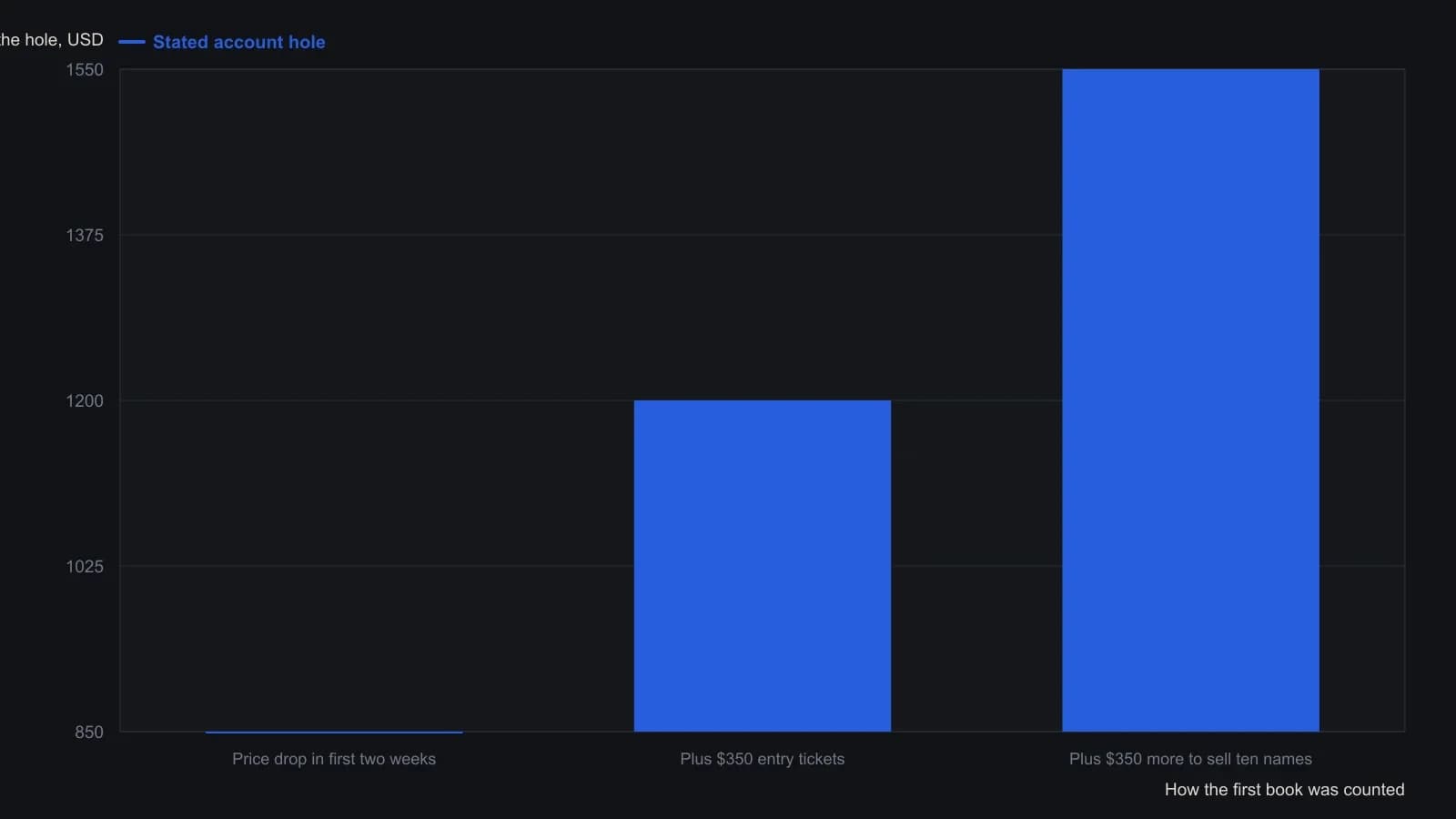
The two-week price loss is the author's "about $850"; each $350 leg is ten tickets at the $35 minimum. The later close-out loss of $975 including commissions is not plotted.
An unfinished event and a second bill
Live trading was wound down just after Christmas and had resumed by the end of January 1985 after a resolution to stay out failed.
An 80-share purchase at 72.50 carried 36 tickets on each side. A same-session mark of 60 was described as almost covering that 72 round-trip-outlay.
A fearful sale at 70.625 a few sessions later realized a 222 loss including commissions, even though the corporate action that motivated the trade had not completed. A later print near 86 sat 13.50 above the 72.50 entry on those 80 shares. The narrator contrasted the 222 realized loss with a roughly 1000 better subsequent mark and with the 72 collected on the two tickets.
All readings on this track · 32 readings
- 1985Matching ticket size to negotiable commission schedules
- 1985Minimum tickets can price a small book out of its own exit
- 1992Stop-order slippage as an execution cost filter
- 1993Cost-aware walk-forward evaluation of pattern-detector signals
- 2001Audit high-turnover operating conditions as one procedure
- 2002Front-load futures commission and slippage
- 2005Inactive account fees as hidden implementation cost
- 2010A pre-trade liquidity screen for futures contracts
- 2011Currency option venues, spreads, clearing, and premium cost
- 2012Filter futures contracts by liquidity and implementation cost
- 2012Futures commission versus one tick of cost
- 2012Ranking futures liquidity for executable orders
- 2013Filter option day trades by spread, volume, and fees
- 2013Filter futures by liquidity, open interest, and effective margin
- 2014Book futures data fees as implementation cost
- 2015Use a futures liquidity rank as a pre-trade checklist
- 2015Filter unexecutable futures by liquidity, open interest, and margin
- 2015Futures liquidity ranking as an execution filter
- 2015Filtering option trades by bid-ask width
- 2016Exchange quote fees as execution costs and liquidity filters
- 2016Filter futures by liquidity, open interest, and margin cost
- 2016Comparing dollar-index futures execution costs and liquidity
- 2016A futures liquidity ranking as a screen for executable orders
- 2017Filter a futures board by liquidity, open interest, and implementation cost
- 2017Filter futures contracts by liquidity and margin cost
- 2017How residency rules raise futures implementation costs
- 2018Screen listed futures by liquidity, open interest, and margin
- 2018Contract selection is the first filter on competing bitcoin futures
- 2018Filter futures execution by liquidity and margin
- 2018Commission analysis for brokerage execution costs
- 2019Ranking futures liquidity before you size the order
- 2020Brokerage selection as an implementation-cost problem