2018issue C0427
Contract selection is the first filter on competing bitcoin futures
Two bitcoin futures listings can split liquidity and leave a broker able to offer only one product. Unit size, cash settlement, and remaining bid-ask width then decide whether the order is executable.
- Two competing bitcoin futures listings split liquidity across venues and can leave a given broker able to offer only one of the two products.
- Platforms that search futures by commodity name rather than by ticker can send an order into the five-unit bitcoin contract when the one-unit contract was intended, or the reverse.
- Both versions were cash-settled, so expiration adjusted accounts in currency, but a fragmented broker-quoted spot market could add slippage if a position was held into expiration.
- The five-unit book often implied a larger cash spread cost than the one-unit book, and sparse early volume left fill quality poor, a growing-pain pattern that can last months or years.
Split listings constrain broker access
Two competing bitcoin futures listings split liquidity across venues and can leave a given broker able to offer only one of the two products.
A split listing is two venues listing futures on the same new underlying, which divides order flow. The practical limit is a broker access constraint: not every intermediary can route both competing bitcoin futures.
Commodity-name search can select the wrong unit size
Platforms that search futures by commodity name rather than by ticker can send an order into the five-unit bitcoin contract when the trader intended the one-unit contract, or the reverse.
Unit size is how many units of the underlying one futures contract represents. It scales both exposure and the quoted spread into a cash cost.
Cash settlement still needs a mapping to spot
Both bitcoin futures versions were cash-settled, so expiration adjusted accounts in currency and did not deliver the digital asset or require a wallet. Cash settlement closes the futures in currency against an exchange cash reference instead of delivering the digital asset.
Because cash bitcoin was quoted across many synthetic broker markets rather than one centralized print, the futures cash-settlement price was hard to map to a single transparent spot and could add slippage if positions were held into expiration. That extra mark-to-market friction is expiration slippage, when a cash-settlement print is drawn from a fragmented, broker-quoted spot market.
Spread width becomes a cash cost through unit size
The five-unit bitcoin futures often showed a bid-ask near 50 price units, implying about 250 currency units of spread cost to complete a trade. Implied spread cost is bid-ask width multiplied by unit size, the hidden friction of crossing a thin book.
The one-unit bitcoin futures typically quoted a narrower 20-to-40 unit bid-ask and drew more speculative volume, yet remained wider than a one-tick equity-index futures market of 12.50.
Sparse early volume leaves fill quality poor
Sparse early volume in the newly listed bitcoin futures produced wide books and poor fill quality. Fill quality is how closely an executed price matches the visible quote when volume is sparse.
That growing-pain pattern can last months or years and sometimes ends in delisting.
Listed futures are not a cash-market transfer
Listed bitcoin futures sat in a regulated market with exchange-level trade guarantees, unlike unregulated cash-market bitcoin transfers.
Dollar cost to cross the bid-ask on early bitcoin futures
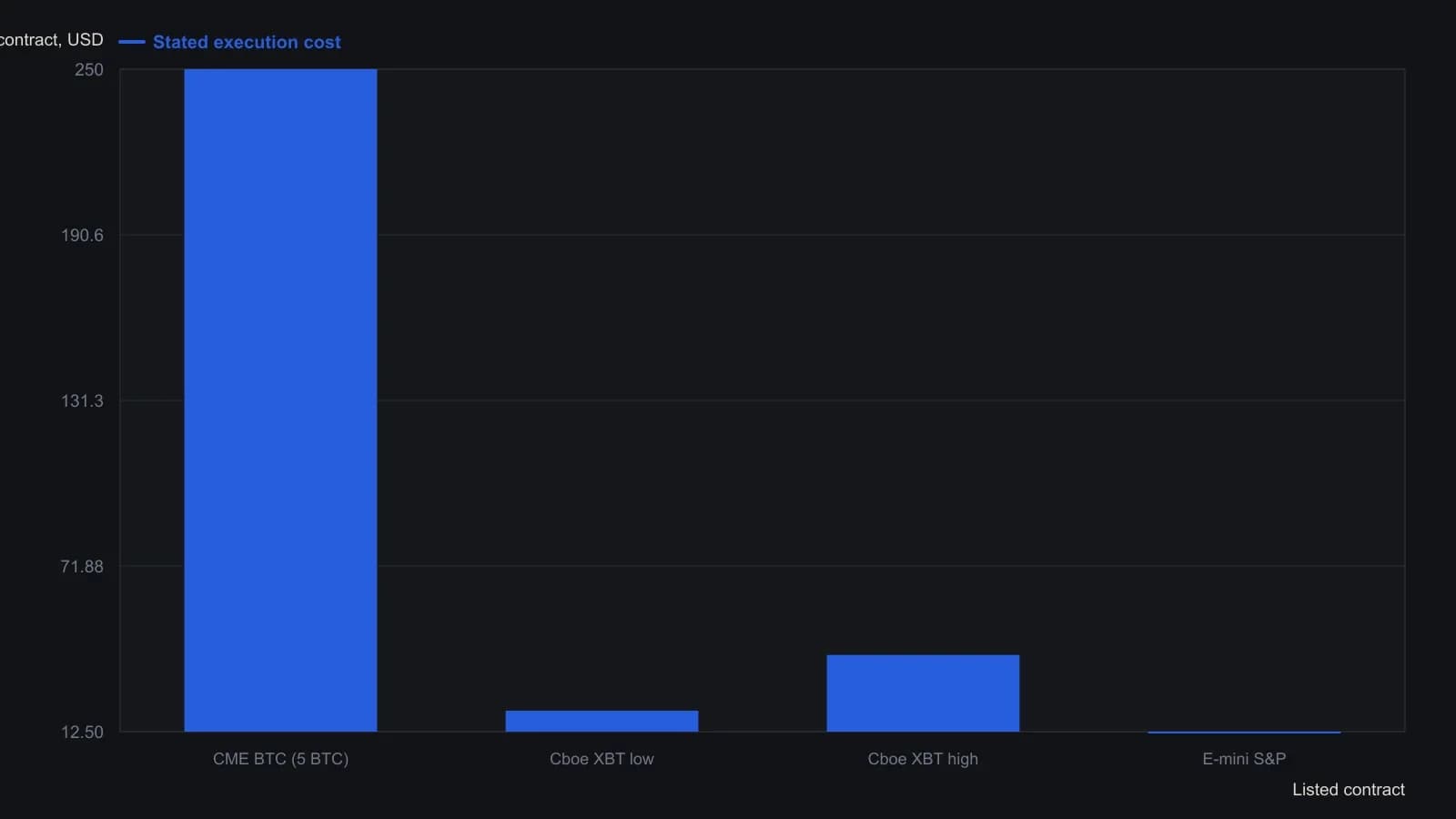
BTC width was described as generally around $50 and then scaled by the five-bitcoin multiplier to $250. XBT was given only as a $20–$40 band, so both ends are plotted instead of a midpoint.
All readings on this track · 32 readings
- 1985Matching ticket size to negotiable commission schedules
- 1985Minimum tickets can price a small book out of its own exit
- 1992Stop-order slippage as an execution cost filter
- 1993Cost-aware walk-forward evaluation of pattern-detector signals
- 2001Audit high-turnover operating conditions as one procedure
- 2002Front-load futures commission and slippage
- 2005Inactive account fees as hidden implementation cost
- 2010A pre-trade liquidity screen for futures contracts
- 2011Currency option venues, spreads, clearing, and premium cost
- 2012Filter futures contracts by liquidity and implementation cost
- 2012Futures commission versus one tick of cost
- 2012Ranking futures liquidity for executable orders
- 2013Filter option day trades by spread, volume, and fees
- 2013Filter futures by liquidity, open interest, and effective margin
- 2014Book futures data fees as implementation cost
- 2015Use a futures liquidity rank as a pre-trade checklist
- 2015Filter unexecutable futures by liquidity, open interest, and margin
- 2015Futures liquidity ranking as an execution filter
- 2015Filtering option trades by bid-ask width
- 2016Exchange quote fees as execution costs and liquidity filters
- 2016Filter futures by liquidity, open interest, and margin cost
- 2016Comparing dollar-index futures execution costs and liquidity
- 2016A futures liquidity ranking as a screen for executable orders
- 2017Filter a futures board by liquidity, open interest, and implementation cost
- 2017Filter futures contracts by liquidity and margin cost
- 2017How residency rules raise futures implementation costs
- 2018Screen listed futures by liquidity, open interest, and margin
- 2018Contract selection is the first filter on competing bitcoin futures
- 2018Filter futures execution by liquidity and margin
- 2018Commission analysis for brokerage execution costs
- 2019Ranking futures liquidity before you size the order
- 2020Brokerage selection as an implementation-cost problem