1982issue C071-5
Park good-till-cancelled targets after commissions at the chart bands
A listed mining share was the equity vehicle for metal-price swings. Charted bands and daily-range marks decided when a prior close was an acceptable purchase, a good-till-cancelled limit held the half-point sale, and commission schedules set the break-even width of each round trip.
- A listed mining share let ordinary equity tickets stand in for metal-price swings in place of a commodity account or a physical-metal holding.
- Charted bands near 4 and 12, with buying preferred between 4 and 9, were read against daily-range marks before a prior close was accepted as a purchase print.
- A good-till-cancelled sale was parked at the half-point increment so a later-week downturn would not cancel an already-available working order.
- Frequent tickets made commission analysis the way to set the break-even width of each round trip, with fund transfer and evening quotes keeping cash in pace.
An equity stand-in for metal-price swings
A listed mining share was used as the executable vehicle for metal-price swings so ordinary equity tickets could replace a commodity account or a physical-metal holding.
The planned cadence was at least twelve purchases a year, with each sale targeted a half point above the paired buy. Extra intra-month turns were treated as compatible with that plan.
A half-point increment was judged usable because the share traded at a low enough price that a 500-share lot still required only a modest outlay. That increment is the planned sale target one half point above the paired purchase, used as the repeatable exit width.
Chart bands and daily-range marks
The stock was read as having a lower band near 4 and an upper band near 12. Those charted price bands mark where new size is preferred and where further buying is treated more cautiously. Purchases were preferred on an uptrend between 4 and 9, with extra caution above that inner band.
Daily high, low, and close marks, together with a chart of the daily-range trend, were used to decide when a prior close was an acceptable purchase print. A daily-range mark is that session high, low, and close, used to judge whether the prior close is an acceptable entry print.
A standing sale through a later-week downturn
After entry, a standing good-till-cancelled limit was left at a higher target so a later-week downturn would not cancel an already-available sale. A good-till-cancelled order is a standing limit that remains live until filled or withdrawn, used to hold a prechosen purchase or sale print through later sessions.
Range still offered later-session tickets even while the week was declining. The working order is the unfilled broker instruction already accepted at the target print, typically left in force across the session or longer.
Commission schedules and break-even width
Because tickets were expected often, comparing discount-broker commission schedules was presented as the way to lower the break-even distance of each round trip. Commission analysis is that comparison of broker fee schedules, used to measure how trading costs widen the break-even distance of each planned round trip.
The break-even width is the price distance a sale must cover after commissions before the ticket is economically positive.
Cash and tickets when turns cluster
Automatic bank-to-broker fund transfer and evening quote review, including use of a broker quote line, were treated as operational steps so cash and tickets could keep pace when several purchases and sales clustered in a short window.
Benguet (BE) round-trip dollar gain by trade
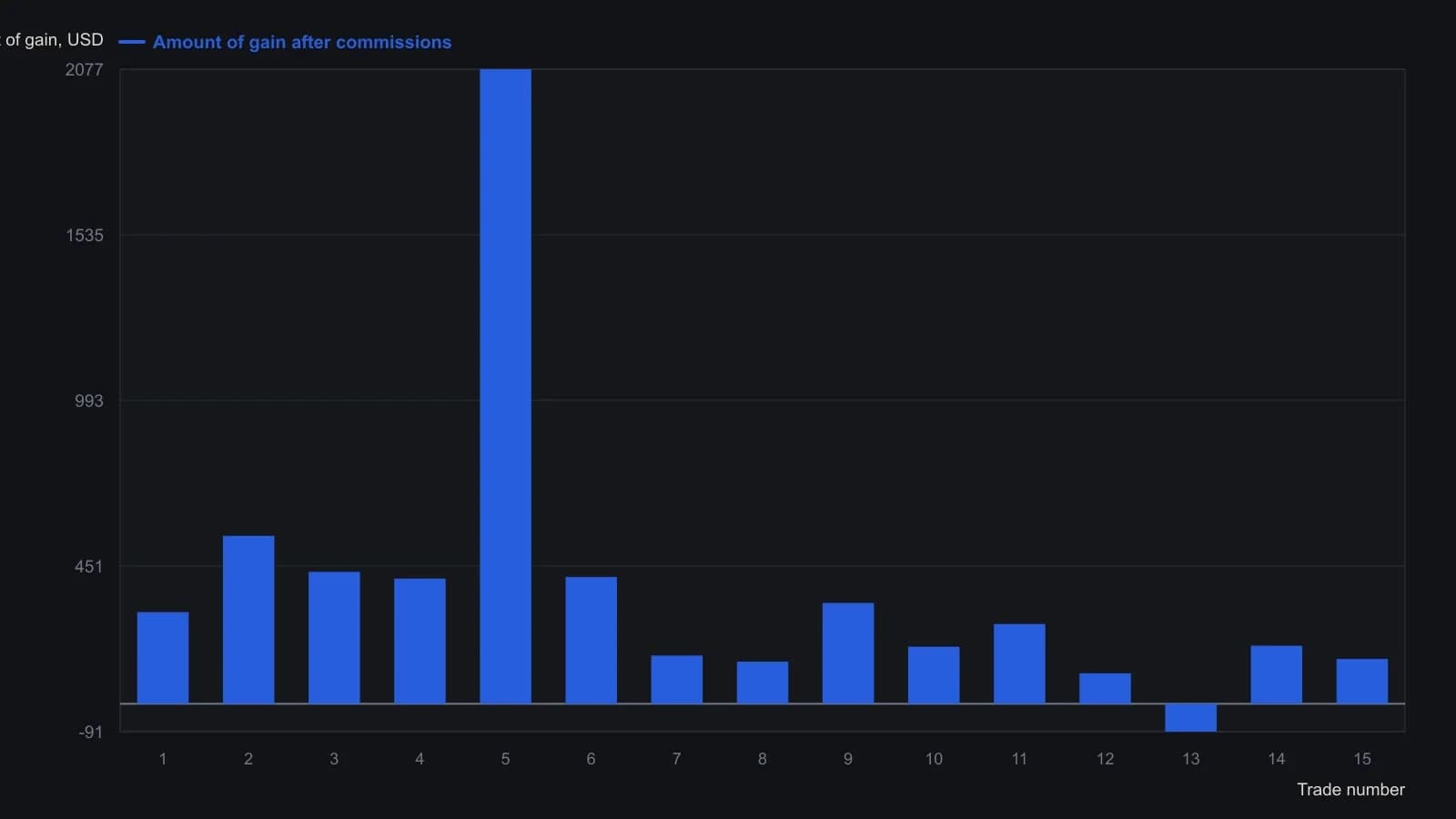
Amount-of-gain column from the published 15-row trade blotter. Trade 13 is a $100 loss. Annualized-percentage and percent-of-investment columns are omitted so the bars stay in dollars. The table’s own average investment of $2,432 is the $36,484 sum divided by 15.
All readings on this track · 8 readings
- 1982Swing charts, stop-loss orders, and good-till-cancelled covers in a bond-market coil
- 1982Park good-till-cancelled targets after commissions at the chart bands
- 1987Write the danger-point stop before the trade is accepted
- 1989Christmas tree construction as a five-week monthly procedure
- 2006Constructing the single-price open from overnight flow
- 2008Overnight session routing for good-till-cancelled, limit, and market orders
- 2013Session cutoffs, good-till-cancelled orders, and exchange margin
- 2013Depth of market ladder versus resting order ticket