2016issue C0547
Exchange quote fees as execution costs and liquidity filters
As of April 1, 2016, ICE billed real-time commodity quotes per exchange and per device. Traders who skipped the live tape faced higher reject and surprise-fill risk, and remaining ICE books were checked with volume and open interest.
- ICE billed real-time commodity quotes at $110 per month per exchange per device, and the bill came from the exchange rather than the broker.
- Traders who worked from 15-minute delayed ICE prices faced greater risk of rejected orders and unexpected fills on limit and stop instructions.
- Volume and open interest were the checks for whether remaining ICE-listed commodities still had enough participants for efficient price discovery.
- Even the most active ICE listings were described as thinner than other US futures markets, so a further drop in retail participation was expected to change liquidity conditions.
Quote access sits inside implementation cost
Implementation cost is the full outlay required to see the market and complete an order. It includes exchange quote fees as well as spread, reject, and surprise-fill risk.
As of April 1, 2016, ICE began charging $110 per month per exchange per device for real-time commodity quotes. The charge was billed by the exchange rather than the broker. Real-time quotes are live exchange price data billed per venue and per device.
Commission analysis treats those exchange quote charges as a pre-trade cost that can make a live, executable view of the book uneconomic for infrequent users.
What the live-quote ticket cost
Live quotes on all five ICE futures venues were priced at $460 per device, or as much as $920 per month if the same quotes were also viewed on a second device.
Combined live quotes for US ICE softs and ICE Futures Europe Brent were described as $220 per month per device, versus $15 per month for nonprofessional CME Group data. Softs are ICE-listed agricultural staples such as sugar, cocoa, coffee, and orange juice.
Monthly real-time quote fees on ICE versus CME
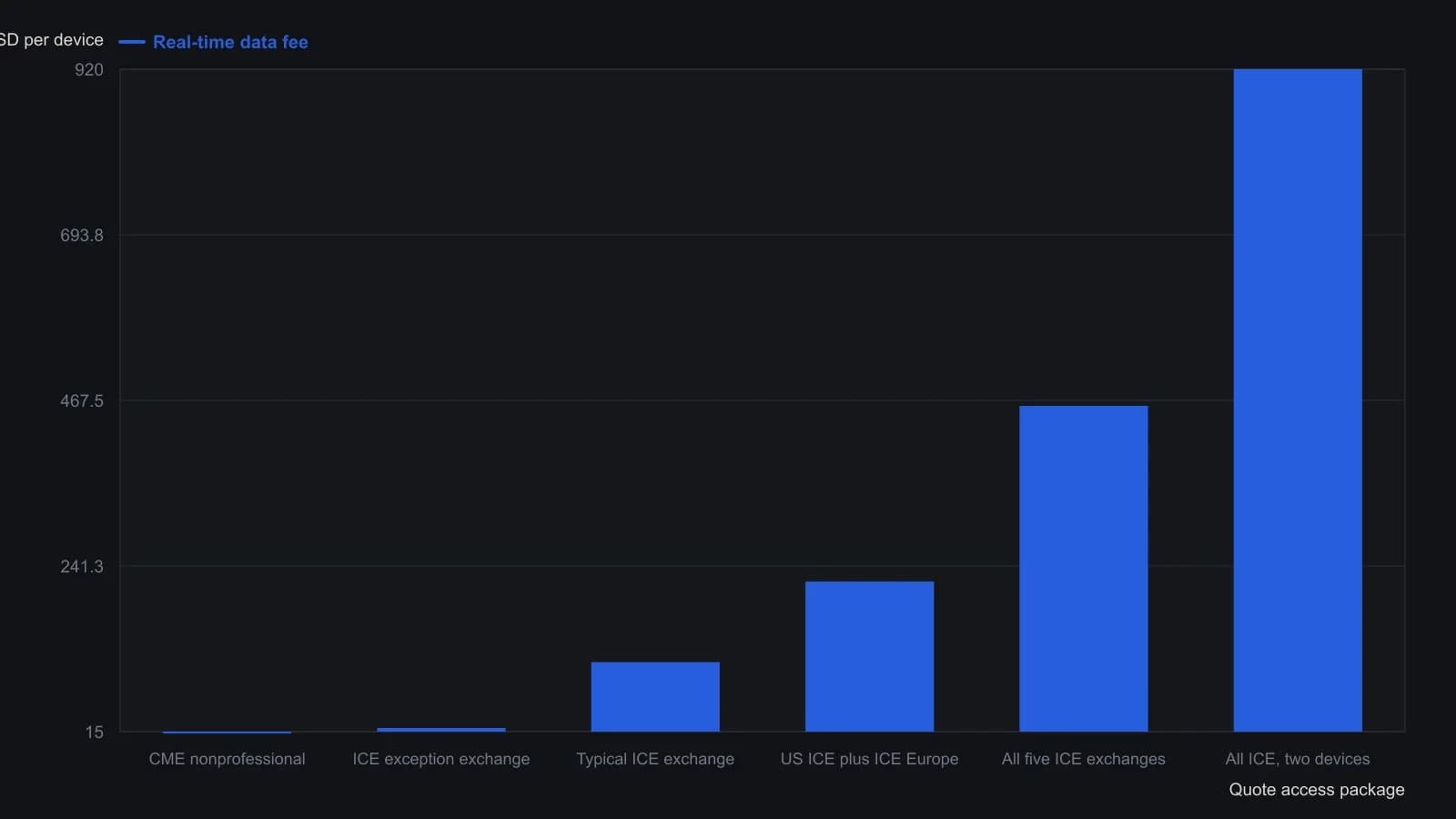
As of 1 April 2016 ICE charged 110 dollars on four of its five futures exchanges and 20 on the remaining venue. The 920-dollar figure is the column’s stated ceiling for the full five-exchange package on two devices.
Delayed quotes and fill risk
Traders who skipped live ICE quotes and worked from 15-minute delayed prices faced greater risk of rejected orders and unexpected fills when using limit or stop instructions.
Delayed quotes are price prints that lag the live tape. Here the lag was 15 minutes and was used to avoid real-time data charges. The archive record ties that choice to reject risk and surprise fills, not to a claim about later profitability.
Filter remaining books with volume and open interest
The 2016 account reported that nearly all observed retail traders were dropping ICE-listed products, while Russell 2000 futures users were moving toward emini S&P and emini Nasdaq contracts.
Volume and open interest were identified as the checks for whether remaining ICE-listed commodities still had enough participants for efficient price discovery.
A liquidity filter is a pre-trade screen of remaining volume, book quality, and participant depth after a cost shock, used to decide whether an order is still executable. Open interest analysis is a check of outstanding contracts, alongside volume, to judge whether enough participants remain for orderly price discovery and a realistic fill.
Thinner books after a retail exit
Even the most active ICE listings were described as thinner than other US futures markets, so a further drop in retail participation was expected to change liquidity conditions.
Editorial: once the quote ticket is refused or accepted, the remaining work is still a filter. If volume and open interest no longer support orderly discovery, the order is not sent.
All readings on this track · 32 readings
- 1985Matching ticket size to negotiable commission schedules
- 1985Minimum tickets can price a small book out of its own exit
- 1992Stop-order slippage as an execution cost filter
- 1993Cost-aware walk-forward evaluation of pattern-detector signals
- 2001Audit high-turnover operating conditions as one procedure
- 2002Front-load futures commission and slippage
- 2005Inactive account fees as hidden implementation cost
- 2010A pre-trade liquidity screen for futures contracts
- 2011Currency option venues, spreads, clearing, and premium cost
- 2012Filter futures contracts by liquidity and implementation cost
- 2012Futures commission versus one tick of cost
- 2012Ranking futures liquidity for executable orders
- 2013Filter option day trades by spread, volume, and fees
- 2013Filter futures by liquidity, open interest, and effective margin
- 2014Book futures data fees as implementation cost
- 2015Use a futures liquidity rank as a pre-trade checklist
- 2015Filter unexecutable futures by liquidity, open interest, and margin
- 2015Futures liquidity ranking as an execution filter
- 2015Filtering option trades by bid-ask width
- 2016Exchange quote fees as execution costs and liquidity filters
- 2016Filter futures by liquidity, open interest, and margin cost
- 2016Comparing dollar-index futures execution costs and liquidity
- 2016A futures liquidity ranking as a screen for executable orders
- 2017Filter a futures board by liquidity, open interest, and implementation cost
- 2017Filter futures contracts by liquidity and margin cost
- 2017How residency rules raise futures implementation costs
- 2018Screen listed futures by liquidity, open interest, and margin
- 2018Contract selection is the first filter on competing bitcoin futures
- 2018Filter futures execution by liquidity and margin
- 2018Commission analysis for brokerage execution costs
- 2019Ranking futures liquidity before you size the order
- 2020Brokerage selection as an implementation-cost problem