2015issue C058-11
Memory-bearing synthetics for dominant-cycle spectra
A market-like series can be synthesized from a random-number stream and an exponential moving average of past draws. An autocorrelation periodogram then estimates the dominant cycle without applying a memory filter to the raw observations first.
- Spectrum tools that themselves apply memory-bearing filters can imprint cyclic structure on memory-free random data, making the measurement circular.
- An autocorrelationPeriodogram forms the autocorrelation of a series and then takes a Fourier transform of that function, so a memory filter is not applied to the raw observations first.
- A randomWithMemory series smoothed by an exponentialMovingAverage held its measured dominantCycle near the filter criticalPeriod, and that look could be steered by changing the cutoff.
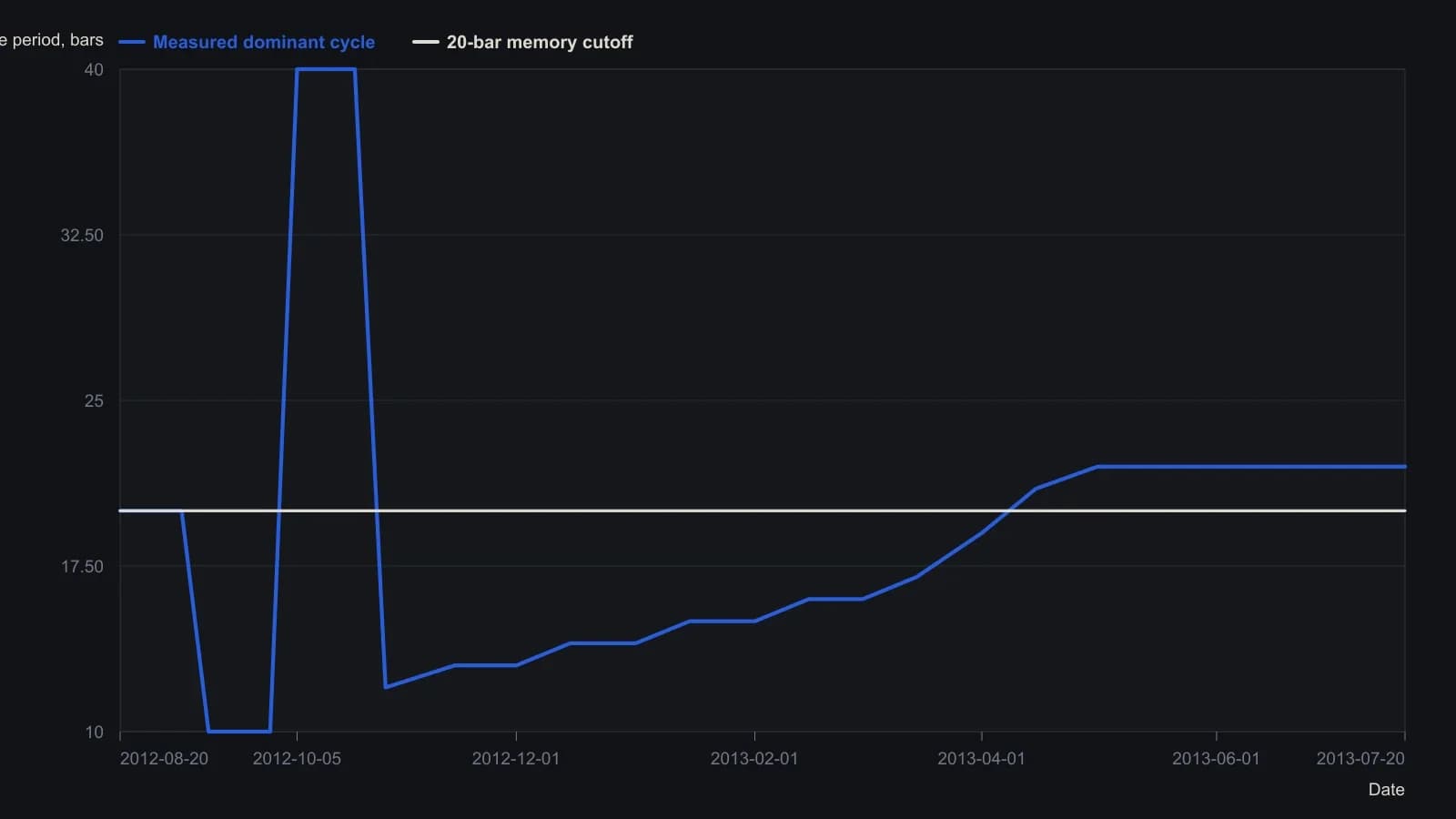
- On about one year of daily bars of a broad equity index fund, the dominantCycle sat between 20 and 25 bars, then near 15 bars, then a poorly defined longer period, and those periods were transient.
Constructing a known memory cutoff
A market-like series can be synthesized by combining a random-number stream with an exponentialMovingAverage of past draws. That constructed series is randomWithMemory: independent random draws are combined with a recursive smoother so successive observations remain dependent.
The exponentialMovingAverage is the memory term. Its criticalPeriod is the cutoff length of the memory filter and sets how long dependence persists in the synthetic series.
When the spectrum adds its own memory
Spectrum tools that themselves apply memory-bearing filters can imprint cyclic structure on memory-free random data, making the measurement circular. The reported cycles can then be an artifact of the filter rather than structure already present in the observations.
An autocorrelation-first spectrum
An autocorrelationPeriodogram estimates frequency content by forming the autocorrelation of a series and then taking a Fourier transform of that function, so a memory filter is not applied to the raw observations first.
That autocorrelation-first spectrum was used because it reduces spectralDilation relative to filter-bank or direct-transform measurements. spectralDilation is a longer-period bias in spectrum estimates. The dominantCycle is the period that currently carries the strongest amplitude in the measured spectrum.
Recovering the cutoff on synthetic series
A memory-free random series of about 250 samples showed little cyclic content, with an apparent dominant period near 10 bars attributed to aliasingNoise. aliasingNoise is spurious short-period energy that can appear when a memory-free random series is given a spectrum.
Adding a low-pass memory filter with a 20-bar criticalPeriod smoothed the random series and held the measured dominantCycle near 20 bars most of the time. Raising that memory filter to a 40-bar criticalPeriod further smoothed the path and lengthened the measured dominantCycle.
Spectra of these memory-bearing synthetics resembled spectra of observed market series, and the synthetic look could be steered by changing the memory filter criticalPeriod.
Autocorrelation periodogram recovers a 20-bar memory cutoff
The synthesizing filter was an EMA with a 20-bar critical period. Overlay readings are whole bars only; the heatmap raster does not support finer precision.
Transient cycles on a broad index fund
On about one year of daily bars of a broad equity index fund, the measured dominantCycle sat between 20 and 25 bars, then near 15 bars during an advance, then became a poorly defined longer period. Measured market cycle periods were transient: they appeared, faded, and changed length quickly rather than remaining fixed.
All readings on this track · 26 readings
- 1989Known-bias price streams for system evaluation
- 1989Constructing holdout-checked synthetic prices from chaos maps
- 1991Closing the feedback loop in auction market simulations
- 1994Evaluating eight-year election regimes
- 1995Constructing equity versus leverage with resampled trades
- 1995Stock leverage from compounded returns and margin cost
- 1996Constructing and optimizing volatility position-sizing profiles
- 1996Constructing fade rules from an empirical deviation histogram
- 1998Return-path volatility and the recovery burden
- 1999Monte Carlo checks beyond a single historical path
- 2002Monte Carlo equity paths from win rate and profit factor
- 2003Checking a small system edge with Monte Carlo simulation
- 2003Evaluate a mechanical trading system with a stop-loss order and Monte Carlo simulation
- 2005Evaluating momentum rank rotation under portfolio constraints
- 2009Bounded risk and rank rotation in portfolio construction
- 2010A calendar for walk-forward robustness and Monte Carlo evaluation
- 2012Treat the optimize view as an evaluation protocol
- 2013Entry, exit and abstention as one testable procedure
- 2014Evaluating stop and target bounds before fading large moves
- 2014Evaluating system exits when markets get noisier
- 2015Memory-bearing synthetics for dominant-cycle spectra
- 2015Constructing next-session implied-volatility forecasts by reordering closes
- 2016Mechanical systems as a gated factory
- 2017Four-sleeve Monte Carlo annual-loss bounds
- 2018When to retire a mechanical system with Monte Carlo drawdown limits
- 2020Treat mechanical system design as a revalidation lifecycle