2018issue C0736-39
When to retire a mechanical system with Monte Carlo drawdown limits
A written stop for a system that no longer works is required in mechanical-system design. A calendar ranking can select among many books, while one or two systems need a separate retirement procedure such as a Monte Carlo drawdown halt.
- Build a mechanical trading system by encoding an identified market behavior pattern as one procedure for entry, exit, and related decisions.
- A written procedure for stopping a system that no longer works is a required part of that design, not an optional afterthought.
- When many systems are ranked on a fixed calendar, the ranking can select which books to use; one or two systems need a different retirement procedure.
- One example halt treats early-year results as a Monte Carlo sample and stops the system when live drawdown exceeds two standard deviations of a maximum historical drawdown.
Write the stop into the system
A mechanical trading system can be built by first identifying a market behavior pattern and then encoding that pattern as one procedure for entry, exit, and related decisions.
The archive treats a written procedure for stopping a system that no longer works as a required part of mechanical-system design, not as an optional afterthought.
A development sequence described in the archive starts from a common model of what the market does, then studies market behavior, then builds systems on that model.
Rank many books, or write a different halt
When many systems are ranked on a fixed calendar, the ranking itself can select which systems to use, reducing the need for a separate abandon-or-keep judgment on each book. That review is a system ranking calendar: a recurring order of competing mechanical systems so allocation follows current rank rather than ad hoc abandonment.
If only one or two systems are traded, a different retirement procedure is required because there is no ranking stack to rotate into.
Biotech ETF total returns versus the S&P 500, year-end 2014 through April 2018
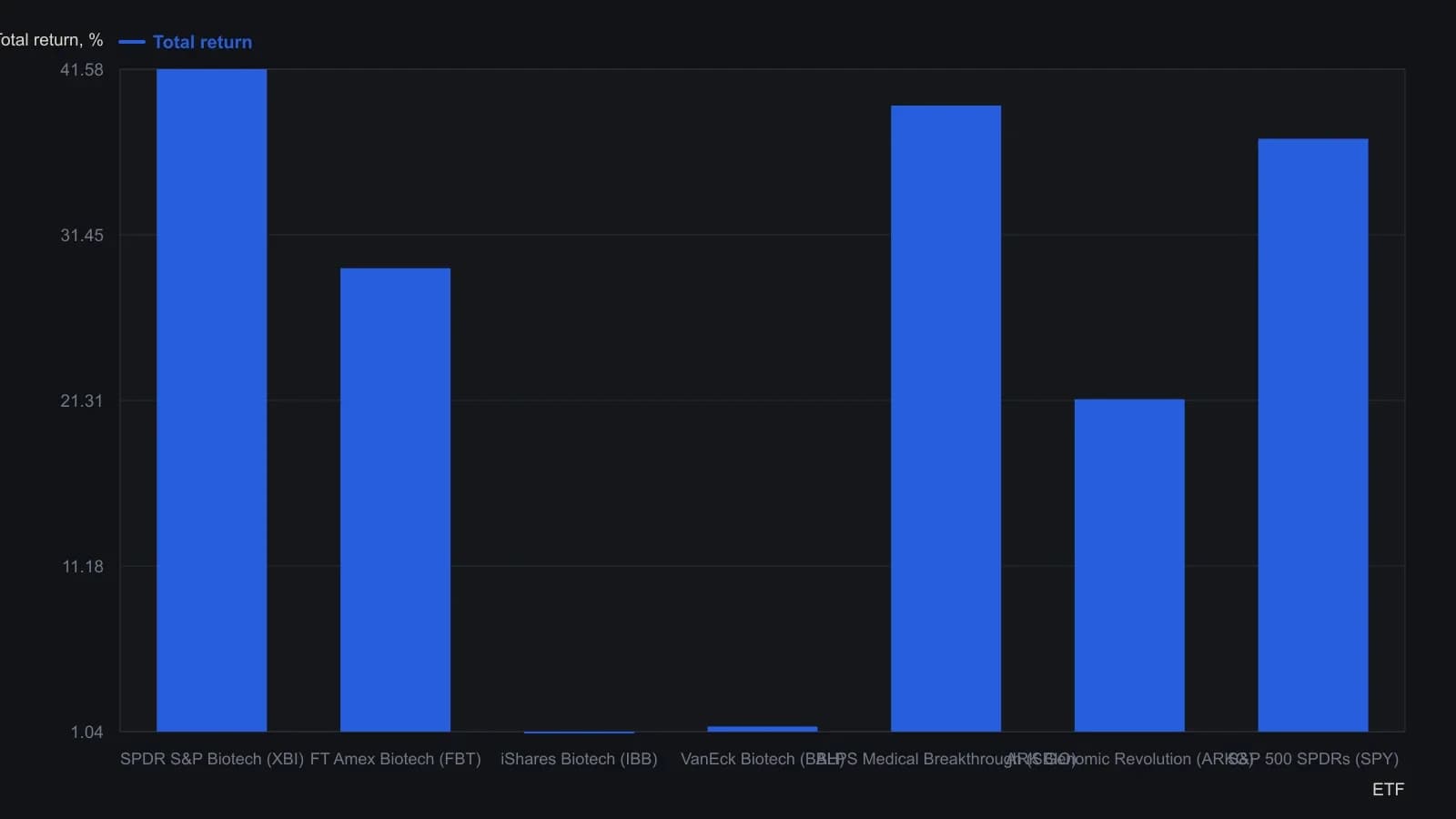
The window is the earliest common history for this set (SBIO listed 30 December 2014). The column text rounds the same results to about 40 percent for XBI and SBIO, 1 percent for IBB, and 37 percent for the S&P 500.
Measure drawdown, then precommit the halt
One stated retirement method is to treat early-year results as a Monte Carlo sample, measure average drawdown and its standard deviations, and stop using the system when live drawdown exceeds two standard deviations of a maximum historical drawdown.
Monte Carlo simulation, in this use, is a resampling of ordered historical outcomes used to estimate the average drawdown of a system and the dispersion of that drawdown. The largest peak-to-trough equity decline in that sample is the maximum historical drawdown. The measured dispersion is the standard deviation of drawdown, which turns the stop-using-the-system rule into a numeric bound.
The two-standard-deviation drawdown stop is presented as one example procedure, not as a unique or ultimate abandonment rule. A drawdown limit is the precommitted filter that retires or pauses a system when live equity loss exceeds a stated multiple of historically measured drawdown.
All readings on this track · 26 readings
- 1989Known-bias price streams for system evaluation
- 1989Constructing holdout-checked synthetic prices from chaos maps
- 1991Closing the feedback loop in auction market simulations
- 1994Evaluating eight-year election regimes
- 1995Constructing equity versus leverage with resampled trades
- 1995Stock leverage from compounded returns and margin cost
- 1996Constructing and optimizing volatility position-sizing profiles
- 1996Constructing fade rules from an empirical deviation histogram
- 1998Return-path volatility and the recovery burden
- 1999Monte Carlo checks beyond a single historical path
- 2002Monte Carlo equity paths from win rate and profit factor
- 2003Checking a small system edge with Monte Carlo simulation
- 2003Evaluate a mechanical trading system with a stop-loss order and Monte Carlo simulation
- 2005Evaluating momentum rank rotation under portfolio constraints
- 2009Bounded risk and rank rotation in portfolio construction
- 2010A calendar for walk-forward robustness and Monte Carlo evaluation
- 2012Treat the optimize view as an evaluation protocol
- 2013Entry, exit and abstention as one testable procedure
- 2014Evaluating stop and target bounds before fading large moves
- 2014Evaluating system exits when markets get noisier
- 2015Memory-bearing synthetics for dominant-cycle spectra
- 2015Constructing next-session implied-volatility forecasts by reordering closes
- 2016Mechanical systems as a gated factory
- 2017Four-sleeve Monte Carlo annual-loss bounds
- 2018When to retire a mechanical system with Monte Carlo drawdown limits
- 2020Treat mechanical system design as a revalidation lifecycle