2015issue C0526-28
Constructing next-session implied-volatility forecasts by reordering closes
A fixed implied-volatility-index lookback can be ranked by close instead of by date so next-session-change values accumulate along a cumulative-delta path. The live overlapping-window cannot observe the trough-close, so mean-substitution or linear-regression supplies the split and the finished rule is judged against a monte-carlo-simulation of random direction calls.
- A close-ranked-reorder treats calendar order as optional: the same implied-volatility-index window is sorted by descending close so next-session-change values can be accumulated out of calendar sequence.
- The trough-close is the ranked close where the cumulative-delta path is lowest, and it is meant to split sessions that more often precede a decline from those that more often precede a rise.
- A live overlapping-window cannot compute that trough-close, so mean-substitution or linear-regression supplies the missing split from already-known window inputs.
- Monte-carlo-simulation of random up-or-down calls on the same sessions is used only as a construction baseline for the finished rule.
Calendar order as a modeling choice
The archive stores an implied-volatility-index overlapping-window as the session date, the close, and the next-session-change assigned to the current row. Those three columns stay together when the window is reordered. The implied-volatility-index is the ordered input for the construction. It is not treated here as a standalone market-timing story.
Editorial reading: calendar order is a modeling choice. The construction inspects relationships that are not calendar-sequential by ranking the same lookback by close rather than by date.
Ranking closes and accumulating changes
A close-ranked-reorder sorts the stored rows by descending close. The next-session-change values are then accumulated in that non-calendar order to form a cumulative-delta path.
In the stored sample that path reaches a low and then turns higher. The close on the ranked row at that low is the trough-close, and it is the intended high-versus-low split.
Closes at or above that trough-close more often precede a next-session decline. Closes below it more often precede a next-session rise. In other overlapping windows the trough-close is frequently off-center rather than at the midpoint of the ranked series.
Cumulative next-session VIX change after ranking 30 closes
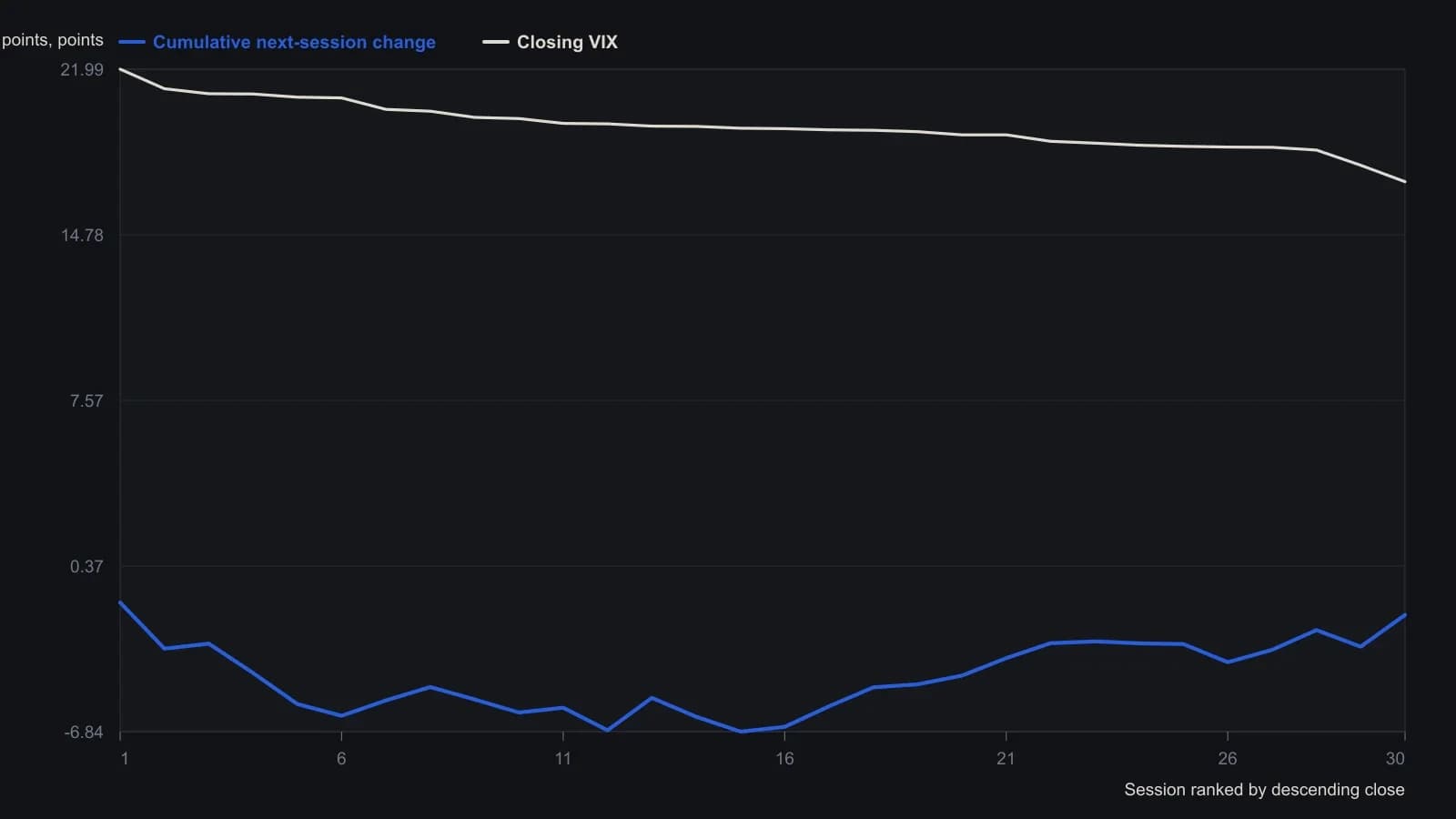
Next-session change is the following trading day's move in calendar time, carried with the row when the window is re-ranked; it is not the step to the next row after sorting. The 28 January 1997 row uses the subsequent session outside the 30-day window.
Why the live trough-close is missing
A window that ends on the current session lacks the final next-session-change. The live ranked series therefore cannot compute the cumulative-delta trough, and the trough-close must be estimated before a same-session forecast can be formed.
Estimating the unobserved split
Historical trough-close values tend to cluster near the middle of each ranked window. Mean-substitution therefore replaces the unobserved trough-close with the already-known window mean or median close.
Linear-regression is offered as an alternative estimator. A least-squares fit on several known window inputs is used to estimate the missing trough-close when the latest next-session-change is not yet available.
A direction null for the finished rule
The finished construction is examined on overlapping windows rebuilt at each new close. A monte-carlo-simulation of random daily up-or-down calls on those same sessions is used only as a construction baseline for the finished rule.
All readings on this track · 26 readings
- 1989Known-bias price streams for system evaluation
- 1989Constructing holdout-checked synthetic prices from chaos maps
- 1991Closing the feedback loop in auction market simulations
- 1994Evaluating eight-year election regimes
- 1995Constructing equity versus leverage with resampled trades
- 1995Stock leverage from compounded returns and margin cost
- 1996Constructing and optimizing volatility position-sizing profiles
- 1996Constructing fade rules from an empirical deviation histogram
- 1998Return-path volatility and the recovery burden
- 1999Monte Carlo checks beyond a single historical path
- 2002Monte Carlo equity paths from win rate and profit factor
- 2003Checking a small system edge with Monte Carlo simulation
- 2003Evaluate a mechanical trading system with a stop-loss order and Monte Carlo simulation
- 2005Evaluating momentum rank rotation under portfolio constraints
- 2009Bounded risk and rank rotation in portfolio construction
- 2010A calendar for walk-forward robustness and Monte Carlo evaluation
- 2012Treat the optimize view as an evaluation protocol
- 2013Entry, exit and abstention as one testable procedure
- 2014Evaluating stop and target bounds before fading large moves
- 2014Evaluating system exits when markets get noisier
- 2015Memory-bearing synthetics for dominant-cycle spectra
- 2015Constructing next-session implied-volatility forecasts by reordering closes
- 2016Mechanical systems as a gated factory
- 2017Four-sleeve Monte Carlo annual-loss bounds
- 2018When to retire a mechanical system with Monte Carlo drawdown limits
- 2020Treat mechanical system design as a revalidation lifecycle