2013issue C0642-51
Entry, exit and abstention as one testable procedure
Treat system evaluation as a two-gate test. Write entry, exit and skip so they can fire without a later human edit. Then resample completed trades so one historical order of fills cannot stand in for the procedure.
- Evaluate a mechanical-system in two gates: write entry, exit and skip so they fire without a later human edit, then resample completed trades.
- Rule-based-entry fires only when every listed bar, level or indicator condition is present at the same time.
- Abstention is a skip after a later filter fails, counted on the unedited-result-tape rather than treated as a missing trade.
- Monte-carlo-resampling builds many one-year paths from stored completed-trade outcomes so one historical fill order cannot stand in for the procedure.
A two-gate test for a mechanical-system
Editorial reading: evaluate a mechanical-system in two gates. First write entry, exit and skip so they can fire without a later human edit. Then resample the completed trades so one historical order of fills cannot stand in for the procedure.
The archive facts below describe a historical workflow. They do not establish present-day results.
Write the full procedure before scoring it
The archive reduced a completed position to the entry price, the loss exit, and the profit exit.
A reversal entry required a pin-shaped bar whose open and close sat in the top or bottom of the range, with a long tail, and only when that bar lined up with a support or resistance level.
That rule set was read from unmarked price charts across several time frames, without overlaying moving averages or other indicators.
Holding-style selects which setup can fire
Editorial reading: holding-style is the planned time in the trade that selects which setup conditions apply, such as a short swing versus a longer trend.
A separate mechanical service issued its own entry and exit alerts for intended holdings of days to a couple of weeks, so trade-class statistics could be collected without adding a discretionary overlay.
The mechanical search covered listed stocks and funds. Each candidate could be read as a swing, momentum, or trend setup, and the published alerts were limited to long entries.
A swing long waited for a cycle trough together with a momentum low. The alert was withheld until momentum reached an extreme negative reading, and the write-up wanted that momentum to turn up within a few days.
Count abstention on the same tape
Extra data-mined conditions discarded most otherwise valid setups before a paid entry alert was shown, so most first-pass patterns were recorded as skips.
Editorial reading: those skips are abstention. They belong on the unedited-result-tape as part of the same procedure, not as missing trades.
Resample so one fill order is not the procedure
Evaluation used two mechanical views of the unedited-result-tape. The first was a month-by-month profit-and-loss average. The second was a Monte Carlo draw of completed-trade outcomes from recent years to stand in for a year of trading, shown as a distribution that could finish higher or lower.
Editorial reading: that second view is monte-carlo-resampling. It draws completed-trade outcomes at random from a stored set to build many one-year paths instead of reading only the original sequence.
Monte Carlo distribution of one-year StockSpotter profit
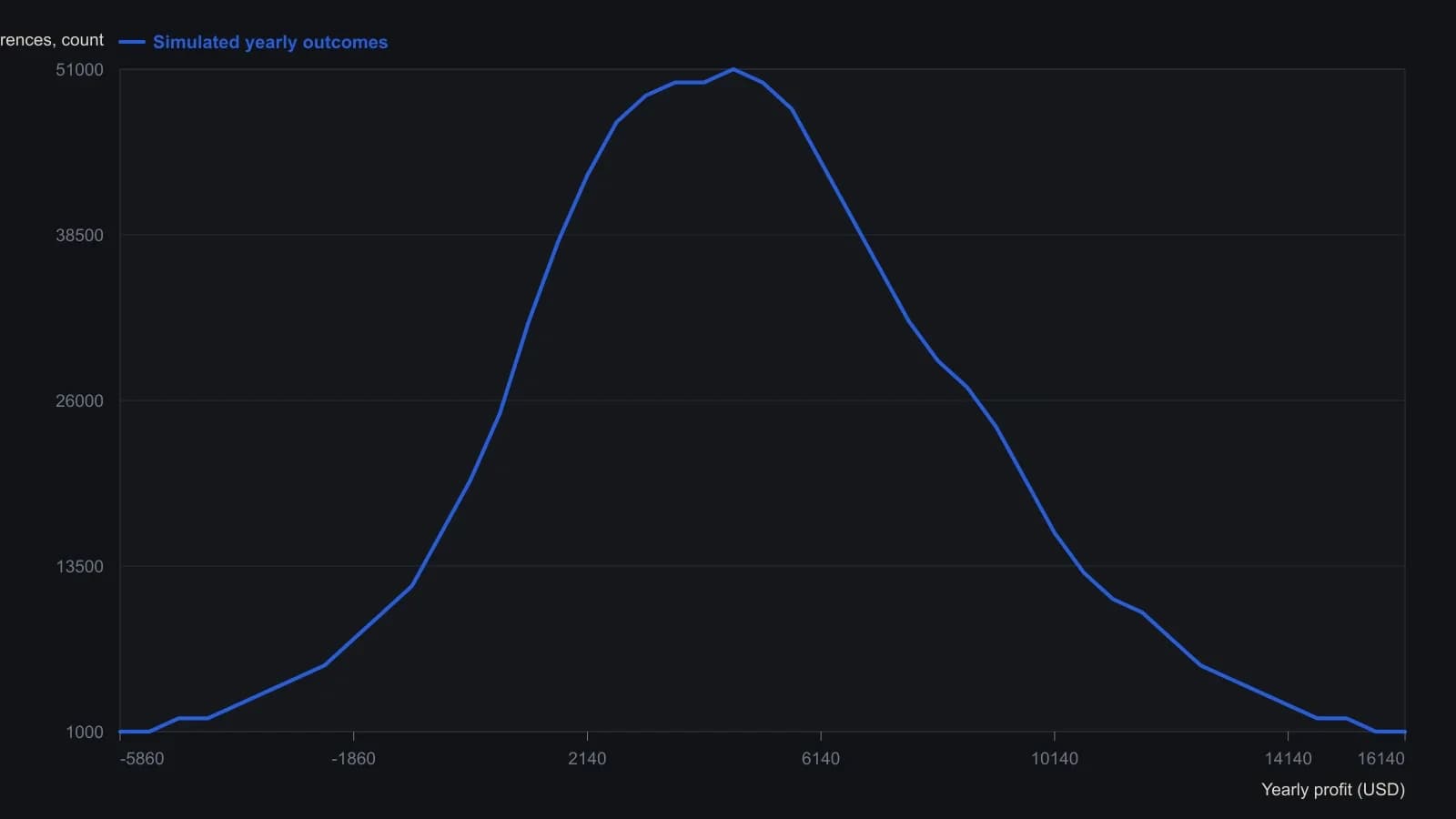
Each simulated year draws 200 completed-signal profits and keeps $10,000 in the market. The review also prints an 89 percent chance of finishing above breakeven and a Sharpe ratio of 1.3; those two figures are not plotted. Occurrence counts are approximate readings from the raster, rounded to the nearest thousand.
All readings on this track · 26 readings
- 1989Known-bias price streams for system evaluation
- 1989Constructing holdout-checked synthetic prices from chaos maps
- 1991Closing the feedback loop in auction market simulations
- 1994Evaluating eight-year election regimes
- 1995Constructing equity versus leverage with resampled trades
- 1995Stock leverage from compounded returns and margin cost
- 1996Constructing and optimizing volatility position-sizing profiles
- 1996Constructing fade rules from an empirical deviation histogram
- 1998Return-path volatility and the recovery burden
- 1999Monte Carlo checks beyond a single historical path
- 2002Monte Carlo equity paths from win rate and profit factor
- 2003Checking a small system edge with Monte Carlo simulation
- 2003Evaluate a mechanical trading system with a stop-loss order and Monte Carlo simulation
- 2005Evaluating momentum rank rotation under portfolio constraints
- 2009Bounded risk and rank rotation in portfolio construction
- 2010A calendar for walk-forward robustness and Monte Carlo evaluation
- 2012Treat the optimize view as an evaluation protocol
- 2013Entry, exit and abstention as one testable procedure
- 2014Evaluating stop and target bounds before fading large moves
- 2014Evaluating system exits when markets get noisier
- 2015Memory-bearing synthetics for dominant-cycle spectra
- 2015Constructing next-session implied-volatility forecasts by reordering closes
- 2016Mechanical systems as a gated factory
- 2017Four-sleeve Monte Carlo annual-loss bounds
- 2018When to retire a mechanical system with Monte Carlo drawdown limits
- 2020Treat mechanical system design as a revalidation lifecycle