1989issue C021-6
Known-bias price streams for system evaluation
Technical trading systems can be evaluated on historical, live, or computer-generated prices. Series built with a known trend-percentage make that evaluation statistical rather than anecdotal.
- Technical trading systems can be evaluated on historical, live, or computer-generated prices, and series built with a known trend-percentage make that evaluation statistical rather than anecdotal.
- When each increment is equally likely to be an uptick or a downtick of the same size, runs of two to four consecutive moves in one direction still occur, so unbiased random generation already produces trends.
- An adaptive-rule-set that revises rules from the character of the price stream requires a known trend target. Otherwise the evaluator cannot tell whether the system adapted.
- Non-repeating generated streams that carry a known trend-percentage and omit periodic waveforms such as sine waves are presented as a suitable test bed for technical trading systems.
Evaluation on generated prices
Technical trading systems can be evaluated on historical, live, or computer-generated prices. Series built with a known trend-percentage make that evaluation statistical rather than anecdotal.
Unbiased increments still form runs
When each increment is equally likely to be an uptick or a downtick of the same size, runs of two to four consecutive moves in one direction still occur. Unbiased random generation already produces trends.
Averaging the five most recent increments and taking the sign of that average yields a trend indicator. That indicator can be used to build streams with a chosen bias, including 10 percent or 20 percent trend.
The trend-percentage is the imposed statistical bias that makes successive increments more likely to continue a signed direction than to reverse it.
Bounds that reverse the increment
Generated streams can wander without limit unless a high-price and low-price bound is applied, and such bounds are often desirable.
A range-constrained-stream is a generated price path forced back inside those stated bounds by reversing the increment sign at the boundary. After an initial signed increment is drawn with a specified trend bias, a breach of the low bound forces a positive increment and a breach of the high bound forces a negative increment before the next price is computed.
Unrestricted vs range-limited generated prices
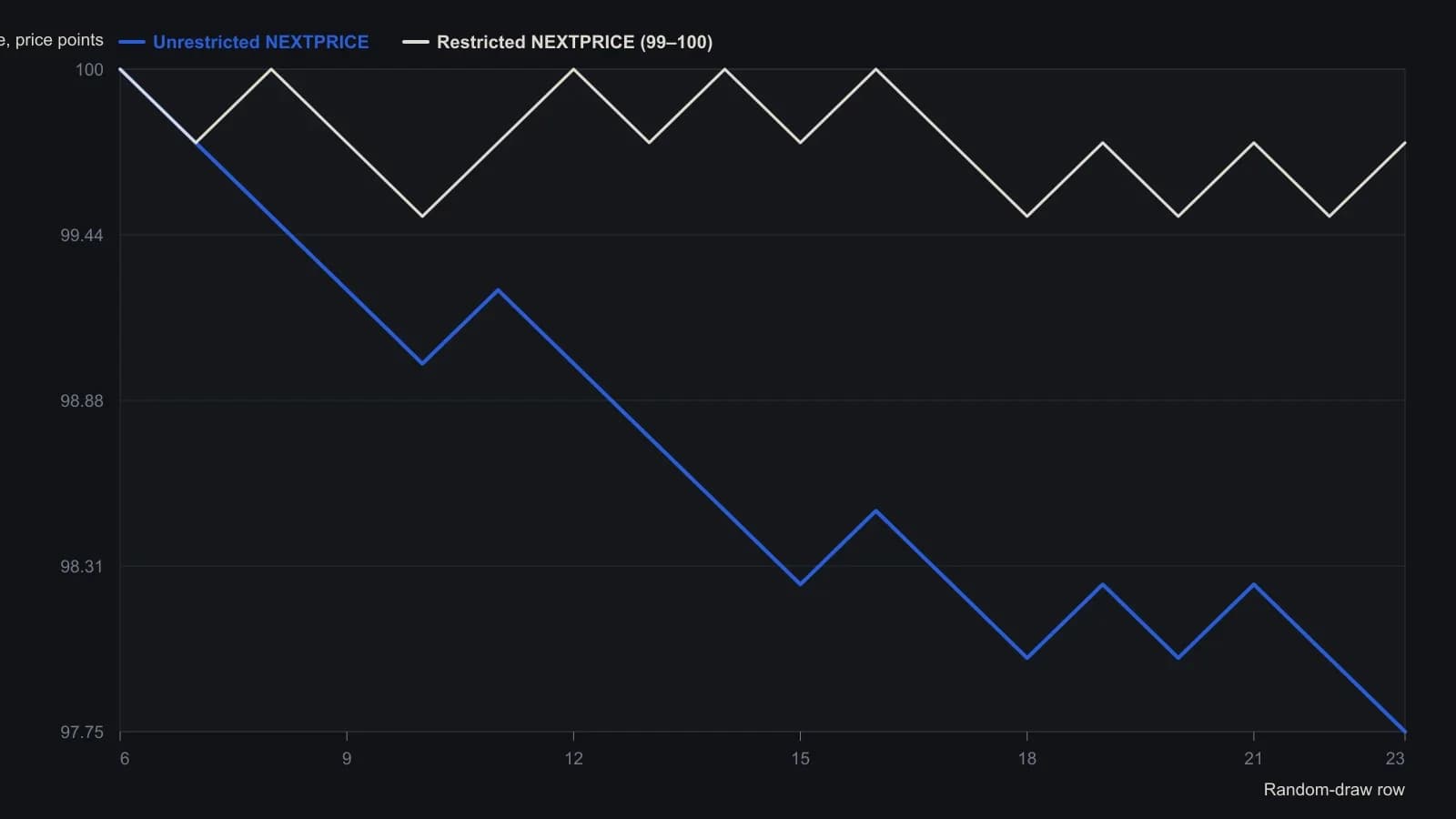
Trend percentage is fixed at 0.1. AVDELTA needs five prior DELTA values, so NEXTPRICE is first stated on random-draw row 6. Restricted stream is clipped to 99–100.
Illustrated streams that did not repeat
One illustrated construction produced 50 points with a 20 percent statistical-trend bias. A second family of 200-point streams started at 100 and compared 0, 20, 40, and 60 percent trend settings, and none of those streams repeated.
A known target for adaptive rules
An adaptive-rule-set revises its own rules from the observed character of the price stream. Adaptive systems that revise rules from the character of the price stream require a known trend target. Otherwise the evaluator cannot tell whether the system adapted.
Non-repeating generated streams that carry a known trend-percentage and omit periodic waveforms such as sine waves are presented as a suitable test bed for technical trading systems.
All readings on this track · 26 readings
- 1989Known-bias price streams for system evaluation
- 1989Constructing holdout-checked synthetic prices from chaos maps
- 1991Closing the feedback loop in auction market simulations
- 1994Evaluating eight-year election regimes
- 1995Constructing equity versus leverage with resampled trades
- 1995Stock leverage from compounded returns and margin cost
- 1996Constructing and optimizing volatility position-sizing profiles
- 1996Constructing fade rules from an empirical deviation histogram
- 1998Return-path volatility and the recovery burden
- 1999Monte Carlo checks beyond a single historical path
- 2002Monte Carlo equity paths from win rate and profit factor
- 2003Checking a small system edge with Monte Carlo simulation
- 2003Evaluate a mechanical trading system with a stop-loss order and Monte Carlo simulation
- 2005Evaluating momentum rank rotation under portfolio constraints
- 2009Bounded risk and rank rotation in portfolio construction
- 2010A calendar for walk-forward robustness and Monte Carlo evaluation
- 2012Treat the optimize view as an evaluation protocol
- 2013Entry, exit and abstention as one testable procedure
- 2014Evaluating stop and target bounds before fading large moves
- 2014Evaluating system exits when markets get noisier
- 2015Memory-bearing synthetics for dominant-cycle spectra
- 2015Constructing next-session implied-volatility forecasts by reordering closes
- 2016Mechanical systems as a gated factory
- 2017Four-sleeve Monte Carlo annual-loss bounds
- 2018When to retire a mechanical system with Monte Carlo drawdown limits
- 2020Treat mechanical system design as a revalidation lifecycle