2016issue C0646-54
Constructing ATR-filtered breakout entries
A swing long is specified as a volatility-and-trend setup, a buy-stop that may expire unused, and a 2-dollar per-share risk bound checked against average true range before size is accepted. Universe screens need unadjusted history, and the same rules can flag new setups or submit both orders.
- A setup is complete only when a close crosses above a 100-period simple moving average, 14-period average true range is at a 14-bar high, and the current bar is a wide-range bar whose range exceeds 1.5 times the recent average range.
- The long is not taken on the setup close. A buy-stop is placed 0.50 above the setup-bar high, and a setup timeout or a recross below the moving average can leave that order unused.
- The per-share risk bound is a fixed 2-dollar initial stop, reused as a trailing stop, and compared with average true range before any size is accepted.
- A universe screen of mid-price, recent dollar range, and average daily volume must be tested on unadjusted series, and the same rules can flag new setups or submit both orders as a strategy object.
The long setup, the buy-stop, and the per-share risk bound are specified as separate rules. A setup is a bar that jointly satisfies a close crossing above a long simple moving average, average true range at a lookback high, and a wide-range expansion test. The long is not taken on that close. Entry waits on a later trade through a buy-stop, and size waits on a check against the per-share risk bound.
The volatility and trend setup
The long setup is complete only when a close crosses above a 100-period simple moving average, 14-period average true range is at a 14-bar high, and the current bar range exceeds 1.5 times the recent average range. That last test is the required wide-range bar. The average-true-range filter admits a setup only when current average true range is at a short-window high, so low-range names are withheld.
Wide-range-bar and rising-volume flags can be listed as extra confirmation columns without being required to generate the setup.
A buy-stop that may expire unused
The long is not taken on the setup close. A buy-stop is placed 0.50 above the setup-bar high and fills only if a later bar trades through that level. Because the fill may occur on a later bar, one recoding cancels an unused setup after a fixed number of bars so a stale buy-stop cannot remain live. That bar limit is the setup timeout.
A setup can expire with no trade if price recrosses below the moving average before any bar exceeds the buy-stop threshold.
The per-share risk bound and trailing stop
The specified risk bound is a fixed 2-dollar per-share initial stop that is also applied as a trailing stop after the position is open. The per-share risk bound is set before entry and is used to accept or reject size once stop distance is known. The trailing stop starts as that per-share bound and then follows price so the long exits when a later bar trades through the updated level.
When average true range at the entry bar exceeds the fixed dollar stop, a later open can gap through that stop even on an up bar, so the stop distance is a volatility-relative size check made before the order is accepted.
NUGT daily close and 100-day average
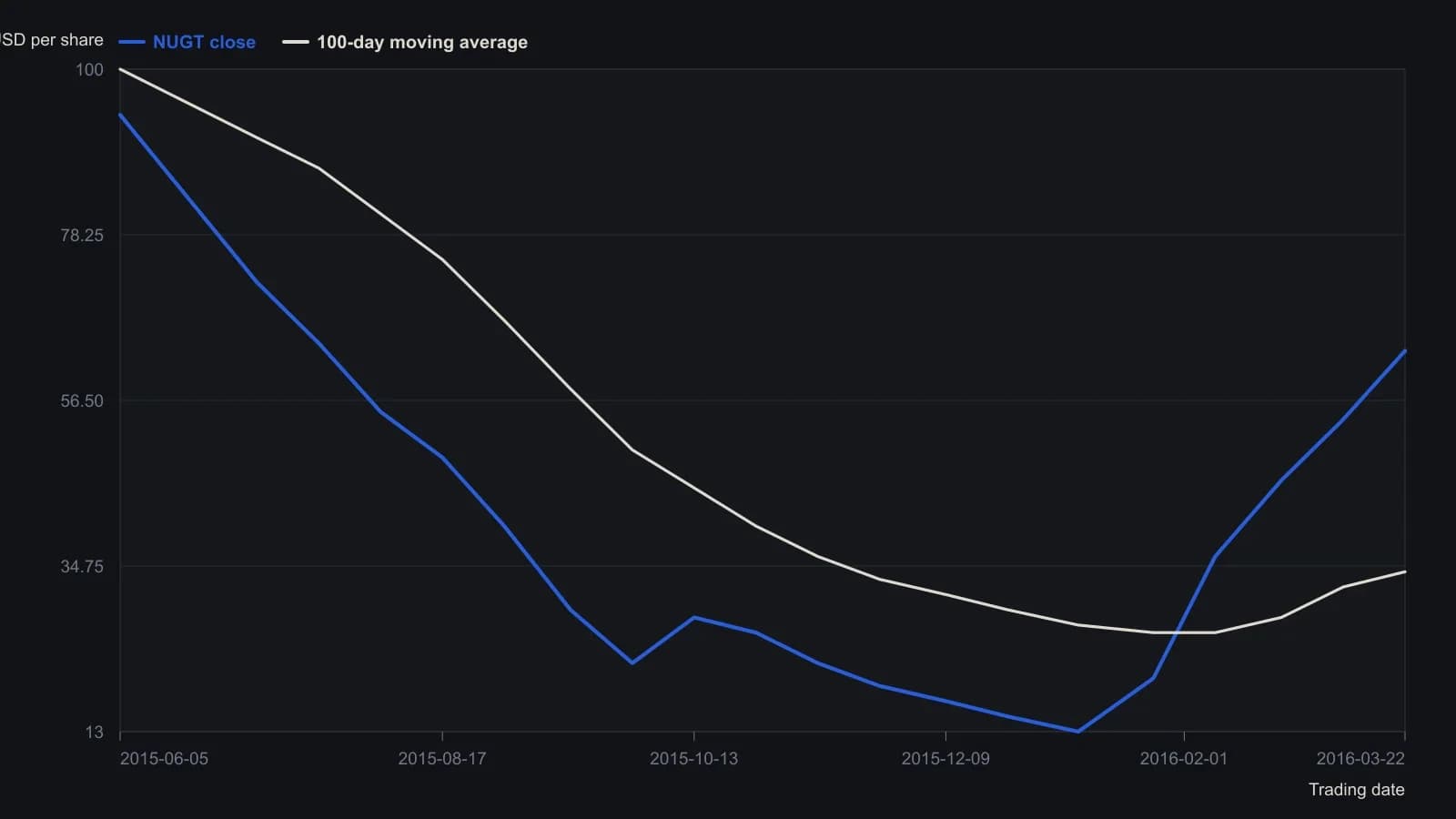
Visual reads from the Excel window (y-ticks every $20, about 200 daily bars). Only the 1 February 2016 print is exact (cursor: open 26.45, high 28.17, low 26.26, close 28.00, ATR 2.62). Other prices are to the nearest dollar. The workbook used a $4 trailing stop after noting ATR was 3.12 on the February entry, so the article’s $2 stop sat inside current range. Close-adjusted history was on.
Universe screens need unadjusted history
Candidate scans add a universe screen before the setup test, including a mid-price band, a minimum recent dollar range, and a minimum average daily volume. Hardcoded price and volume thresholds applied to split-adjusted history can admit symbols that never traded in the intended band, so unadjusted series are required for a valid historical test of those filters.
Scanner flags and strategy orders
The same rules can be packaged as a scanner or chart alert that only flags new setups and as a strategy object that submits the buy-stop and the per-share stop for historical testing.
All readings on this track · 36 readings
- 1988Constructing unsigned true range for directional models
- 1989Evaluate an always-in ATR breakout as one procedure
- 1992Variable lookback and average true range as a trend-filter construction
- 1993A random-walk index that uses true range as its scale
- 1993A shared harness for trend-filter construction
- 1998Finish a trend with a volatility trail, wave permission, and a slower-frame veto
- 1999A trend filter that switches tactics and scales ATR targets
- 2001Filter higher lows with linear regression, then judge the exit
- 2003A Mechanical trading system is a maintained procedure, not only an entry trigger
- 2005Construction of a volatility-bounded long entry
- 2005Six-zone encoding of open, high, low, and close
- 2006Normalized average true range as a pre-entry volatility bound
- 2006Chandelier exits, ATR position sizing, and trailing stops
- 2007Constructing a rule-based entry with Relative Strength Index and ATR position sizing
- 2008Constructing a zero-lag TMA and heikin-ashi crossover as a complete rule set
- 2010Use the session-range percent stop as a pre-trade filter
- 2011OCA exit groups, trailing limits, and ATR stops
- 2011ATR bands around support and resistance for stops and targets
- 2013Algorithmic head-and-shoulders construction with bounded exits
- 2013Constructing ATR-scaled swing pivots and linear-regression divergence
- 2013Constructing volatility bands from typical price
- 2014Constructing true-range contraction filters before expansion
- 2015Constructing touch plans from modified true range
- 2015One checklist for breakout entry and ATR risk
- 2015Percentage true-range construction for cross-market volatility filters
- 2015Construct a percentage true range for cross-market volatility
- 2015Percentage true range as a pre-entry exposure filter
- 2016Constructing ATR-filtered breakout entries
- 2017A dividend date as a pairs-trading classroom
- 2018Range-based volatility as a true-range construction
- 2018Moving average support and volatility-band construction
- 2018Construct a lifecycle breakout from compression
- 2018Pair the book first and let volatility or range set the size
- 2019Trend systems need a no-trade rule
- 2020Average true range as a shared unit for size, pairs, and stops
- 2020Volatility sizing and target-risk leverage as a pre-trade gate