2001issue C101-5
Filter higher lows with linear regression, then judge the exit
A higher-low sequence is late and noisy until Linear regression decides which lows are worth acting on. Entry waits for a later close-stop confirmation, and the same entry was judged by how ATR position sizing and a Stop-loss order changed drawdowns rather than by headline gain.
- A higher-low sequence is treated as a late and noisy signal unless a filter decides which lows are worth acting on.
- Linear regression of recent lows creates a buy setup when the current low stays above the regression projection of the prior lookback window, but entry waits for a later close-stop confirmation.
- The same Linear regression entry produced similar point totals across three exits, so evaluation focused on drawdowns, consecutive losers, and time in the market rather than headline gain.
- An ATR-based stop widens or tightens with volatility. A conventional Stop-loss order can bound drawdowns more tightly than using the same regression of lows as an exit.
Why a higher-low sequence is not enough
A higher-low sequence is treated as a late and noisy signal unless an additional filter decides which lows are worth acting on.
Linear regression as the confirmation filter
Linear regression of recent lows is used as that filter. A buy setup occurs when the current low stays above the regression projection of the prior lookback window.
Entry is delayed until a later close-stop confirmation rather than taken immediately when the regression setup appears.
S&P 500 daily with linear-regression lows
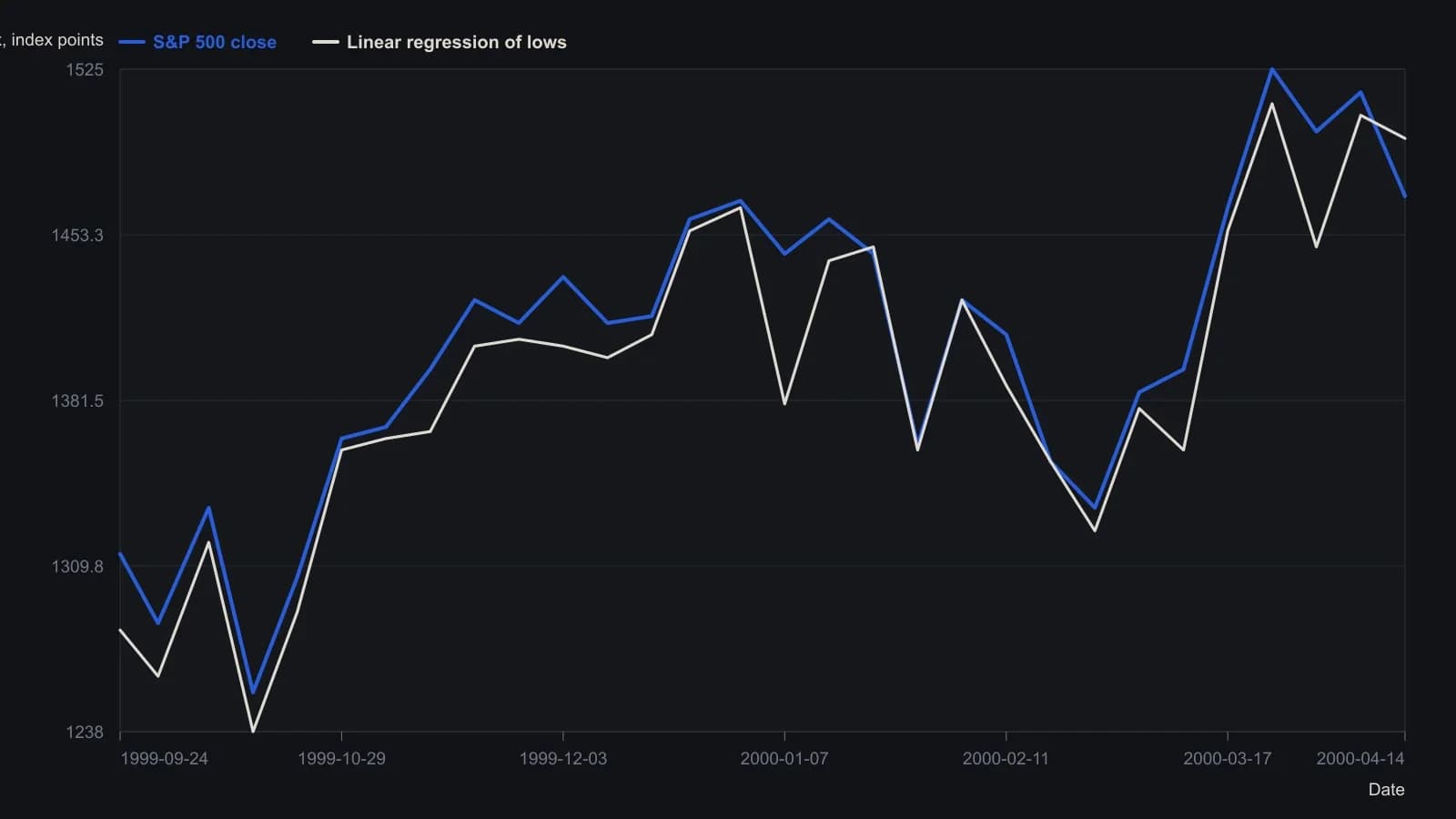
Values are approximate visual readings from the published daily chart (about five index points). The software header quotes 31 May 2001, but the plotted window runs from late September 1999 through mid-April 2000.
An ATR-based stop that follows volatility
ATR position sizing applies an ATR-based stop that subtracts a multiple of recent average true range from a recent high so the exit level widens or tightens with volatility.
Similar point totals, different drawdown behavior
The same Linear regression entry produced similar point totals across three exits, so evaluation focused on drawdowns, consecutive losers, and time in the market rather than headline gain.
The ATR exit captured sustained advances but generated repeated small losses during later consolidation, showing the need to inspect regime quality rather than average results alone.
A stop-loss bound versus a regression exit
Pairing the Linear regression entry with a conventional Stop-loss order or money-management stop was also considered, to bound drawdowns more tightly.
Using the same Linear regression of lows as an exit was examined and judged weaker than the more common ATR exit.
All readings on this track · 36 readings
- 1988Constructing unsigned true range for directional models
- 1989Evaluate an always-in ATR breakout as one procedure
- 1992Variable lookback and average true range as a trend-filter construction
- 1993A random-walk index that uses true range as its scale
- 1993A shared harness for trend-filter construction
- 1998Finish a trend with a volatility trail, wave permission, and a slower-frame veto
- 1999A trend filter that switches tactics and scales ATR targets
- 2001Filter higher lows with linear regression, then judge the exit
- 2003A Mechanical trading system is a maintained procedure, not only an entry trigger
- 2005Construction of a volatility-bounded long entry
- 2005Six-zone encoding of open, high, low, and close
- 2006Normalized average true range as a pre-entry volatility bound
- 2006Chandelier exits, ATR position sizing, and trailing stops
- 2007Constructing a rule-based entry with Relative Strength Index and ATR position sizing
- 2008Constructing a zero-lag TMA and heikin-ashi crossover as a complete rule set
- 2010Use the session-range percent stop as a pre-trade filter
- 2011OCA exit groups, trailing limits, and ATR stops
- 2011ATR bands around support and resistance for stops and targets
- 2013Algorithmic head-and-shoulders construction with bounded exits
- 2013Constructing ATR-scaled swing pivots and linear-regression divergence
- 2013Constructing volatility bands from typical price
- 2014Constructing true-range contraction filters before expansion
- 2015Constructing touch plans from modified true range
- 2015One checklist for breakout entry and ATR risk
- 2015Percentage true-range construction for cross-market volatility filters
- 2015Construct a percentage true range for cross-market volatility
- 2015Percentage true range as a pre-entry exposure filter
- 2016Constructing ATR-filtered breakout entries
- 2017A dividend date as a pairs-trading classroom
- 2018Range-based volatility as a true-range construction
- 2018Moving average support and volatility-band construction
- 2018Construct a lifecycle breakout from compression
- 2018Pair the book first and let volatility or range set the size
- 2019Trend systems need a no-trade rule
- 2020Average true range as a shared unit for size, pairs, and stops
- 2020Volatility sizing and target-risk leverage as a pre-trade gate