2016issue C037-9
Risk-adjusted earnings yield as a portfolio overlay
A single-name idea can be admitted, sized, or parked by comparing its earnings yield with a risk-adjusted required-return hurdle, so construction sits in a weeks-to-months valuation regime rather than in an isolated chart setup.
- A payback-period reading of a price-to-earnings multiple treats future earnings as constant and names as equally risky, and both assumptions fail in ordinary markets.
- Earnings yield is the inverse of that multiple and can be read analogously to the current yield on a perpetual bond, with earnings standing in for coupon cash flows.
- The overlay signal is the short-run gap between expected return, written as earnings over price, and required return, written as a risk-free rate plus a risk premium.
- Aberration packs that gap into one residual, scoring a single name against equilibrium rather than against a peer multiple screen.
A multiple is not a construction filter
A payback-period reading of a price-to-earnings multiple only holds if future earnings are treated as constant and names are treated as equally risky. Both assumptions fail in ordinary markets.
Inverting the multiple produces an earnings yield that can be read analogously to the current yield on a perpetual bond, with earnings standing in for coupon cash flows. Earnings yield is the market-implied expected return on equity capital.
Expected return versus required return
Expected return can be written as earnings over price, while required return can be written as a risk-free rate plus a risk premium. Required return is a hurdle that scales with systematic risk exposure.
Long-run parity is assumed between expected and required returns. Short-run gaps arise when earnings estimates or risk perceptions shift, and those gaps are the overlay signal.
How the residual is supposed to close
When earnings yield exceeds the required-return hurdle, competitive bidding is described as lifting price until the two rates meet. The opposite gap is described as inviting selling until the yield rises enough to restore balance.
Convergence of expected and required returns is described as faster in markets with higher information efficiency, where information is processed cheaply and short-selling costs are low. The price-to-earnings level implied once the two rates have converged is the equilibrium multiple.
Aberration as a single-name overlay
Aberration is defined as earnings yield minus the sum of the risk-free rate and the risk premium. It combines company profitability and perceived riskiness in one equilibrium residual and is used as a misvaluation overlay instead of a peer-multiple rank.
The overlay is illustrated with a listed Nordic forest-products manufacturer observed as underperforming. The workflow scores that single name against the equilibrium residual rather than a peer multiple screen.
Printed earnings-yield stack versus the risk-adjusted hurdle
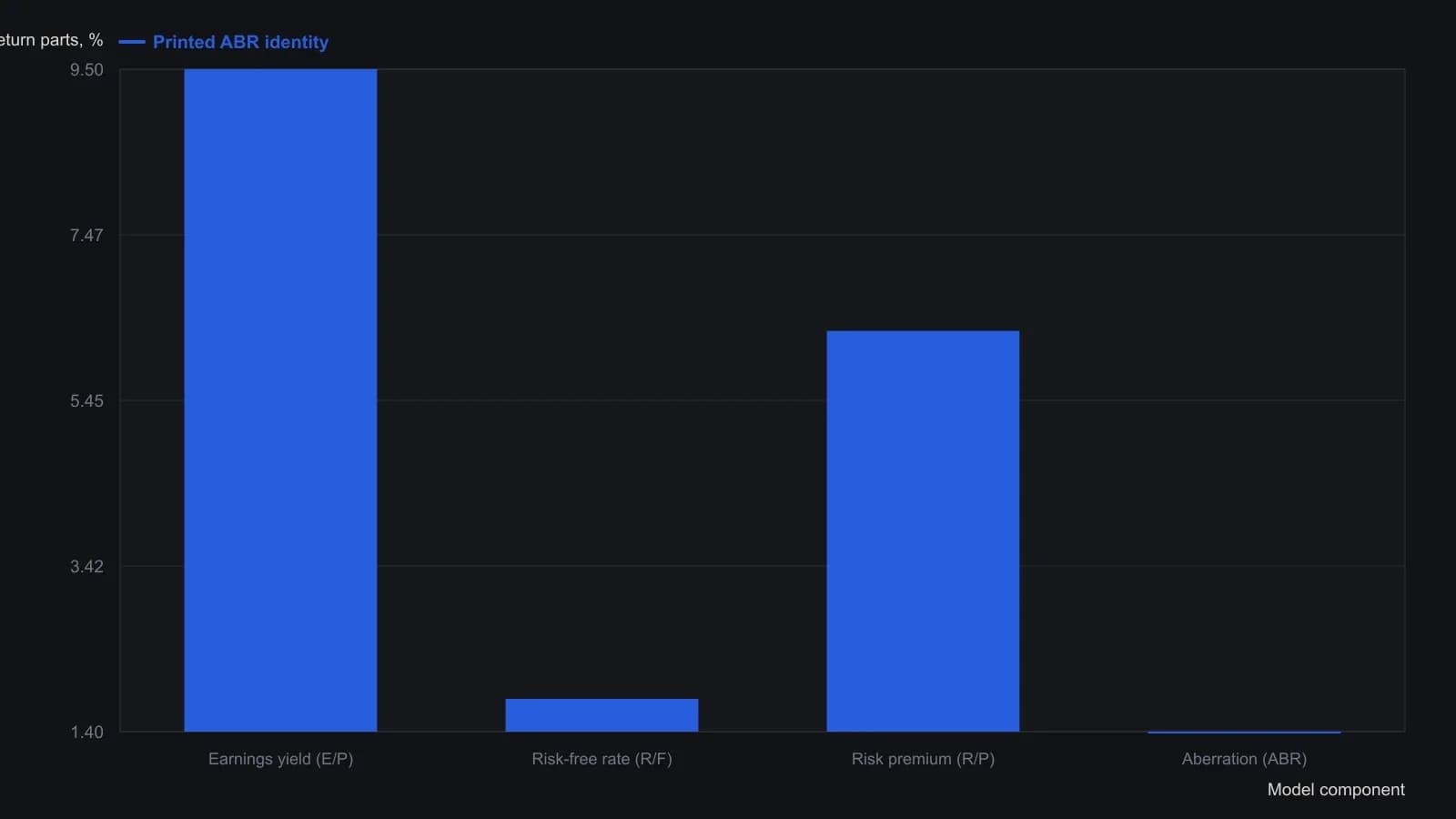
The figure also prints P/E as 10.5 percent. That is the multiple implied by the 9.5 percent earnings yield, not a fifth yield, so it is left off the bars. Required return is not printed as a single total; only its two parts are.
All readings on this track · 21 readings
- 1991Growth earnings and price-to-earnings as a market-regime overlay
- 1991Earnings-price reliability as a first gate for growth-sleeve construction
- 1991Growth-adjusted earnings years as construction filters
- 1992Constructing an index nominal from smoothed earnings and effective rates
- 1992Real bond yields as a deficit-share regime
- 1994Relative valuation as regime context for fund allocation
- 1995A flattening trendline as a critique of the fundamental overlay
- 1998An earnings-to-price mapping is unfinished until add, reduce, and stand-aside are rules
- 1999Regime-aware stock exposure when rates and market condition agree
- 2002Short-rate velocity regimes before tightening
- 2003A pre-trade checklist that requires rule and fundamental agreement
- 2004Evaluating P/E overlays with matched crossovers
- 2004Constructing a stock-versus-bond regime from earnings yields
- 2012Cash-rich relative strength as a pre-trade portfolio filter
- 2012Inactivity as a feature: a small-cap earnings overlay with a monthly average and weekly MACD
- 2015Evaluating a capitalization-to-output-ratio as a regime overlay
- 2016Risk-adjusted earnings yield as a portfolio overlay
- 2017Oil, yields, and implied volatility as a regime critique
- 2017When a one-year bull sits inside a secular bear
- 2018A critique of rules-only trading systems
- 2019When seasonal and policy regimes override crowd mood