1992issue C031-10
Constructing an index nominal from smoothed earnings and effective rates
A least-squares earnings path and an effective-interest-rate produce a nominal-value for the broad composite. Yield-correction and a dividend-ratio overlay then place the industrial average in the same rate regime, rather than against a headline multiple.
- Index level is built as earnings over an effective-interest-rate, not as a standalone price-to-earnings multiple.
- Average-earnings is a least-squares yearly path dated one year, or four quarters, ahead of the price observation.
- Yield-correction and dividend-ratio let the industrial average share the same least-squares-baseline as the broad composite.
- A sharp earnings drop can push a reported multiple above 100 while the rate-based nominal-value remains the comparison path.
A rate-based index identity
The archive constructs the index level as proportional to earnings divided by a composite effective-interest-rate. That construction is not a standalone price-to-earnings multiple.
The fitted result is a nominal-value: the index level implied by smoothed forward earnings, the effective-interest-rate, and yield corrections.
Average-earnings one year ahead
The earnings input is a smoothed yearly path dated one year, or four quarters, ahead of the price observation rather than the latest quarterly print.
That average-earnings path is obtained by a least-squares fit in calendar time defined as year plus quarter divided by four, offset from 1900.
Building the effective-interest-rate
The effective-interest-rate combines a three-month bill yield with spreads to a long bond and to year-over-year consumer-price change. It then enters as a power of the bill yield with a slowly drifting exponent.
A separate dividend-yield multiplier of a few percent is applied so payout changes adjust the fitted composite level. That small multiplier is the yield-correction.
Transferring the baseline across indices
The industrial-average construction reuses the same smoothed composite earnings scaled by ten, then applies its own yield-correction and a piecewise correction based on the dividend-ratio versus the broad index.
The dividend-ratio is the relative payout of the industrial average versus the broad composite, used to transfer the least-squares-baseline across indices.
Five-year averages and reported multiples
Five-year moving averages of price, earnings, and dividend ratios show the industrial average's premium to the composite beginning to fade in 1958, before its earnings ratio deteriorates.
Because the industrial average does not move in proportion to its own reported earnings, a sharp earnings drop can produce a price-to-earnings reading above 100 even while the rate-based nominal series is still the comparison path.
Weekly sampling of the least-squares-baseline
The least-squares output is treated as a nominal-value that can be sampled weekly and compared with the industrial average as a rate-regime overlay.
The least-squares-baseline is that fitted identity, used as the out-of-sample comparison path for the observed index.
Weekly DJIA versus model nominal value, 1989–1991
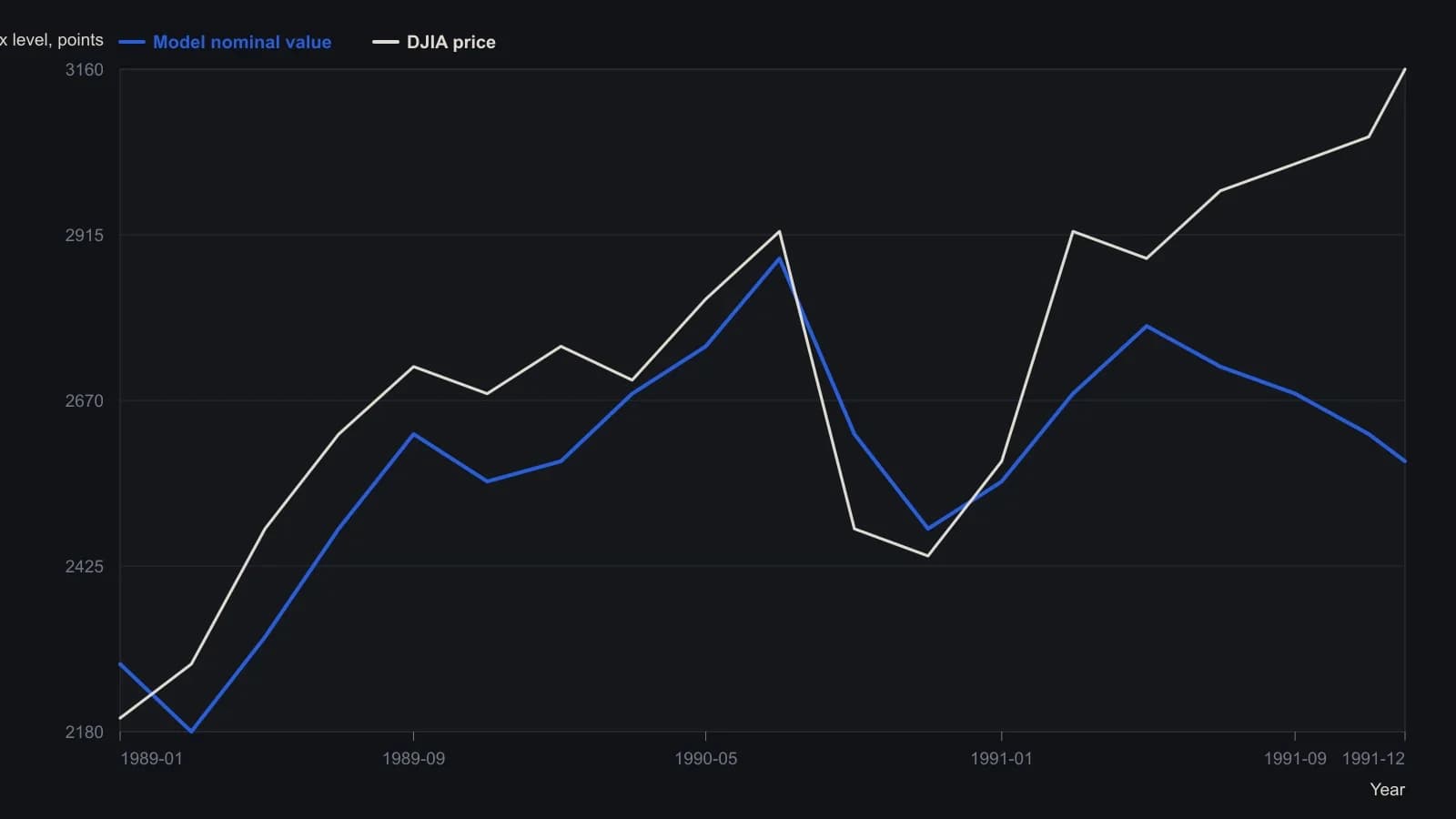
Raster digitization of the 1989–1991 weekly panel; y-values are approximate to the published 200-point grid. Mean-error and variance cited in the article belong to the longer Figure 5 sample, not this weekly window.
All readings on this track · 21 readings
- 1991Growth earnings and price-to-earnings as a market-regime overlay
- 1991Earnings-price reliability as a first gate for growth-sleeve construction
- 1991Growth-adjusted earnings years as construction filters
- 1992Constructing an index nominal from smoothed earnings and effective rates
- 1992Real bond yields as a deficit-share regime
- 1994Relative valuation as regime context for fund allocation
- 1995A flattening trendline as a critique of the fundamental overlay
- 1998An earnings-to-price mapping is unfinished until add, reduce, and stand-aside are rules
- 1999Regime-aware stock exposure when rates and market condition agree
- 2002Short-rate velocity regimes before tightening
- 2003A pre-trade checklist that requires rule and fundamental agreement
- 2004Evaluating P/E overlays with matched crossovers
- 2004Constructing a stock-versus-bond regime from earnings yields
- 2012Cash-rich relative strength as a pre-trade portfolio filter
- 2012Inactivity as a feature: a small-cap earnings overlay with a monthly average and weekly MACD
- 2015Evaluating a capitalization-to-output-ratio as a regime overlay
- 2016Risk-adjusted earnings yield as a portfolio overlay
- 2017Oil, yields, and implied volatility as a regime critique
- 2017When a one-year bull sits inside a secular bear
- 2018A critique of rules-only trading systems
- 2019When seasonal and policy regimes override crowd mood