1988issue C021-4
A two-rule classroom book of cheapness and new highs
A social-problems class built a model book by letting each student hold one New York Stock Exchange common stock under a cheapness gate and a new-high gate. Sparse reviews, familiar-name clustering, and later listing events then reshaped that book.
- Every student name entered through the same non-chart pair: a price-earnings gate near a ratio of ten and a new daily price high.
- The model book held one New York Stock Exchange name per student and used listing-termination when an issue was delisted, merged, or renamed.
- Sparse midyear and year-end reviews left mergers, a split, and other distributions untracked, so some names later looked missing or cheaper.
- Commentary-insulation kept conflicting market letters out so the two published rules remained the only decision inputs.
A one-name book for the school year
A senior social-problems unit spent a class hour on exchange listing symbols, then limited the selection exercise to two short periods. Those periods included a briefing on the allowed rules.
With prices moving sideways, each student chose one New York Stock Exchange common stock to hold for the school year. The model book was that collection of names, reviewed only at midyear and year-end.
A student holding ended if the chosen issue was later delisted, merged, or renamed. That listing-termination rule was the construction close when the listing itself ended.
Cheapness on a new-high gate
The only allowed gates were a new daily price high and a price-earnings ratio as close to ten as possible. Charts, graphs, and outside research files were not used.
Value investing, in this book, was a price-earnings gate that preferred listed common stocks priced near a ratio of ten, used to keep each pick inside a simple cheapness bound.
The momentum strategy was a timing rule that required a new daily price high before a name could be chosen, then held that name for the school-year horizon unless the listing itself ended.
The fundamental overlay was the pair of non-chart filters, valuation plus a fresh daily high, applied uniformly so every student name entered the same model book.
Classroom two-rule book: return by NYSE name
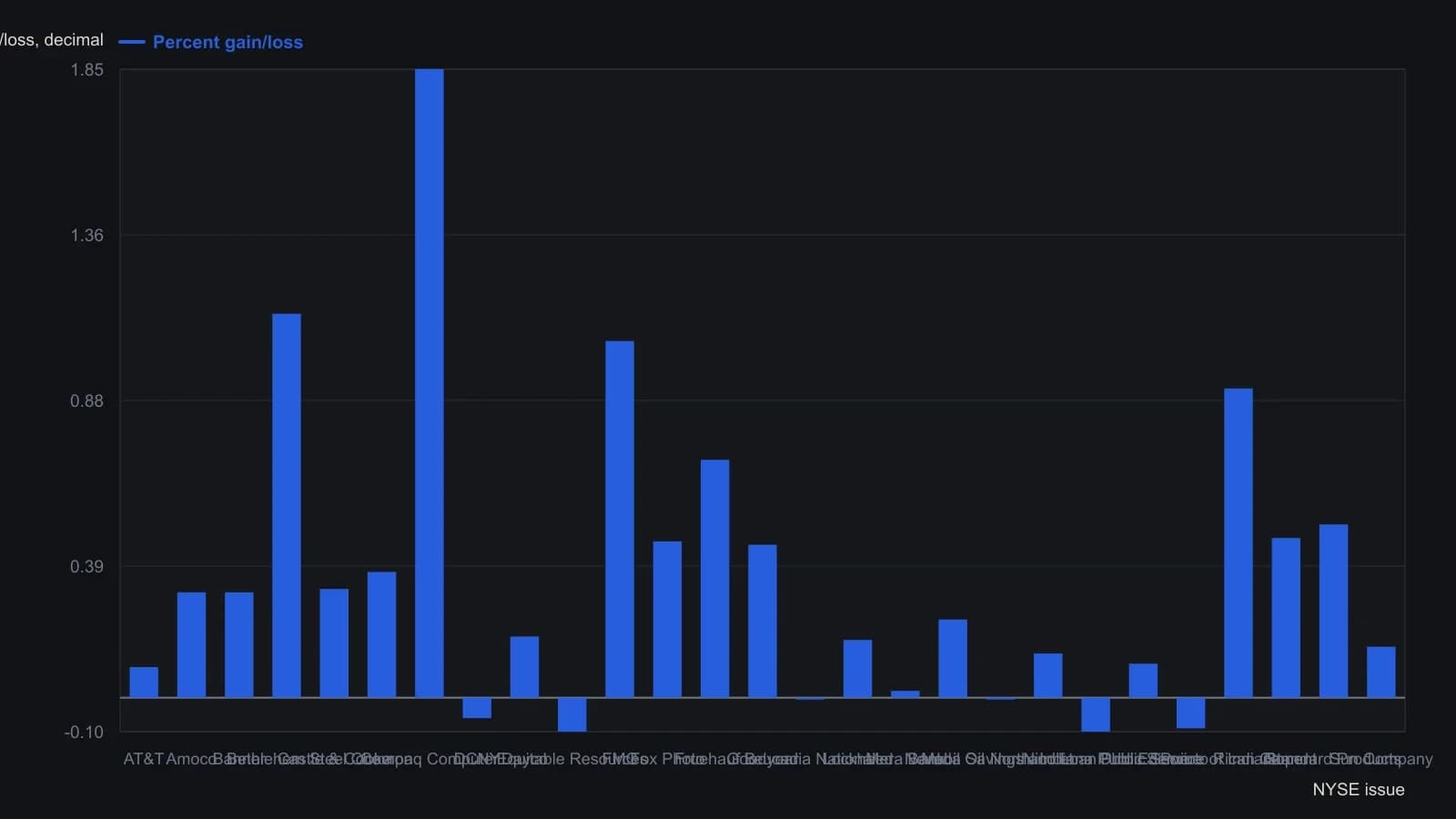
The assignment opened 26 October 1986 with the Dow at 1832.26. The source reports a 9.54 percent net gain on the book over seven months and a 35 percent average per name across 27 issues. Banner and Fruehauf B have purchase and closeout prints that do not match their listed percents; the chart follows the percent column, which is the series those averages use. Leading hyphens on the Bethlehem Steel and DCNY purchase prints look like typesetting marks.
Sparse review and uneven print
Formal reviews occurred only at midyear and at the end of the school year. Students could follow quotes more often, but most did not.
Class copies of the newspaper were not identical, so a stack of back issues was used. Some printed prices predated the official start.
Familiar names and later listing events
Students clustered in familiar names, including AT&T, Mobil, and Goodyear. Others chose Banner. The instructor answered business-description questions but did not override picks.
At the midyear review, some names were missing from the listings or looked sharply cheaper because of mergers, a split, or other distributions that unmonitored holders had not tracked.
Waiting without a second screen
The stated classroom aims were to show that two objective rules could define a book, to treat a low price-earnings ratio as a fundamental overlay, to treat a new high as a timing filter, and to practice waiting by staying away from conflicting market commentary.
Commentary-insulation meant keeping selectors away from conflicting market letters so the two published rules stayed the only decision inputs.
All readings on this track · 16 readings
- 1988A two-rule classroom book of cheapness and new highs
- 1995A supermarket-chain case for yield, trendline, and a written checklist
- 1996Annual normalized-yield rank rotation for cyclical sleeves
- 1996Value filter then rank-rotate as one procedure
- 1997Dow high-yield rank rotation as a testable portfolio procedure
- 1998Low relative P/E plus a trendline reversal for regime-aware stock selection
- 1998Rank rotation, value screens, and ten-stock diversification
- 2001Earnback period ranking for growth-adjusted screens
- 2003Stress-testing calendar yield rotation in a declining tape
- 2003A value overlay and strangle hedge during a growth-led regime
- 2005Unfashionable value versus momentum in the book
- 2007Why premove fundamentals rarely flag tenfold-price moves
- 2012Year-end yield rank rotation with a collapse veto
- 2015A five-name January book from yield and price ranks
- 2017Screening value traps with regime-aware overlays
- 2017A pre-trade fail test for the cheap-looking name