2014issue C0934-36
Pretrade drawdown fences and volatility sizing
A completed trade history can be reshuffled into two precommitted limits: a safe-mode pause that also sets position size, and a kill-switch that retires the logic. The archive places both decisions before live trading, so an ordinary pullback is not confused with a system that is going to zero.
- Systematic execution is described as requiring the same action through new equity highs and new lows, and that consistency is said to fail after a meaningful loss unless trust in the system already exists.
- Trade-order-simulation reshuffles one fixed profit-and-loss sequence many times so every path starts at zero and sums to the same total.
- The kill-switch is the worst maximum drawdown across those paths. Safe-mode is a tighter stretch of the same distribution at which new trading pauses.
- Position size is taken from starting equity, a maximum-loss tolerance, the safe-mode drawdown, and the cash value of one price unit.
Consistency has to exist before live fills
Systematic execution is described as requiring consistent action through both new equity highs and new lows. That consistency is said to fail after a meaningful loss unless trust in the system already exists.
Before live trading, the operational question is how to tell an ordinary equity pullback from logic that has stopped working. Ordinary drawdowns can then be sat through without remaining in a system that is going to zero.
Reshuffle one completed sequence
The process starts with a statistically large sample of completed trades, stated as at least 200. That same profit-and-loss sequence is then reshuffled many times, typically in the thousands. Every path starts at zero and sums to the same total. Only the order of results changes. That procedure is trade-order-simulation.
One illustrated simulation used more than 350 trades from an intradary foreign-exchange scalping sequence, with each path a different ordering of the same results.
Two fences from the same distribution
The worst maximum drawdown across simulated paths is treated as a kill-switch. That floor is the point at which the trading logic is treated as no longer valid. In the illustrated series the kill-switch was 1,047.2 pips, against an original-path maximum of 317.9 pips and an average of 376.4 pips.
A tighter operating limit is taken from the distribution of maximum drawdowns and is used as safe-mode. The illustration uses 1.5 standard deviations, given as 545.1 pips and described as covering 93.3 percent of simulated drawdowns. Any chosen percentile should stay above 90 percent.
After the operating limit is breached, the described rule is to pause new trading until either the kill-switch floor is reached and the system is discarded, or a new equity high is printed and trading resumes.
Monte Carlo equity paths for a forex scalping system
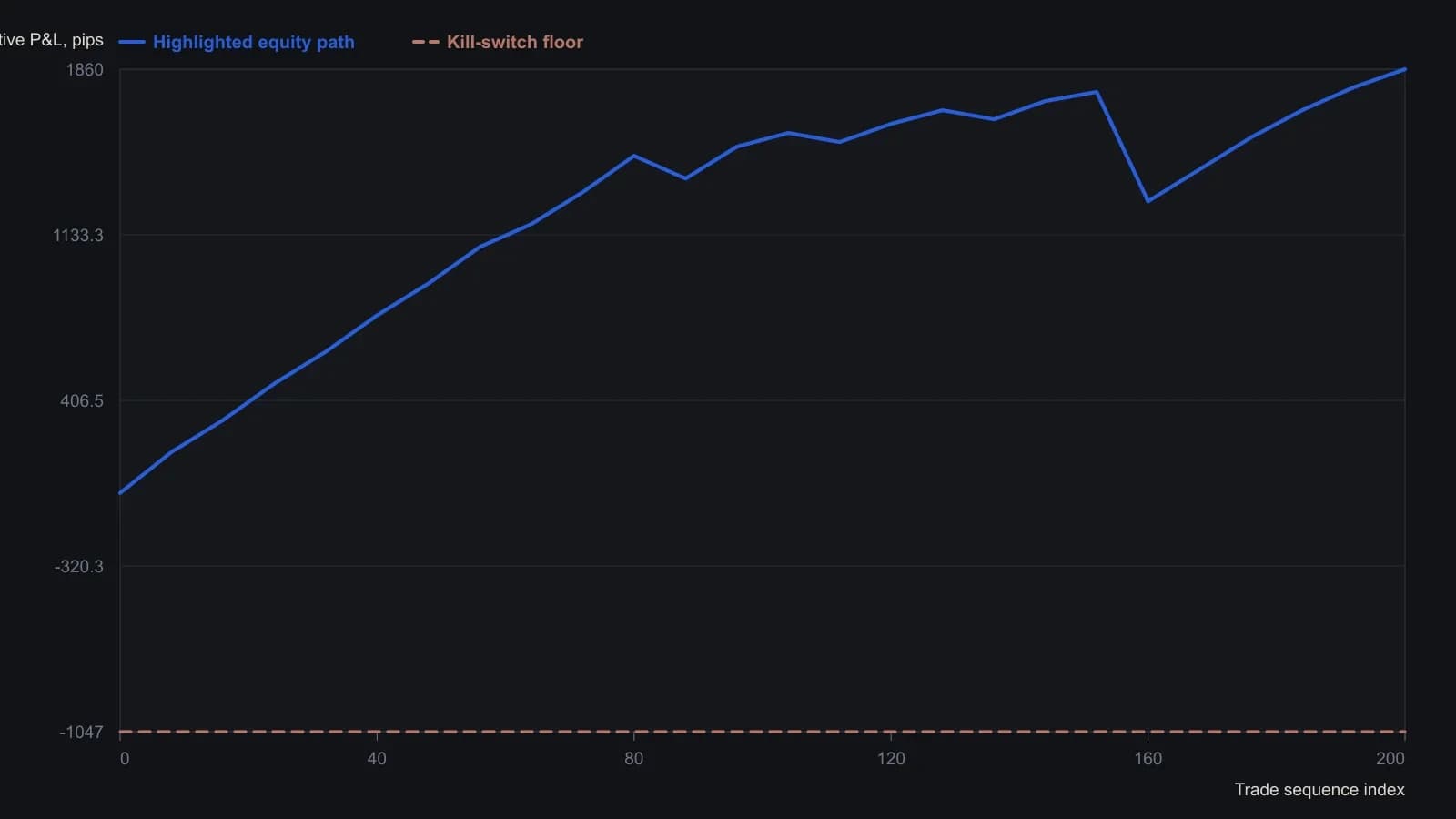
Paths share the same trade P&L sequence and differ only by order. Digitized points are approximate; the article states the kill-switch trough as -1,047.2 pips.
Convert the pause into a position size
Position size is computed from starting equity, a maximum-loss tolerance, the safe-mode drawdown, and the cash value of one price unit. The illustration of 10,000 starting equity, a 20 percent loss tolerance, a 545.1-pip safe-mode, and 1 currency unit per pip produced 3.6 lots per 10,000 of equity.
All readings on this track · 25 readings
- 1988Two-sided optimization for volatility-scaled breakout rules
- 1990Weekly range volatility as a tactical regime filter
- 1993Heat first, then contract count on a weekly close-only breakout
- 1994Shared sigma for trend entries, retests and stops
- 1995The promised result as one testable trading procedure
- 2001Convert a survival ceiling into a volatility filter
- 2002Bound the next loss before the bear trade
- 2004Dollar-loss tolerance versus percent-of-equity stops
- 2004Bounded risk before entry: stop, size, and leverage
- 2006Position sizing as the pre-trade bound on loss and exposure
- 2006A trend-regime matrix for volatility position sizing
- 2011A premarket range checklist for opening-hour breakouts
- 2011Stop-defined share count on a clustered intraday short
- 2012Mechanical system design with strategy, signals, and size
- 2012Precommit size before a one-day policy shock
- 2013R-multiple expectancy, drawdown, and volatility position sizing
- 2014Constructing trend-aware slope-divergence rules
- 2014Pretrade drawdown fences and volatility sizing
- 2015Convert pip value into cash before a forex lot size is chosen
- 2016Expectancy as an execution skill rather than a backtest score
- 2017Volatility parity equalizes the ticket; implied volatility is a regime dial
- 2018Wide-range breakout rules from chart volatility
- 2019A structure-based stop, then resize or pass
- 2020A cash rule that zeros a trend book on extreme volatility and a short losing window
- 2025R-multiples before you size up