2010issue C0493
Futures liquidity filter for equal-dollar size and open interest
A historical liquidity-filter scores listed futures from equal-dollar size, open interest, and a volume-factor so the kept books are the ones that look executable. TradersWeek editorial: treat the setup as unfinished until the three-year dollar range is a contract count and that size is checked against the book.
- Relative-contract-liquidity is scored from contract point value, a three-year maximum price move, open interest, and a volume adjustment.
- Contracts needed for equal dollar profit equal tick dollar value times the three-year maximum price excursion, so every figure in that column represents the same dollar opportunity.
- The same relative-liquidity score can be written as contracts-to-trade multiplied by total open interest and then by a volume-factor.
- Each column is a proportional comparison and is meaningful only against other markets in the same column.
What the screen keeps
The archive liquidity-filter is a comparative screen that keeps only contracts whose size, range, open interest, and volume make an order realistically executable. Relative-contract-liquidity is a cross-market score of how readily an entire futures book can be traded versus other listed contracts. Relative futures liquidity is scored from contract point value, a three-year maximum price move, open interest, and a volume adjustment.
Equal-dollar contract counts
Contracts-to-trade-for-equal-dollar-profit is how many contracts of one market are required to match another market's three-year dollar range. Contracts needed for equal dollar profit equal tick dollar value times the three-year maximum price excursion, so every figure in that column represents the same dollar opportunity.
Open interest and volume
The same relative-liquidity score can be written as contracts-to-trade multiplied by total open interest and then by a volume-factor. Open-interest-analysis uses outstanding contracts as a scale factor so markets with deeper open books rank as easier to enter and exit.
The volume-factor is an adjustment that rescales a liquidity score when volume is unusually thin or heavy. It is typically between 1 and 4 and is the greater of 1 and an exponential transform of volume relative to a 5,000-contract reference.
Reading each column
Effective-percent-margin is posted margin expressed as a share of the contract's three-year dollar price range. Effective percent margin equals dollar margin divided by the contract's three-year dollar price range, then multiplied by one hundred.
Dense activity marks identify the more executable books; one mark or none indicate little activity and a thinner market. Each column is a proportional comparison and is meaningful only against other markets in the same column.
Share-turnover on listed shares
For listed shares, share-turnover is period volume divided by shares outstanding, used as an equity-market stand-in for trading liquidity. Period volume as a percentage of shares outstanding is treated as a turnover-rate proxy for trading liquidity.
Equal-dollar contract counts on the April 2010 futures liquidity screen
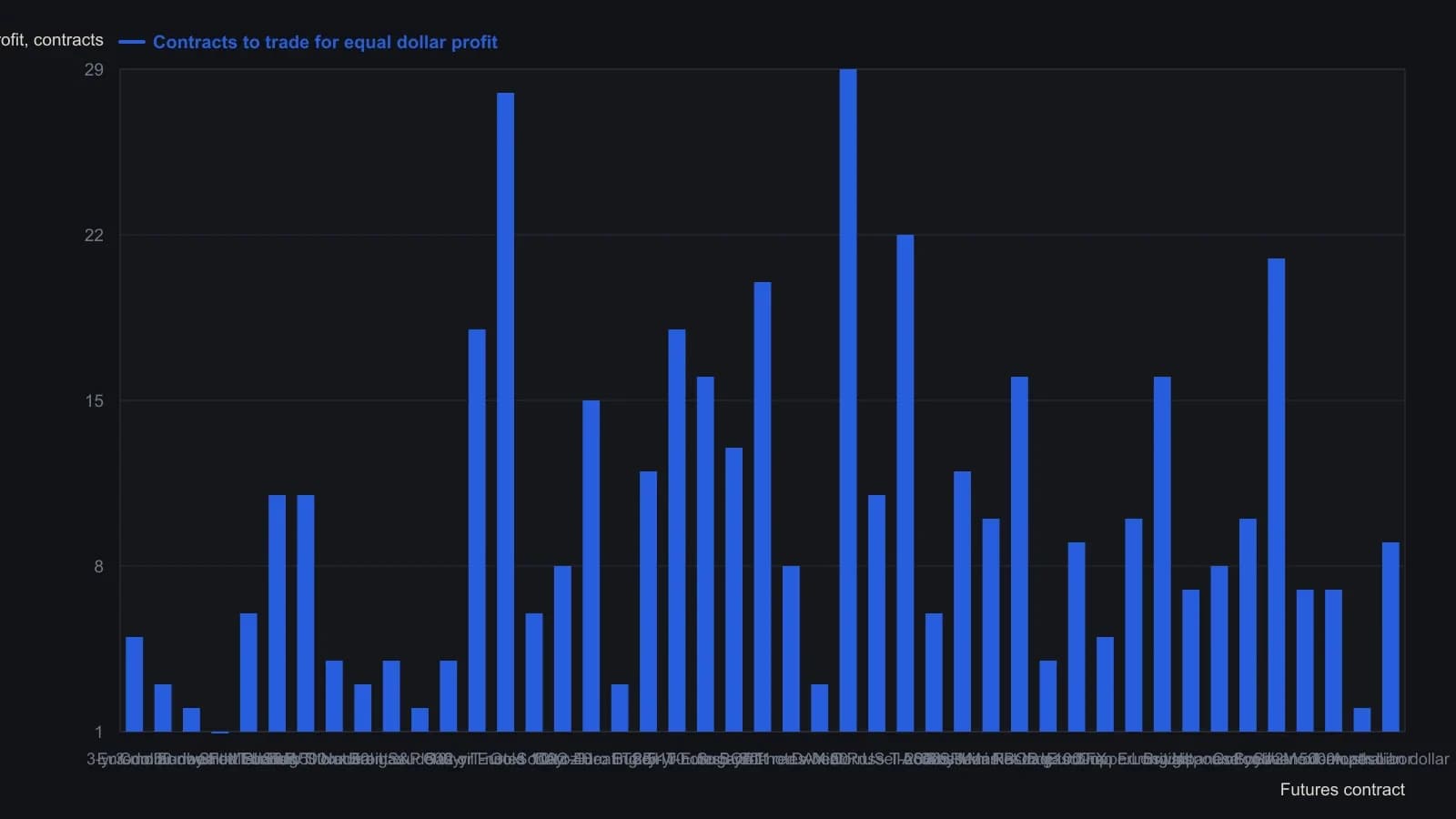
The source defines contracts to trade as tick dollar value times the three-year maximum price excursion, so every listed future is scaled to the same dollar-profit unit. Relative contract liquidity is a separate ranking from open interest times a volume factor and is not plotted here.
All readings on this track · 20 readings
- 1988Wave-count consensus and open-interest confirmation
- 1990Calibrating volume and open interest at support and resistance
- 1997Grading volume and open interest after moving-average crosses
- 2003Constructing an expiration settlement map from listed open interest
- 2010Futures liquidity filter for equal-dollar size and open interest
- 2010Screen futures for tradeable liquidity before sizing
- 2011Screen futures liquidity with open interest and equal dollar size
- 2011Construct a daily initiator filter from lead-contract price, open interest, and volume
- 2012Ranking futures markets by executable liquidity
- 2013Equal-dollar open interest as a futures liquidity filter
- 2013Filter futures by open interest and relative liquidity
- 2015Filter futures contracts by open interest and volume
- 2015Screen listed futures for executable liquidity first
- 2015Money-flow lookback versus aggregated open interest
- 2016Ranking futures by executable liquidity and open interest
- 2018Futures liquidity and open interest as an execution filter
- 2019Evaluate futures liquidity with open interest and equal-dollar filters
- 2019Screen futures contracts by open interest and liquidity
- 2020Filter futures orders by liquidity and open interest
- 2020Ranking futures liquidity before you place the order