2010issue C1085
Screen futures for tradeable liquidity before sizing
A futures liquidity ranking combines contract point value, a three-year maximum price move, open interest, and a volume-based factor so thin books are dropped before markets are compared on an equal-dollar and effective-margin grid.
- A liquidity filter drops contracts whose open interest and activity cannot carry speculative size before any position is sized.
- Equal-dollar contract count and effective percent margin put remaining markets on a shared dollar and margin-stretch scale, so a cheap tick is not read as cheap, executable risk.
- Relative contract liquidity multiplies equal-dollar contract count by open interest and a volume factor; compare figures only within the same column.
- A single activity mark, or none, flags a thin book treated as a poor candidate for speculative execution.
Liquidity as a pre-trade gate
A liquidity filter is a pre-trade screen that keeps only contracts with enough activity, depth, and cost characteristics to be entered and exited at intended size. Open interest analysis uses outstanding contract count, with volume, as a size-and-activity input when judging how easily a futures position can be put on or taken off.
Activity marks on that ranking increase with participation. A single mark or none flags a thin book treated as a poor candidate for speculative execution.
How the ranking is assembled
A futures liquidity ranking can be built by combining contract point value, a three-year maximum price move, open interest, and a volume-based factor. Relative contract liquidity is defined as the equal-dollar contract count times total open interest times a volume factor.
That volume factor is the larger of one and an exponential transform of volume relative to a 5,000-contract reference, minus two.
Equal-dollar size and margin stretch
An equal-dollar column counts how many contracts of one market are needed to match another market's potential dollar excursion. It uses tick dollar value times the three-year maximum price excursion, so figures in that column share the same dollar scale.
Effective percent margin is margin dollars divided by the three-year range of the contract's dollar value, then multiplied by one hundred. It is shown beside raw percent margin to compare how posted capital stretches across contracts.
Column values are proportional and are meant to be read only against other values in the same column, not as standalone scores.
Posted versus effective margin in the October 2010 futures liquidity ranking
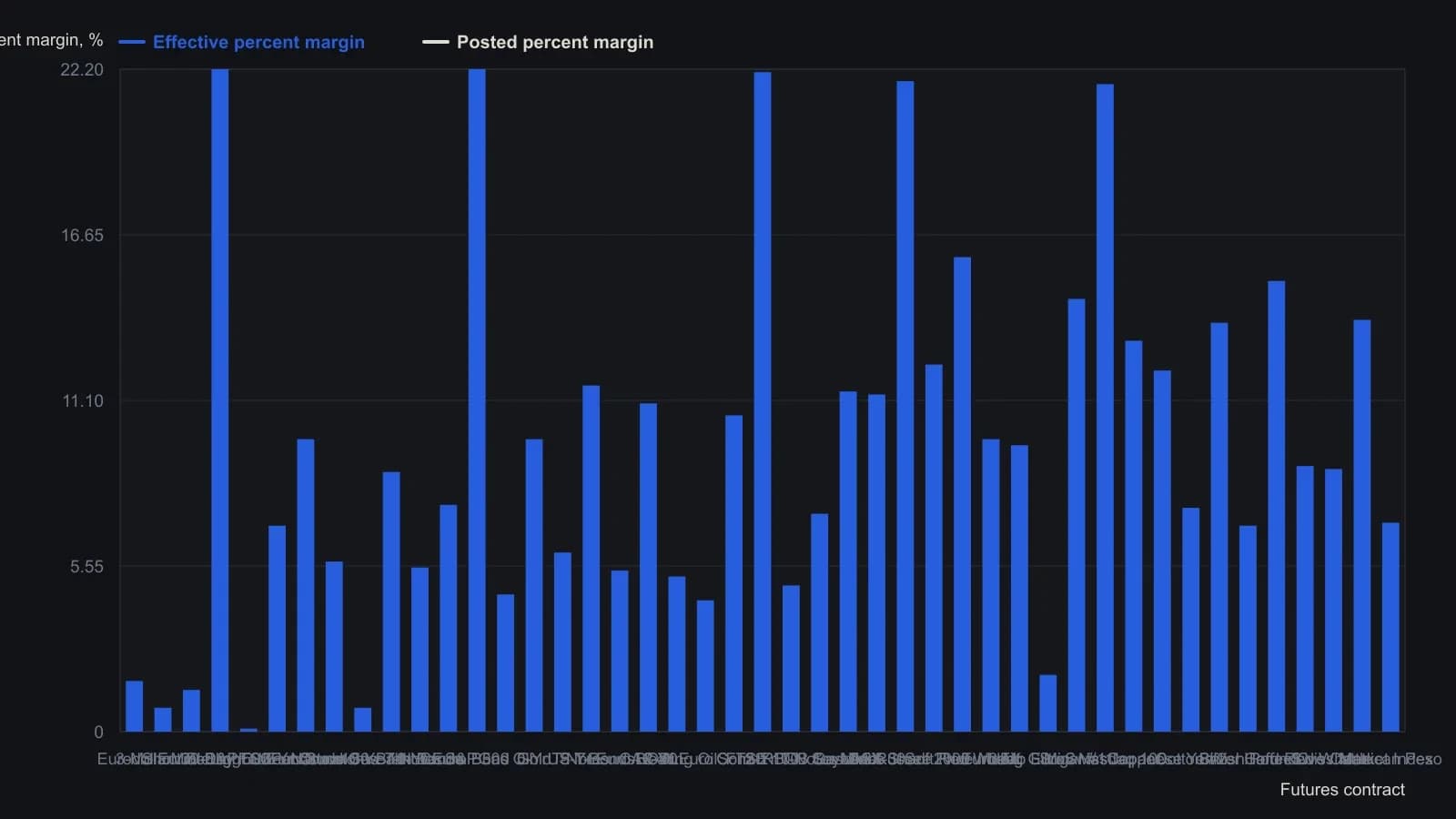
The source also prints a relative-liquidity glyph that overruns the page for the top two contracts; that glyph is not treated as a number here. Effective margin uses the magazine’s three-year maximum price excursion as the denominator.
What the illustrated ranking showed
In the illustrated ranking, short-rate interest-rate futures sit at the most liquid end, while several agricultural, metal, and currency contracts sit at the sparse end with a single activity mark.
Share-turnover as an equity stand-in
For equities, share-turnover is period volume as a fraction of shares outstanding. It is presented as a stand-in for trading liquidity, on the view that activity can proxy how easily a security's price can be moved.
All readings on this track · 20 readings
- 1988Wave-count consensus and open-interest confirmation
- 1990Calibrating volume and open interest at support and resistance
- 1997Grading volume and open interest after moving-average crosses
- 2003Constructing an expiration settlement map from listed open interest
- 2010Futures liquidity filter for equal-dollar size and open interest
- 2010Screen futures for tradeable liquidity before sizing
- 2011Screen futures liquidity with open interest and equal dollar size
- 2011Construct a daily initiator filter from lead-contract price, open interest, and volume
- 2012Ranking futures markets by executable liquidity
- 2013Equal-dollar open interest as a futures liquidity filter
- 2013Filter futures by open interest and relative liquidity
- 2015Filter futures contracts by open interest and volume
- 2015Screen listed futures for executable liquidity first
- 2015Money-flow lookback versus aggregated open interest
- 2016Ranking futures by executable liquidity and open interest
- 2018Futures liquidity and open interest as an execution filter
- 2019Evaluate futures liquidity with open interest and equal-dollar filters
- 2019Screen futures contracts by open interest and liquidity
- 2020Filter futures orders by liquidity and open interest
- 2020Ranking futures liquidity before you place the order