2016issue C0456
Ranking futures by executable liquidity and open interest
A futures liquidity ranking can be read as an execution filter that scores how easily a public contract can be bought or sold. Relative contract liquidity is built from equal-dollar size, open interest, and a volume factor.
- A futures liquidity ranking scores how easily a public contract can be bought or sold relative to other listed markets.
- Relative contract liquidity is built from the contracts needed for equal dollar profit, total open interest, and a volume factor that down-weights thin trading.
- Markets at the top of the ranking are described as easiest to buy and sell; markets at the bottom are described as the most difficult.
- Column values are proportional and matter only when compared with other markets in the same column, not as standalone trading signals.
What the ranking measures
A futures liquidity ranking can be read as an execution filter that scores how easily a public contract can be bought or sold relative to other listed markets.
Relative contract liquidity is a ranking of how easily a listed futures market can be bought and sold, built from equal-dollar contract count, open interest, and a volume adjustment.
A liquidity filter is a screen that keeps only markets whose order-book activity, spread, volume, and trading costs support the intended order over its life cycle.
Size to a comparable dollar range
Relative contract liquidity is constructed from the number of contracts needed for equal dollar profit, total open interest, and a volume factor.
The equal-dollar contract count is defined as tick dollar value times the three-year maximum price excursion so each listed market is scaled to a comparable dollar range. That figure is the contracts to trade for equal dollar profit: how many contracts of one futures market are needed to match another market’s potential dollar move over a three-year price range.
Then check whether that size can be executed
Open interest is the stock of outstanding futures contracts used, with volume, to judge whether a chosen size can be executed.
The volume factor is the greater of 1 and the exponential of the natural log of volume divided by the natural log of 5000, minus 2, which down-weights thinly traded contracts.
Equal-dollar contract counts, ranked by relative futures liquidity
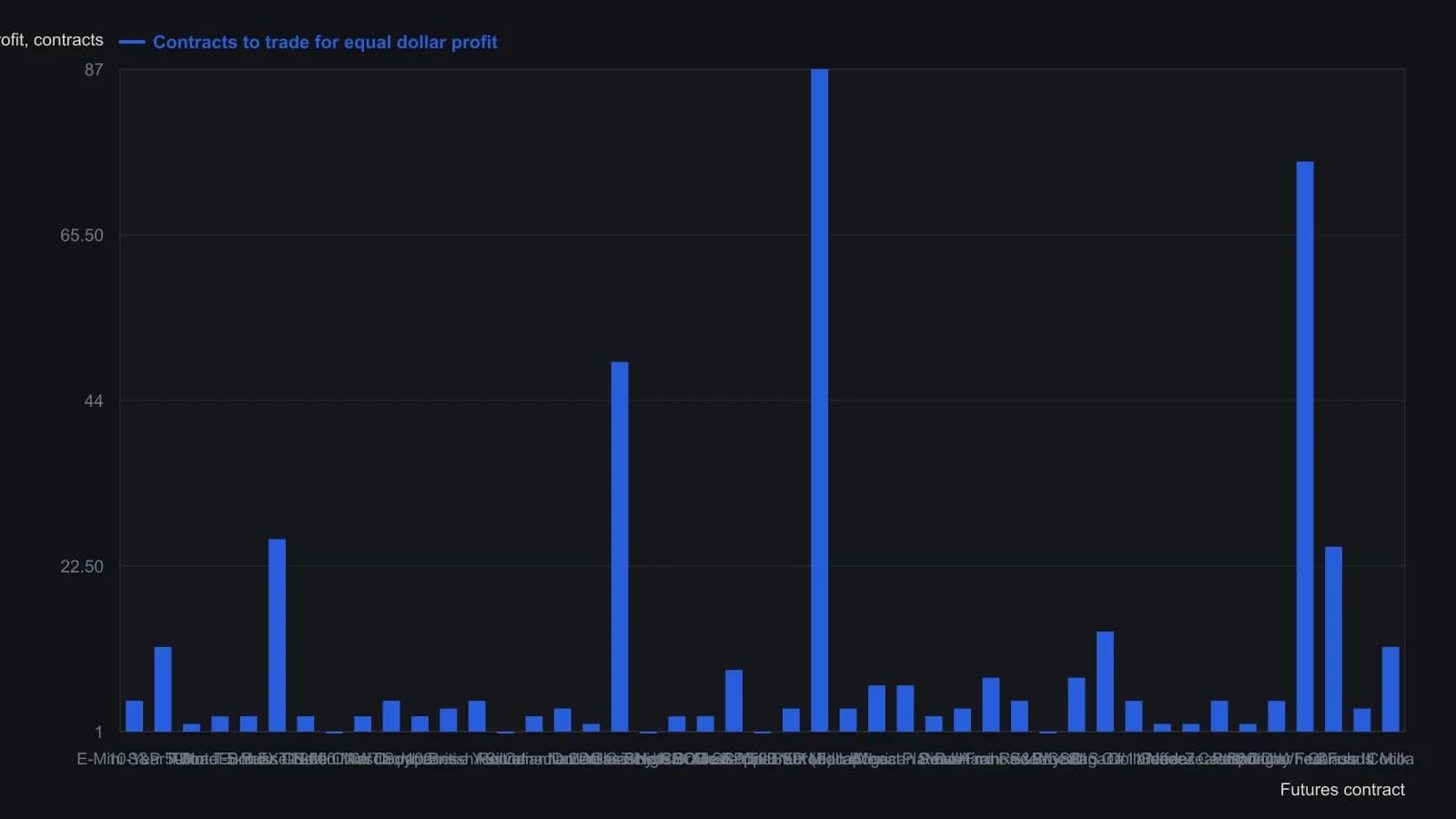
The source defines Contracts to Trade as tick dollar value times the three-year maximum price excursion, so every bar is an equal-dollar comparison. Relative liquidity itself is only a dot bar in the original table and is not a numeric series here.
How the list is described
Markets at the top of the ranking are described as easiest to buy and sell. Markets at the bottom are described as the most difficult.
In the April 2016 ranking, E-mini S&P 500, 10-year T-note, T-bond, and Ultra T-bond sit at the most liquid end of the list, while several agricultural and metals contracts sit near the least liquid end.
A companion view of margin use
Effective percent margin is posted margin divided by the three-year contract dollar range, then multiplied by one hundred, so margin use can be compared across contracts.
All readings on this track · 20 readings
- 1988Wave-count consensus and open-interest confirmation
- 1990Calibrating volume and open interest at support and resistance
- 1997Grading volume and open interest after moving-average crosses
- 2003Constructing an expiration settlement map from listed open interest
- 2010Futures liquidity filter for equal-dollar size and open interest
- 2010Screen futures for tradeable liquidity before sizing
- 2011Screen futures liquidity with open interest and equal dollar size
- 2011Construct a daily initiator filter from lead-contract price, open interest, and volume
- 2012Ranking futures markets by executable liquidity
- 2013Equal-dollar open interest as a futures liquidity filter
- 2013Filter futures by open interest and relative liquidity
- 2015Filter futures contracts by open interest and volume
- 2015Screen listed futures for executable liquidity first
- 2015Money-flow lookback versus aggregated open interest
- 2016Ranking futures by executable liquidity and open interest
- 2018Futures liquidity and open interest as an execution filter
- 2019Evaluate futures liquidity with open interest and equal-dollar filters
- 2019Screen futures contracts by open interest and liquidity
- 2020Filter futures orders by liquidity and open interest
- 2020Ranking futures liquidity before you place the order