2018issue C1160
Futures liquidity and open interest as an execution filter
Rank listed futures by whether open interest and volume can absorb intended size, then restate the remaining books as equal-dollar contract counts and margin-to-range ratios so implementation cost decides which order is executable.
- Editorial reading: treat order choice as a two-step drill that first drops books whose open-interest-and-volume composite cannot absorb intended size.
- A listed-futures liquidity rank multiplies contract point value, three-year maximum price motion, open interest, and a volume factor usually set between 1 and 4.
- Relative contract liquidity equals the equal-dollar contract count times total open interest times the volume factor.
- Effective percent margin is posted margin divided by the three-year dollar range of the contract, then multiplied by 100.
Order choice as a two-step drill
Editorial interpretation: TradersWeek reads the archive workflow as a two-step execution drill. First drop futures books whose open-interest-and-volume composite cannot absorb intended size. Then convert the remaining names into equal-dollar contract counts and margin-to-range ratios so implementation cost, not the trade idea, decides which book is executable.
A liquidity filter is a pre-trade screen that keeps only markets whose ranked activity can absorb intended size and that surfaces implementation cost before an order is sent.
How the liquidity rank is formed
A listed-futures liquidity rank can be formed by multiplying contract point value, three-year maximum price motion, open interest, and a volume factor usually set between 1 and 4.
A single liquidity mark, or none, is used to flag little activity and therefore weaker speculative executability.
Open interest as a capacity input
Open interest analysis uses the stock of outstanding futures as a capacity input when judging whether a contemplated size is executable.
Equal-dollar counts and effective percent margin
Futures in the equal-dollar column are scaled so each row's contract count has the same dollar value, by multiplying contract value by the largest three-year price change.
The equal-dollar contract count equals tick dollar value times the three-year maximum price excursion. It states how many contracts of one futures product are required to match another product's three-year dollar price range.
Effective percent margin is posted margin divided by the three-year dollar range of the contract, then multiplied by 100. It expresses posted margin as a percentage of that range so capital locked per unit of historical range can be compared across names.
Contracts needed for equal dollar profit
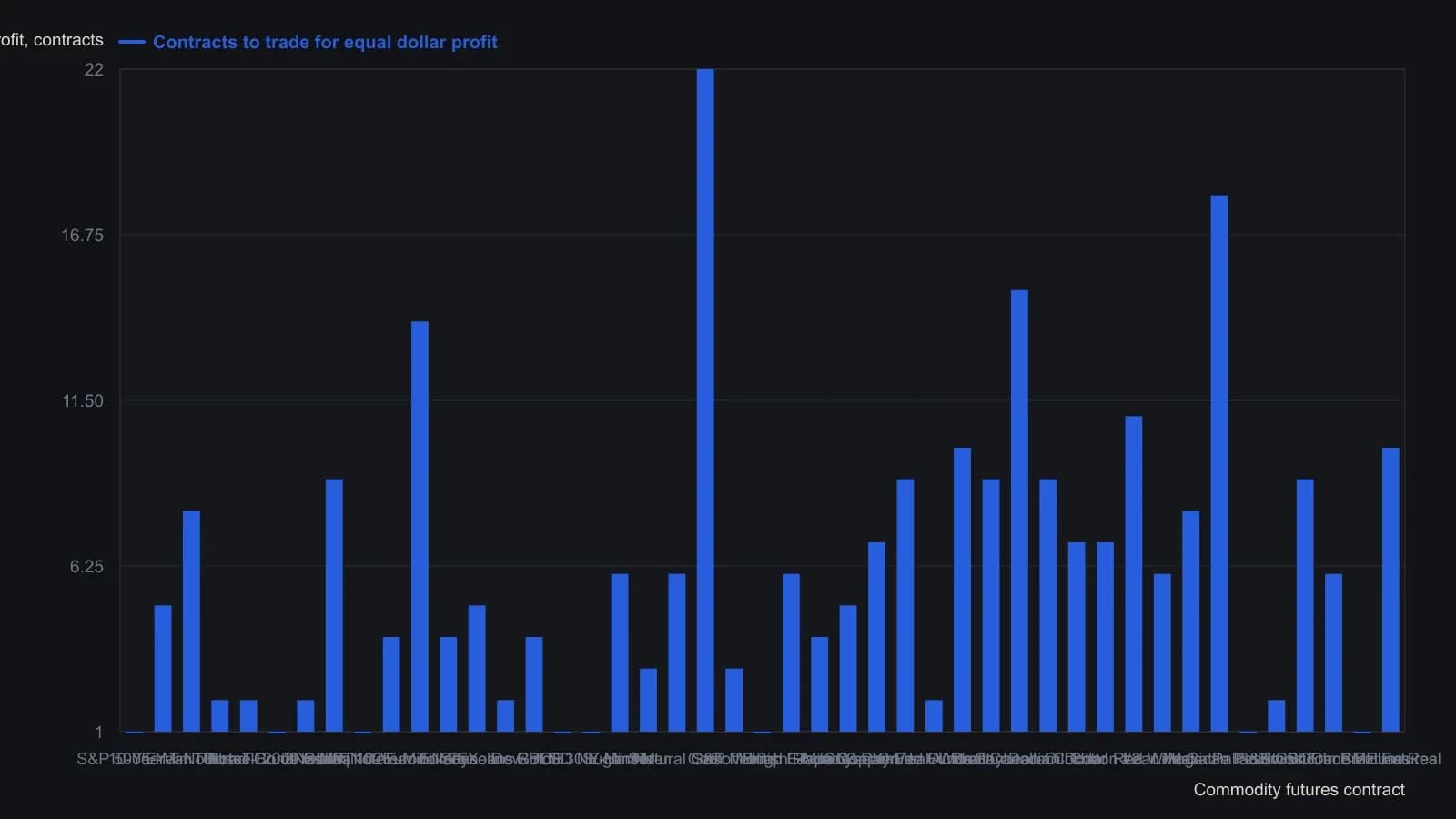
Source formula: contracts to trade = tick dollar value times the three-year maximum price excursion, so every name is scaled to the same dollar profit potential. Bitcoin CME effective percent margin is reported as 21.2 in the source wrap.
Relative contract liquidity
Relative contract liquidity equals the equal-dollar contract count times total open interest times a volume factor. It is a cross-market rank of how readily a futures book can be transacted, built from those three inputs.
That volume factor is the greater of 1 and the exponential of the natural log of volume divided by the natural log of 5000, minus 2. It is a multiplier, usually between 1 and 4, that adjusts the liquidity rank for unusually low or high volume.
Share turnover as an equity proxy
Equity trading activity can be treated as a liquidity proxy by expressing period volume as a percentage of shares outstanding. Share turnover is period share volume divided by shares outstanding, used as that equity-market proxy for trading liquidity.
All readings on this track · 20 readings
- 1988Wave-count consensus and open-interest confirmation
- 1990Calibrating volume and open interest at support and resistance
- 1997Grading volume and open interest after moving-average crosses
- 2003Constructing an expiration settlement map from listed open interest
- 2010Futures liquidity filter for equal-dollar size and open interest
- 2010Screen futures for tradeable liquidity before sizing
- 2011Screen futures liquidity with open interest and equal dollar size
- 2011Construct a daily initiator filter from lead-contract price, open interest, and volume
- 2012Ranking futures markets by executable liquidity
- 2013Equal-dollar open interest as a futures liquidity filter
- 2013Filter futures by open interest and relative liquidity
- 2015Filter futures contracts by open interest and volume
- 2015Screen listed futures for executable liquidity first
- 2015Money-flow lookback versus aggregated open interest
- 2016Ranking futures by executable liquidity and open interest
- 2018Futures liquidity and open interest as an execution filter
- 2019Evaluate futures liquidity with open interest and equal-dollar filters
- 2019Screen futures contracts by open interest and liquidity
- 2020Filter futures orders by liquidity and open interest
- 2020Ranking futures liquidity before you place the order