2011issue C0377
Screen futures liquidity with open interest and equal dollar size
A futures liquidity ranking can mark each listed contract by trading activity and open interest, then state how many contracts of each product deliver the same three-year dollar range so a liquidityFilter can keep only executable names.
- A futures liquidity ranking can mark each listed contract so that more marks mean more trading activity and one mark or none means little activity.
- Markets are equalized with contractsToTradeForEqualDollarSize so each line represents the same three-year dollar price range.
- relativeContractLiquidity multiplies the equalizing contract count by open interest and a volumeFactor, and each column is meaningful only against other entries in the same column.
- effectivePercentMargin is margin divided by the three-year dollar range of the contract, then scaled to a percent, so capital lock-up can be compared across markets.
A pre-trade liquidity screen
A liquidityFilter is a pre-trade screen that keeps only futures contracts whose activity, open interest, and implementation cost look executable. A futures liquidity ranking can mark each listed contract so that more marks mean more trading activity and one mark or none means little activity.
openInterestAnalysis uses outstanding open futures positions as a size-capacity input when judging whether a contract can be entered and exited.
How the ranking is built
The ranking is produced by multiplying contract point value, a three-year maximum price move, the contract's open interest, and a volumeFactor. That volume adjustment is usually between one and four.
The volumeFactor is the greater of one and the exponential of the natural log of volume divided by the natural log of 5000, minus two. It raises or lowers a liquidity rank when traded volume is unusually low or high.
Equal dollar size
Markets on the list are equalized by stating how many contracts of each futures product must be traded so each line represents the same three-year dollar price range.
contractsToTradeForEqualDollarSize is that equalizing contract count. It is defined as tick dollar value multiplied by the three-year maximum price excursion, so every entry in that column sits on the same dollar footing.
Relative contract liquidity
relativeContractLiquidity is a comparative score of how easily a listed futures product can be bought and sold. It is defined as the equalizing contract count times total open interest times a volume factor.
Margin lock-up and share turnover
effectivePercentMargin is margin value divided by the three-year range of contract dollar value, then multiplied by one hundred, to compare margin lock-up against each market's historical dollar swing.
For listed shares, shareTurnover treats period volume expressed as a percentage of shares outstanding as a turnover-rate proxy for trading liquidity.
Contracts that match the same three-year dollar range
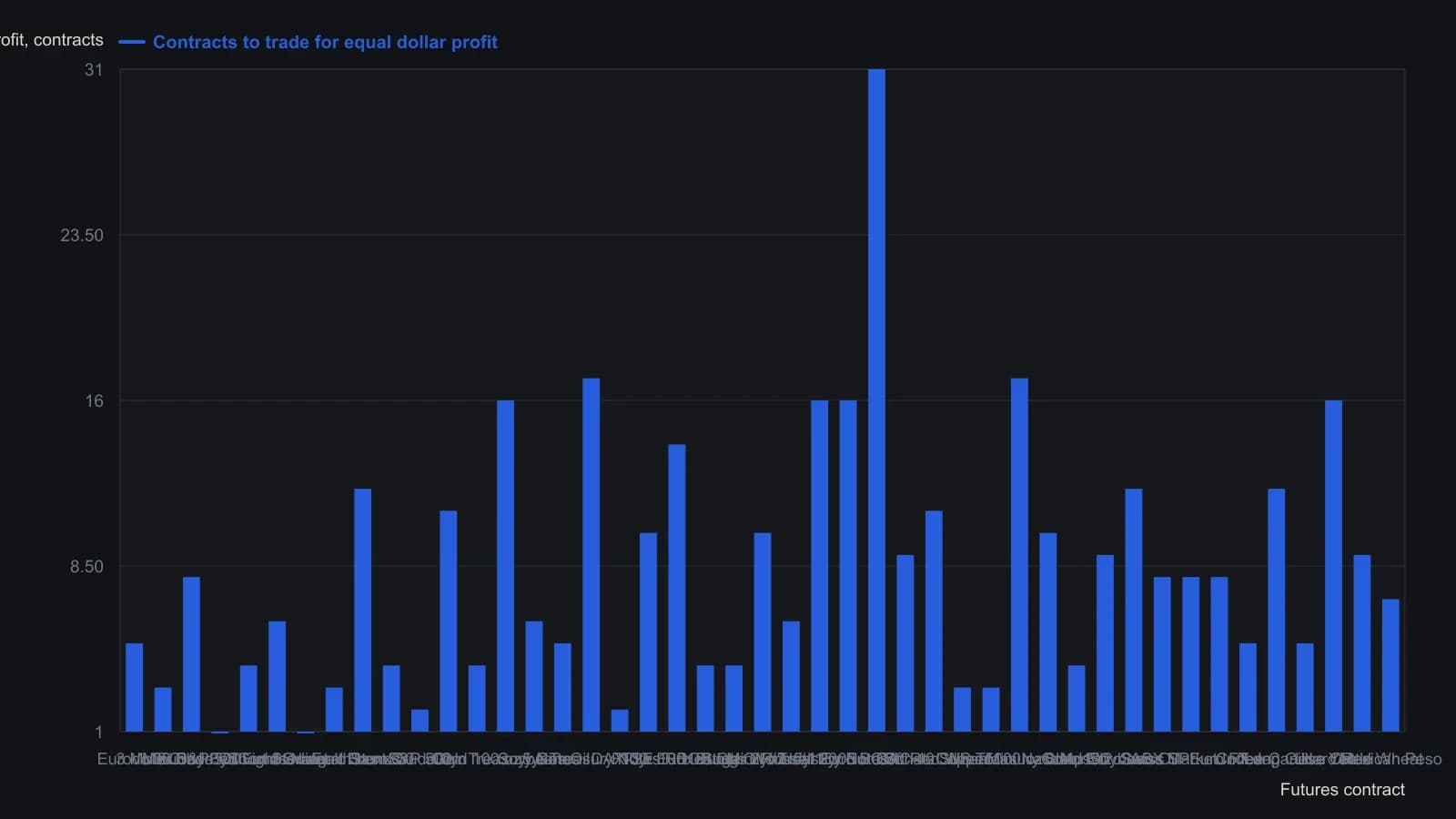
The source sets every name onto the same dollar scale by multiplying contract value by the largest price change in the prior three years.
All readings on this track · 20 readings
- 1988Wave-count consensus and open-interest confirmation
- 1990Calibrating volume and open interest at support and resistance
- 1997Grading volume and open interest after moving-average crosses
- 2003Constructing an expiration settlement map from listed open interest
- 2010Futures liquidity filter for equal-dollar size and open interest
- 2010Screen futures for tradeable liquidity before sizing
- 2011Screen futures liquidity with open interest and equal dollar size
- 2011Construct a daily initiator filter from lead-contract price, open interest, and volume
- 2012Ranking futures markets by executable liquidity
- 2013Equal-dollar open interest as a futures liquidity filter
- 2013Filter futures by open interest and relative liquidity
- 2015Filter futures contracts by open interest and volume
- 2015Screen listed futures for executable liquidity first
- 2015Money-flow lookback versus aggregated open interest
- 2016Ranking futures by executable liquidity and open interest
- 2018Futures liquidity and open interest as an execution filter
- 2019Evaluate futures liquidity with open interest and equal-dollar filters
- 2019Screen futures contracts by open interest and liquidity
- 2020Filter futures orders by liquidity and open interest
- 2020Ranking futures liquidity before you place the order