2019issue C1258
Screen futures contracts by open interest and liquidity
A futures setup is not an executable order until a liquidity-filter and open-interest-analysis rank the contract by range-scaled size, standing open interest, and volume.
- A liquidity-filter keeps only contracts whose equal-dollar size, open interest, and volume can support the intended order.
- Open-interest-analysis uses outstanding futures positions as a capacity input when ranking how easily a contract can be bought or sold.
- Each liquidity column is comparative only: a reading is meaningful against other contracts in the same column, not as a standalone score.
- Contracts near the top of a relative-liquidity ranking are easier to buy and sell than contracts near the bottom.
Screen the contract before the order
A liquidity-filter is a pre-trade screen that keeps only contracts whose equal-dollar size, open interest, and volume can support the intended order. Open-interest-analysis uses outstanding futures positions as a capacity input when ranking how easily a contract can be bought or sold.
Relative contract liquidity is a comparative rank of how easily a futures contract can be traded, built from equal-dollar-profit size, open interest, and a volume adjustment.
How the relative rank is built
A relative futures-liquidity score can be built by multiplying the number of contracts needed for equal dollar profit by total open interest and by a volume factor.
Equal-dollar-profit size is how many contracts of one market are needed to match another market's three-year dollar range. That contract count is formed from tick dollar value and the largest three-year price excursion.
The volume factor is a multiplier, never below one, that lifts a liquidity rank when traded volume is large relative to a 5,000-contract baseline. In the ranking it is at least 1 and otherwise scales with volume relative to that baseline.
Read each column as a comparison
Each liquidity column is comparative only. A reading is meaningful against other contracts in the same column, not as a standalone score.
Contracts near the top of a relative-liquidity ranking are easier to buy and sell than contracts near the bottom. Sparse displayed activity identifies markets that are harder to use for speculative execution.
Companion margin column
Effective percent margin is posted margin expressed as a percentage of the three-year dollar range of the contract. The historical workflow forms it by dividing posted margin by the three-year range of contract dollar value, then expressing the result as a percentage.
A listed-share liquidity proxy
For listed shares, period volume divided by shares outstanding can serve as a turnover-rate proxy for trading liquidity. Turnover rate is that same ratio, used as an equity-market liquidity proxy.
Contracts to trade for equal dollar profit, ranked by liquidity
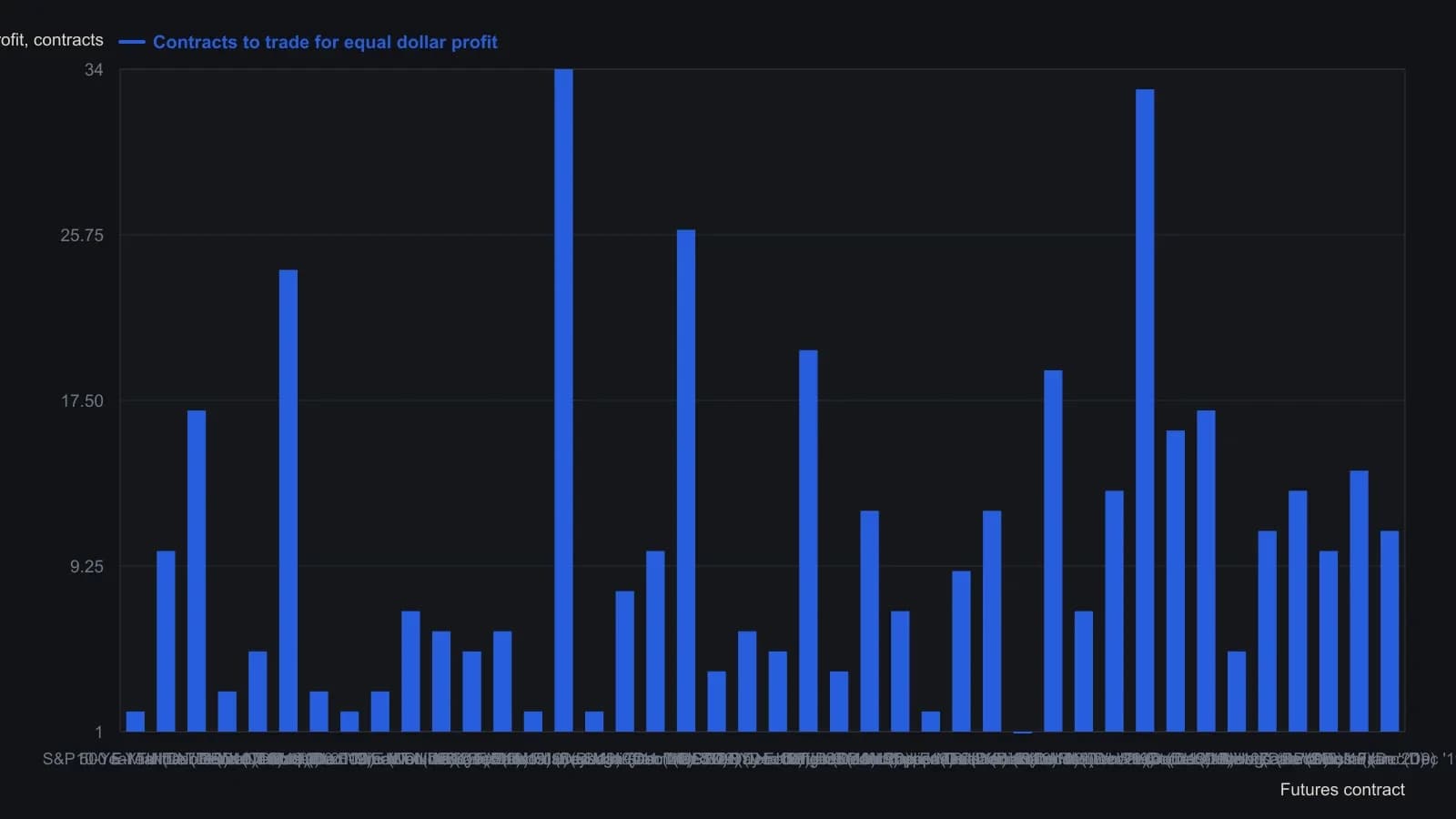
The source defines this column as tick dollar value times the three-year maximum price excursion, so every listing is scaled to the same dollar-profit unit. Relative liquidity was printed only as a dot bar and is not plotted.
All readings on this track · 20 readings
- 1988Wave-count consensus and open-interest confirmation
- 1990Calibrating volume and open interest at support and resistance
- 1997Grading volume and open interest after moving-average crosses
- 2003Constructing an expiration settlement map from listed open interest
- 2010Futures liquidity filter for equal-dollar size and open interest
- 2010Screen futures for tradeable liquidity before sizing
- 2011Screen futures liquidity with open interest and equal dollar size
- 2011Construct a daily initiator filter from lead-contract price, open interest, and volume
- 2012Ranking futures markets by executable liquidity
- 2013Equal-dollar open interest as a futures liquidity filter
- 2013Filter futures by open interest and relative liquidity
- 2015Filter futures contracts by open interest and volume
- 2015Screen listed futures for executable liquidity first
- 2015Money-flow lookback versus aggregated open interest
- 2016Ranking futures by executable liquidity and open interest
- 2018Futures liquidity and open interest as an execution filter
- 2019Evaluate futures liquidity with open interest and equal-dollar filters
- 2019Screen futures contracts by open interest and liquidity
- 2020Filter futures orders by liquidity and open interest
- 2020Ranking futures liquidity before you place the order