2010issue C0114-19
Four-gate veto before trend entries
A trend-following setup is handled as a pre-trade four-gate checklist. The book stays flat unless a defined trend, a signal in that direction, a counted profit-to-loss ratio, and an approximate holding time all clear.
- Risk control is treated as a central part of the trading system, because a profit-first framing that avoids risk is presented as a main reason traders leave after large losses.
- Trend alignment is the weekly and daily MACD histogram slopes pointing the same way, and the directional signal must agree with that trend.
- Trading price is the expected-value result of a take-profit and stop-loss pair after their probabilities are applied, and those probabilities are the hardest inputs.
- If any gate fails, the output is abstention: stay out and wait, and treat later losing trades as a production-cost loss.
A four-gate pre-trade procedure
The archive pre-trade procedure is a four-gate checklist. Confirm a trend, wait for a signal in that direction, count the profit-to-loss ratio, and set an approximate time in the market.
If no trend exists, a trend exists without a clear directional signal, or potential risk exceeds potential profit, the procedure is to stay out and wait.
Risk control inside the system
A profit-first framing that avoids thinking about risk is presented as a main reason traders leave after large losses. Risk control is treated as a central part of a trading system rather than as an optional extra after the setup is chosen.
Trading price and its hard inputs
Trading price is the expected-value result of a take-profit and stop-loss pair after their probabilities are applied. The hardest inputs in that calculation are the probabilities of profit and loss.
Continued activity with a negative or even-odds trading price and no money-management plan is described as exhausting the account if it is kept up, regardless of starting size.
Trend alignment and the directional test
Trend alignment is the higher-timeframe condition in which weekly and daily MACD histogram slopes point the same way. That shared slope is how trend direction is taken.
A controlled comparison keeps the same hourly moving-average-crossover rules and the same take-profit and stop-loss sizes, and changes only whether trades follow or fade the higher-timeframe trend. In that hourly crossover sample, counted frequencies of profit and loss produced a positive trading price when trades followed the trend and a negative trading price when they faded it.
Crossover outcomes with and against the EUR/USD downtrend
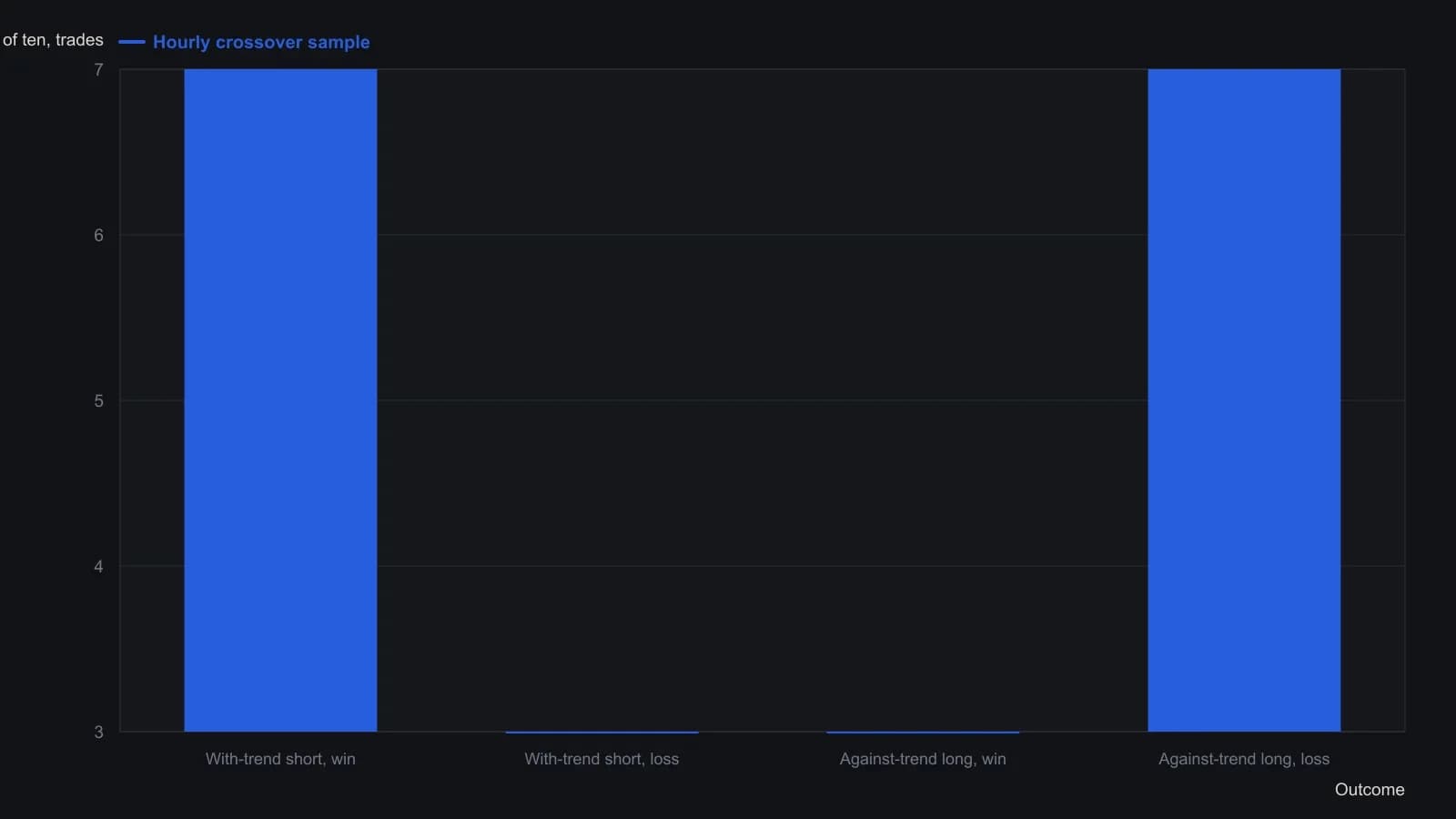
Take-profit and stop-loss were both fixed at 50 points on EMA(8) and EMA(21) applied to the close. Each side of the comparison is a ten-trade sample taken while the weekly and daily MACD histograms pointed down.
Abstention when a gate fails
The four-gate checklist is the full sequence: a defined trend, a signal in that direction, a counted profit-to-loss ratio, and an approximate holding time. When any gate fails, the system output is abstention and the book is left flat.
Losing trades as a production cost
Because every system produces losing trades, those losses are to be treated as operating costs. A production-cost loss is a losing trade treated as an expense of running the procedure rather than as a failed prediction. The rules are aimed at larger take-profits than stop-losses and at keeping losses small rather than maximizing wins.
All readings on this track · 27 readings
- 1987Precommit the stop and require a surplus payoff
- 1987When open losses overwrite precommitted exit rules
- 1991Ranking month-end holds with risk-reward and stops
- 1994Evaluating percentage profit exits on trend-following averages
- 2001Construct reward to risk before entry
- 2003A pre-trade readiness checklist for entry, abstention, and risk
- 2003Evaluating out-of-the-money strikes with saddle premiums and implied volatility
- 2004A critique of one-procedure trading decisions
- 2004Mechanical stops leak intent and misprice losses
- 2004Implied-volatility premium on rate indexes
- 2006Keep the stop that authorized the entry
- 2006Bound the loss with a risk-to-reward filter before entry
- 2007Audit the operator before abandoning a system
- 2007Failed-break slingshot reversal rules
- 2007A system-management template that sets the stop and the required reward before entry
- 2007Construct a pre-trade style envelope for entries and skips
- 2008Systems that skip the three decision gates
- 2010Four-gate veto before trend entries
- 2012Construct a trading plan as one written procedure
- 2012Forex stops and reward targets by quote increment
- 2013The average directional index as a lookback cluster and a risk-reward bound
- 2014A three-step worksheet for VIX futures tick value and low-vol risk-reward
- 2014Binary option premia, fees, and pre-expiry risk-reward
- 2015Selling far out-of-the-money commodity option premium as a forgiving timing case
- 2016Prepaid option spreads that bound range-day risk and reward
- 2016Pre-trade risk-reward versus instinctive exits
- 2020Bounding a short-dated option spread with a stop, a gap remainder, and a credit exit